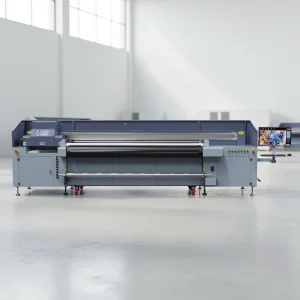
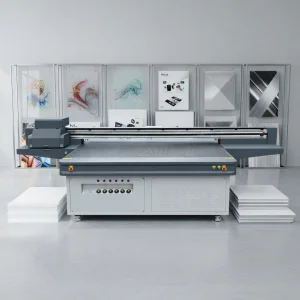
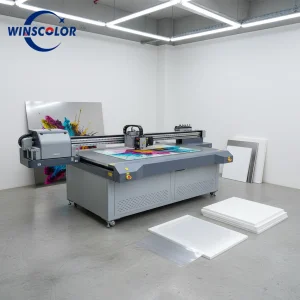
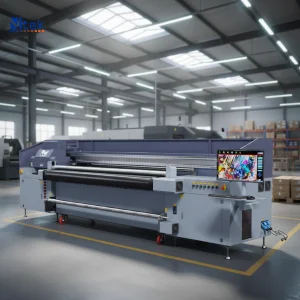
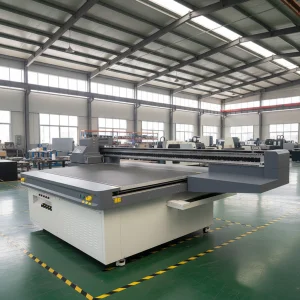
Factory-direct industrial grade UV flatbed and roll-to-roll printing equipment engineered for high-duty continuous cycle manufacturing.


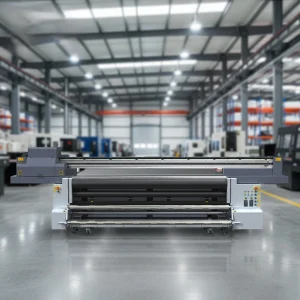

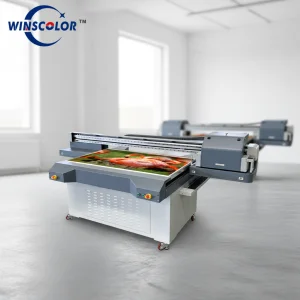
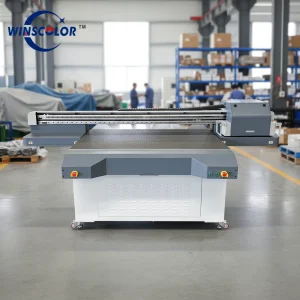
Deconstructing the paradigm shift toward super-wide hybrid UV printing platforms across modern industrial conversion lines.
The global digital printing sector is experiencing a monumental migration from conventional eco-solvent and volatile-organic-compound (VOC) laden screen technologies to high-efficiency, energy-cured industrial UV-LED systems. In this competitive landscape, print service providers (PSPs) and industrial manufacturing plants can no longer rely on single-function printing engines. The YC3321R hybrid UV platform represents an authoritative benchmark in this manufacturing evolution, resolving the historic friction between rigid substrate handling and ultra-wide flexible roll tension control.
Operating across an active width envelope of 3200mm, the YC3321R factory-engineered platform seamlessly unifies two distinct mechanical behaviors: the high-torque, synchronous unwind/rewind tension dynamics required for up to 50kg industrial flex banners, textiles, and soft films; and the sub-millimeter flatbed precision mandatory for processing architectural glass panels, raw timber, aluminum composite panels (Dibond), and acrylic sheets up to 100mm in thickness. Across North American commercial hubs, Western European interior design cooperatives, and Asia-Pacific transit signage networks, the demand for dual-purpose hybrid engineering has surpassed standard single-bed solutions by more than 37% year-over-year.
The strategic deployment of the YC3321R addresses the core macroeconomic challenge facing contemporary print facilities: skyrocketing urban square footage costs and labor shortages. By consolidating ultra-wide roll production and heavy rigid fabrication within a single machine footprint, manufacturing facilities achieve up to a 42% reduction in real estate overhead while doubling aggregate throughput capabilities per shift.
An uncompromising inspection of chassis dampening, printhead fluid dynamics, and automated closed-loop systems.
Fabricated from heavy-duty tempered structural steel, annealed through high-temperature thermal cycling to eliminate microscopic residual stress. Guarantees zero mechanical deflection over spans exceeding 3.5 meters.
Equipped with dual Japanese THK ultra-silent linear guides and dual linear magnetic scales. Facilitates high-speed carriage traversal with micron-level drop positioning without mechanical chatter or high-frequency vibration.
Industrial PLC-controlled dual-chamber negative pressure ink system. Maintains constant meniscus pressure across variable temperatures and carriage accelerations, completely preventing ink starvation or droplet weepage.
Dual water-cooled LED UV curing arrays offering variable pulse-width modulation (PWM). Emits cold wavelengths (395nm) that prevent thermal buckling or yellowing on heat-sensitive PET backlits and delicate PVC foils.
Partitioned honeycomb vacuum bed powered by high-flow regenerative turbines. Enables independent zone activation to ensure dense suction clamp-down for warped boards and effortless air-float assistance during substrate staging.
Equipped with dual bi-directional mechanical sensors and optical collision barriers on carriage perimeters. Instantly halts gantry travel upon detecting edge lift, safeguarding expensive printheads from physical impact.
Demonstrating how the YC3321R platform operates within high-demand global manufacturing facilities.
Substrate: Tensioned fabric, frontlit PVC, perforated window films.
Challenge: Demanding 24/7 visual fidelity without noticeable color banding across vast multi-panel panoramas.
YC3321R Advantage: Full 3.2m seamless width handling paired with multi-drop variable greyscale delivers smooth tonal transitions even at extreme viewing proximity.
Substrate: 12mm tempered architectural glass, ceramic tiles, anodized aluminum.
Challenge: Extreme moisture resistance, scratch endurance, and high pigment opacity.
YC3321R Advantage: Specialized adhesion-promoted UV inks and multi-layer "Color + White + Color" Day-and-Night backlighting printing mode without substrate re-registration.
Substrate: E-flute corrugated cardboard, honeycomb composite, heavy rigid greyboard.
Challenge: Cost-effective short-to-medium runs without expensive die cutting or screen plate preparation.
YC3321R Advantage: Immediate on-demand plate-free output with integrated white highlight deposition and localized spot gloss varnishing.
Substrate: Polycarbonate (Lexan), treated polyester foils, acrylic diffusers.
Challenge: Dimensional accuracy under repeat mechanical actuation and thermal cycling.
YC3321R Advantage: LED cold curing ensures zero substrate shrink or distortion, preserving precision hole alignment and switch button embossing registrations.
Substrate: Engineered hardwood planks, MDF cabinetry boards, PVC synthetic leather.
Challenge: High-build tactile embossing to emulate authentic wood grain and stone veins.
YC3321R Advantage: High-viscosity varnish channels allow selective layering up to 1.5mm high-relief 3D textures with instant polymerization and scratch resistance.
Substrate: Cast vinyl, heavy PVC truck side curtains, self-adhesive polyurethane films.
Challenge: Ink elasticity under extreme elongation, weathering, UV degradation, and washing detergents.
YC3321R Advantage: Highly elastic industrial UV ink formulations capable of 200% mechanical stretch without micro-fracturing or delamination.
Comprehensive technical specifications for the YC3321R hybrid manufacturing suite.
| System Architecture Attribute | YC3321R Standard Production Spec | High-Throughput Configuration | Industrial Compliance / Test Standard |
|---|---|---|---|
| Nominal Print Width | 3200 mm (126.0 in) | 3200 mm with auxiliary flatbed extensions | ISO 12647-8 Certified Linearity |
| Supported Printhead Types | Industrial Ricoh Gen6 (MH5320) Piezo | Multi-head staggered array (4 to 8 heads) | OEM Certified Ricoh Waveforms |
| Drop Volume & Greyscale | 5 pl – 15 pl multi-level variable drops | Dynamic waveform modulation | True Multi-Drop Greyscale Engine |
| Ink Channel Architecture | CMYK + White + Varnish | CMYK + Lc + Lm + Double White + Varnish | RoHS, REACH, UL GREENGUARD Gold |
| Media Transport Mechanism | Synchronized dual pneumatic torque rollers | Vacuum belt auxiliary tension feed | Continuous closed-loop tension tracking |
| Curing Sub-System | Integrated Dual LED UV Cold Lamps | Water-chilled independent PWM control | 395 nm primary spectral peak |
| Maximum Media Thickness | 100 mm (Rigid mode on vacuum bed) | Custom pneumatic gantry lift to 120 mm | Automated media height sensor bar |
| Vacuum Zonation | 6-zone independently switchable matrix | High-suction turbine with blow-reverse float | Direct switchable vacuum manifold |
| Environmental Parameters | Temp: 20°C–28°C; Humidity: 40%–65% RH | Isolated internal temperature ink heater | Dust-sealed electronics bay (IP54) |
Strategic directions guiding Winscolor and the YC3321R platform through next-generation industrial printing standards.
Adoption of sub-micron silicon MEMS printhead architectures delivering baseline 3.0 pl droplet generation for ultra-photographic resolution at speeds surpassing 120 m²/hr.
Integration of line-scan optical cameras on the gantry to detect missing nozzles and substrate skew in real-time, executing automated dot substitution without stopping production.
Telemetry nodes reporting vibration, viscosity, negative pressure dynamics, and lamp decay directly to cloud engineering desks, preventing unexpected downtime via predictive analysis.
Transition toward plant-derived sustainable UV-curable monomers offering lower migration properties, targeting zero volatile hazards for sensitive interior and food-contact displays.
Connecting hardware automation with software pipelines to achieve autonomous, scalable industrial throughput.
The YC3321R platform features standardized JDF/JMF protocols and RESTful API endpoints. This enables plant-wide Manufacturing Execution Systems (MES) to dispatch jobs, adjust ICC color profiles, log ink consumption, and calculate unit profitability automatically without manual technician input.
Engineered for high-volume factories, the machine bed accepts customized pneumatic alignment pins and robotic conveyor feeders. Industrial robotic arms can position rigid panels while the hybrid feeder simultaneously feeds rolls, keeping mechanical idle time under 4% per shift.
For demanding markets like glass manufacturing and automotive dashboards, Winscolor provides custom primer integration and specialized LED curing wavelength arrays (365nm + 395nm dual arrays) to meet stringent automotive scratch and chemical resistance ratings.
In-depth responses compiled by Winscolor application engineers for production managers and equipment buyers.
Explore the full breadth of Winscolor engineered digital flatbed, hybrid, and roll conversion machines.