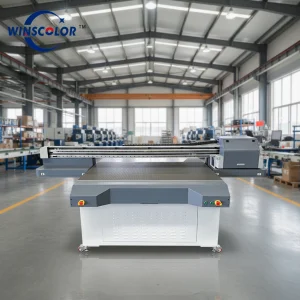
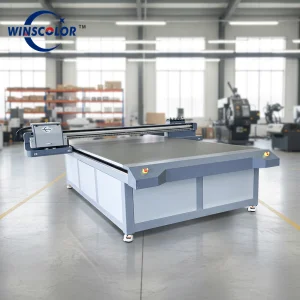
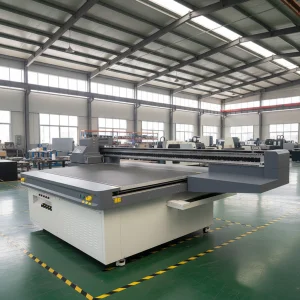
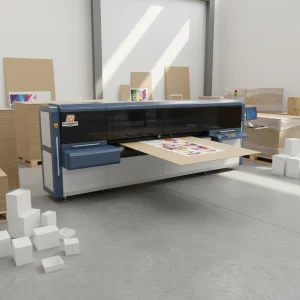
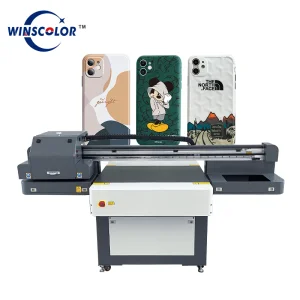
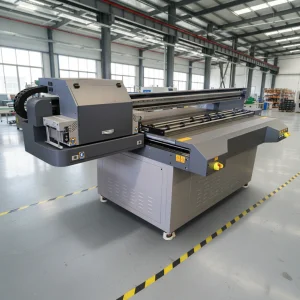
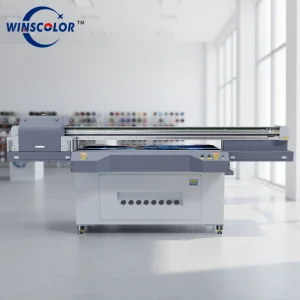
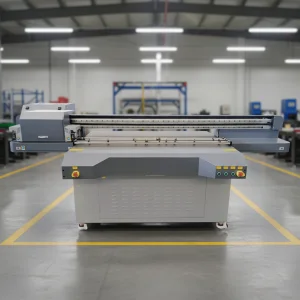
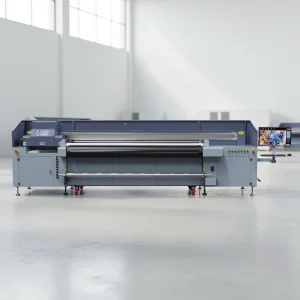
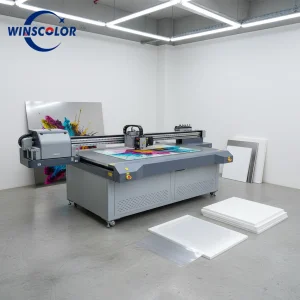
Explore our flagship All-In-One Rs1900-E16 packaging line alongside leading-edge UV LED flatbed, hybrid, and corrugated single-pass production platforms.
A systematic teardown of how the All-In-One Machine Rs1900-E16 eliminates manual substrate transit between disparate digital printers, offline thermal laminators, and flatbed plotters.
The core inkjet engine features high-frequency grayscale piezo printheads capable of droplet volumes ranging from 3.5pl to 12pl. Operating under constant negative pressure with sub-micron carriage linear encoders, it delivers true photographic rendering directly onto coated kraft, folding boxboards, and synthetic liner papers.
Immediately downstream from the curing array, printed webs enter a pneumatic, oil-heated calendar roller module. This prevents ink degradation, eliminates micro-bubbles, and seals printed graphics against scuffing, chemical exposure, and moisture ingress prior to final structural conversion.
Equipped with dual high-speed oscillating blades, creasing wheels, and an ultra-fast high-definition CCD camera, the finishing module reads registration marks on the fly. It compensates in real-time for media stretch, web wander, or thermal shrinkage, executing through-cuts, kiss-cuts, and creasing in a single stroke.
How the Rs1900-E16 is empowering commercial exporters and mid-to-large converters across Europe, North America, Southeast Asia, and the Middle East to capture short-run digital market margins.
Global e-commerce brands demand seasonal, localized packaging in runs of 200 to 5,000 units. The Rs1900-E16 renders die tooling obsolete, cutting lead times from 14 days to under 4 hours.
Converters transition from stockpiling thousands of pre-cut litho-laminated cartons to pure Just-In-Time (JIT) roll-fed conversion, reducing warehouse carrying overhead by up to 40%.
Regional satellite plants in North America and Western Europe adopt the compact footprint of the Rs1900-E16 to fulfill local retail packaging without transatlantic shipping latency.
Engineered under ISO 9001 and CE directives, machines integrate standardized Siemens/Schneider PLC controls and remote telemetry for fast overseas deployment and auditing.
A rigorous examination of production throughput, material waste, registration variance, and labor allocation between legacy isolated finishing and the Rs1900-E16 inline continuum.
| Evaluation Parameter | Legacy Multi-Machine Workflow | NTEK Rs1900-E16 All-In-One Machine | Strategic Gain / SEO Intent Factor |
|---|---|---|---|
| Workflow Footprint | 120–180 m² (Requires separate digital printer, offline laminator, flatbed cutter) | 32 m² total integrated footprint | 75% floor space compression; fits standard industrial micro-plants |
| Labor Allocation | 3 to 4 dedicated operators (Printing tech, lamination operator, cutting programmer) | 1 unified line operator (Single RIP + CAD interface) | Eliminates shift handover bottlenecks; cuts labor cost by >60% |
| Substrate Waste | 8%–15% setup scrap per batch due to web re-threading and registration drift | < 1.2% web scrap via synchronized tension feedback | Direct bottom-line savings on premium virgin kraft & coated SBS boards |
| Setup & Changeover | 45–90 minutes per job (Manual die mounting, calibration, laminate heating) | Instant digital job switch (< 3 mins via barcode read) | Enables profitable micro-lot fulfillment down to single-digit runs |
| Registration Accuracy | ±0.5 mm to ±1.2 mm accumulated mechanical error across 3 machines | ±0.05 mm optical dynamic registration via CCD | Flawless edge bleeds, precision fold scoring, and zero creasing burst |
| Max Media Throughput | Capped by slowest manual transfer step (typically offline cutting queuing) | Continuous synchronized processing up to 1,900 mm web | High linear yield matching demanding container loading schedules |
Real-world integration points where the Rs1900-E16 provides measurable competitive advantage across specialty manufacturing, pharmaceutical packaging, and luxury consumer goods.
Luxury packaging converters require tactile soft-touch laminates paired with micro-precise embossing creases. The Rs1900-E16 applies matte BOPP film inline over crisp vibrant branding, instantly routing contour tabs without cracking the paper grain along fold lines.
Medical packaging demands absolute traceability, high-density variable 2D datamatrix codes, and zero dust contamination. The knife cutting system on the Rs1900-E16 generates clean edges without the fiber dust typically caused by traditional mechanical rotary die cutting.
Direct printing and cutting of E-flute, F-flute, and high-tensile kraft paper mailers. The continuous roll-feed and heated lamination stage strengthens water-resistant exterior packaging while custom structural cutouts create interior drop-in bottle partitions.
Winscolor / NTEK engineering vectors directing next-generation industrial printing-converting machines, from closed-loop spectral feedback to autonomous AI cutting trajectories.
Full deployment of the Rs1900-E16 platform incorporating dynamic industrial inkjet firing, inline thermal encapsulation, and dual-axis servo blade control calibrated for ISO paper and synthetic substrates up to 1.9 meters web width.
Integration of embedded spectrophotometers reading live color patches directly behind the curing zone. Automated nozzle-out compensation algorithms seamlessly redistribute droplet firing among neighboring orifices without stopping web momentum.
Transition to aqueous water-based barrier dispersion modules replacing fossil-based plastic laminates for 100% repulpable paperboard packaging, paired with high-frequency ultrasonic cutting heads eliminating blade wear on heavy fibers.
In-depth responses compiled by senior packaging and field-service engineers regarding technical parameters, export crating, ink chemistries, and operational logistics.
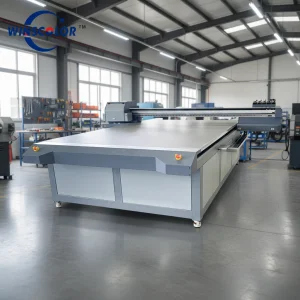
Complementary heavy-duty platforms engineered for glass, acrylic, metal, decorative ceramics, and roll-to-roll production facilities worldwide.