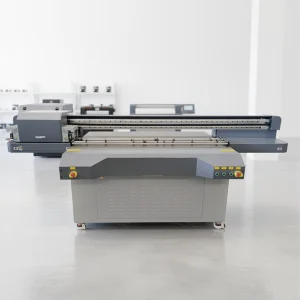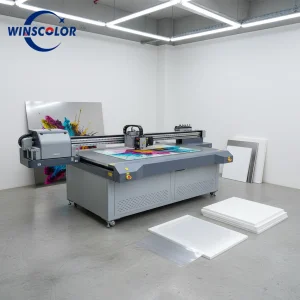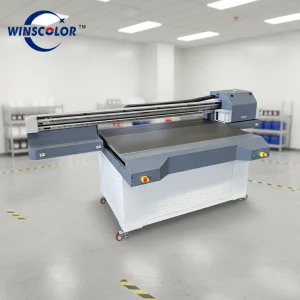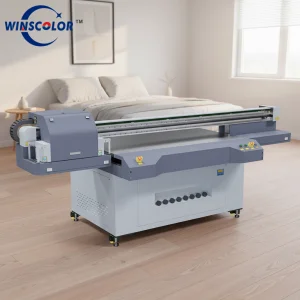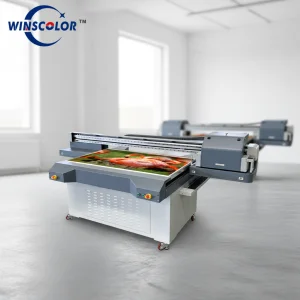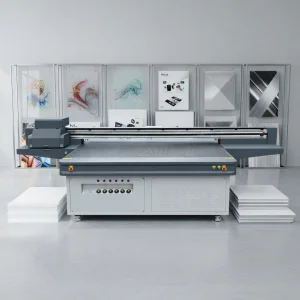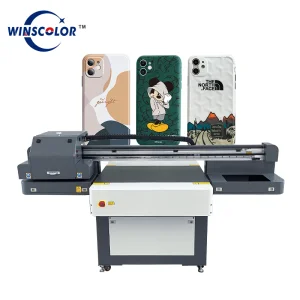
Explore factory-direct industrial platforms configured with piezoelectric greyscale printheads, anti-static ionizers, and high-adhesion UV-LED polymerization systems.



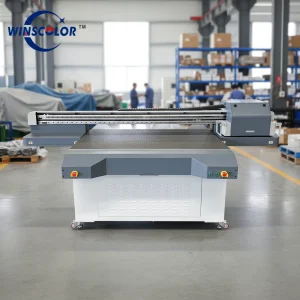

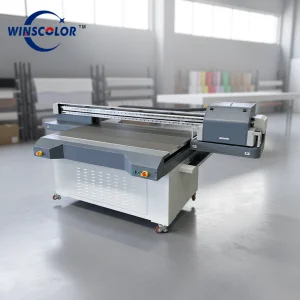
A deep analysis of surface energy dynamics, photoinitiator chemistry, and variable-drop piezoelectric jetting on engineering polymers including ABS, Polycarbonate, Polypropylene, and Acrylic.
Thermoplastics such as Polypropylene (PP) and Polyethylene (PE) possess inherently low surface energy (typically 29–31 dynes/cm). Winscolor industrial digital plastic printers integrate integrated inline corona dischargers and atmospheric plasma jets to elevate surface energy beyond 44 dynes/cm, ensuring absolute wetting without pinholing or edge reticulation.
Employing native industrial Ricoh Gen6 and Kyocera KJ4A micro-piezo printheads, our systems fire drops from 5pl to 18pl at high jetting frequencies (up to 50 kHz). This ensures smooth skin-tone gradients, microscopic text clarity down to 2-point fonts on technical instrument dials, and precise drop placement tolerance under ±5 microns across 3.2m gantries.
Equipped with dual independent water-cooled LED UV curing cassettes radiating at 395nm wavelength. The instant cold-curing prevents thermal distortion of heat-sensitive polystyrene (PS) and thin PVC sheets. Multi-channel ink delivery allows simultaneous opaque white backing, vibrant photorealistic color, and localized tactile 3D embossed varnish in a single continuous pass.
| Plastic Substrate Type | Surface Energy (Dyne/cm) | Pre-treatment Requirement | Recommended Printhead / Ink Configuration | Curing Wavelength & Dosage |
|---|---|---|---|---|
| Cast / Extruded Acrylic (PMMA) | 38 – 42 | Anti-static ionization bar | Ricoh Gen6 (5–12pl) / Winscolor Rigid UV Ink | LED UV 395nm @ 650–800 mJ/cm² |
| Rigid PVC Foam & Sheet | 36 – 40 | Direct printing without primer | Ricoh Gen5 / Gen6 / Universal Hybrid Ink | LED UV 395nm @ 500–600 mJ/cm² |
| Polycarbonate (PC) & ABS | 34 – 38 | Alcohol wipe / Optional bonding promoter | Ricoh Gen6 / Flexible Thermoforming Ink | LED UV 395nm @ 700–900 mJ/cm² |
| Polypropylene (PP) / Fluted Coroplast | 29 – 31 | Inline Corona / Atmospheric Plasma | Kyocera KJ4A / High-Drop Direct UV Ink | Dual LED UV 395nm @ 800–1000 mJ/cm² |
| PETG & Vacuum-Formed Plastics | 40 – 44 | Anti-static dedusting wipe | Ricoh Gen6 / 350% Elongation Thermoforming UV Ink | Progressive Curing @ 550 mJ/cm² |
Winscolor specialized plastic printing formulations achieve Class 5B adhesion rating (zero flaking or ink detachment) under ASTM D3359 cross-hatch adhesive tape protocols on rigid acrylic, corona-treated PP, and treated ABS panels, ensuring exterior weatherability up to 5 years without protective overlaminates.
Headquartered in Jinan, Shandong—China's heavy industrial and CNC precision machinery center—Winscolor combines raw component manufacturing, localized precision gantry milling, and rigorous quality control.
Our 20,000m² manufacturing complex houses 5-axis 12-meter CNC bridge milling machines that fabricate high-tensile steel gantry beams annealed to relieve stress, guaranteeing structural deflection under 0.02mm over a decade of continuous factory operation.
We leverage native direct supply arrangements with global leaders: Japanese THK silent linear guide rails, Panasonic and Yaskawa AC brushless servo systems, German IGUS drag chains, and Italian Megadyne synchronous belts, delivering world-class MTBF (Mean Time Between Failures).
Every unit undergoes 72 hours of uninterrupted dry running, continuous 100% solid field raster testing, vacuum bed air leakage pressure decay verification, and laser interferometer calibration prior to export packaging in fumigation-free vacuum-sealed maritime crates.
Offering bespoke industrial hardware and software customization for global printer distributors. We provide tailored chassis industrial design, private-label RIP software profiles, custom PLCs, and customized vacuum zoning matching proprietary regional plastic sheet formats.
B2B procurement executives prioritize Total Cost of Ownership (TCO), consumable yield economics, mechanical uptime, and turnkey ERP workflow integration over initial capital expense.
Traditional screen printing incurs hefty plate-making overheads and chemical washing costs. Winscolor high-density UV ink technology consumes an average of only 8.5ml to 11ml per square meter at 100% CMYK coverage, lowering square-meter production costs by 42% compared to solvent or OEM cartridge systems.
Engineered for continuous 24/7 dual-shift manufacturing environments. Hardened chassis frames, dual Taiwan Hiwin ballscrews on the Y-axis, and heavy-duty zoned vacuum blowers ensure that precision registration is maintained across 10,000-cycle high-volume production runs.
Complete integration with Caldera, Onyx, Photoprint, and ColorGATE RIP software platforms. Full ICC color profiling support delivers ISO 12647-7 color proofing compliance and exact Pantone PMS spot matching across transparent acrylic and colored plastics.
Procuring overseas machinery requires watertight regulatory validation and responsive after-sales service. Winscolor bridges cross-border supply chains with local compliance and technical deployment.
Our entire printing machine portfolio carries full European Conformity (CE) Machinery Directive 2006/42/EC and Low Voltage Directive 2014/35/EU certifications. Electrical cabinets comply with North American UL 508A safety guidelines and FCC Class A electromagnetic compatibility standards.
Winscolor eco-curable UV inks conform strictly to EU REACH (EC 1907/2006), RoHS 2.0 restrictions on heavy metals, and stringent volatile organic compound (VOC) emissions testing. Safe for sensitive indoor applications including medical instrumentation and children's educational plastic toys.
Supported by our international network of trained distribution partners and in-house multilingual field engineers. We provide direct on-site commissioning, operator workflow training, remote cloud diagnostics via encrypted IP interfaces, and rapid 48-hour spare parts dispatch.
From architectural signage and electronics to automotive interior panels, our digital printing systems replace screen printing with zero plates, zero set-up waste, and instant on-demand customization.
Direct printing on polycarbonate (PC) and PMMA back-illuminated instrument clusters, EV dashboard bezels, and climate control fascia. High opacity white under-printing allows selective multi-level optical transmission and daytime/nighttime dual backlighting effects.
Personalized and high-volume decoration of mobile phone bumpers, power bank ABS shells, gaming console faceplates, and wearable housings. Precision drop jetting renders micro logos, QR authentication markers, and rich tactile 3D relief effects resistant to skin oils.
Equipped with specialized motorized rotary tooling fixtures, models such as the YC1610H print 360-degree seamless cylindrical graphics on acrylic cream jars, lipstick sleeves, PET bottles, and plastic tubes, including gloss varnish highlights in one single run.
Utilizing Winscolor thermoforming-grade ultra-flexible UV inks capable of up to 350% elongation without cracking or micro-crazing. Flat PVC, PETG, or acrylic sheets are printed digitally then vacuum-formed into complex 3D deep-draw illuminated store channel signs.
The transition from analogue screen printing to automated digital direct-to-substrate platforms is accelerating under five transformative technological trends.
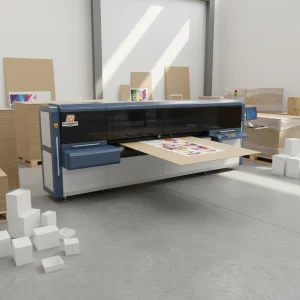
While scanning flatbeds dominate custom production, high-volume plastic packaging and corrugated plastic sheet printing are rapidly adopting stationary printhead bars that jet full CMYK in a single pass at line speeds surpassing 50 meters per minute.
Traditional inkjet heads require a tight 1.5mm gap to prevent drop trajectory scatter. Advanced waveform-controlled printheads now project stable micro-droplets across 10mm to 15mm gaps, opening direct-to-object digital printing on curved, stepped, and molded plastic parts.
With global initiatives targeting non-recyclable materials, next-generation UV-curable ink chemistries are engineered to facilitate plastic de-inking during standard municipal recycling flotation processes, enabling post-consumer acrylic and polyolefins to re-enter circular supply chains.
In-depth responses compiled by our engineering directors addressing technical configurations, substrate chemistry, shipping logistics, and warranty terms.
Poor adhesion on plastics like untreated Polypropylene (PP), Polyethylene (PE), or low-grade Acrylonitrile Butadiene Styrene (ABS) stems from low surface energy (typically below 32 dynes/cm), which inhibits proper chemical bonding between the UV photopolymer and the plastic matrix. Winscolor digital plastic printing platforms overcome this via three complementary methods: (1) Integrated high-output anti-static ionizer bars that neutralize surface charges and static repulsion; (2) Compatible automated inline corona discharge systems that elevate surface energy beyond 44 dynes/cm; and (3) Specialized high-potency silane coupling primers and formulated monomer networks in Winscolor UV inks that chemically graft onto the polymer during 395nm polymerization.
Traditional metal halide / mercury arc lamps emit significant infrared (IR) heat, raising substrate surface temperatures beyond 85°C. This causes severe warping, wrinkling, and buckling on thin plastic substrates such as 0.5mm PVC sheets, polystyrene (PS), or thin PET films. In contrast, Winscolor UV-LED curing arrays emit a narrow 395nm spectral bandwidth with virtually zero IR thermal emission, keeping substrate temperatures below 38°C. Furthermore, UV-LED lamps boast a operational lifespan of 25,000+ hours (compared to 1,000 hours for mercury tubes), require zero ozone ventilation, and offer instant on/off cycling without warm-up delays.
The choice depends directly on your target throughput and product geometry. The Ricoh Gen6 (MH5320) features 1,280 nozzles, an isolated ink flow channel system, and variable drop firing from 5pl to 15pl. It is exceptional for ultra-high-resolution photographic graphics, multi-layer white/varnish tactile 3D relief, and mixed rigid substrate production. The Kyocera KJ4A offers 2,656 nozzles with a continuous 30kHz–50kHz firing rate, making it the industry benchmark for high-speed automated roll-to-roll operations or single-pass inline carton and fluted plastic packaging lines where square-meter output per hour is the primary KPI.
Yes. By specifying Winscolor TF-Series Thermoforming UV Inks, you can print distorted flat graphics onto sheets of ABS, PETG, or Polycarbonate, which are subsequently heated and vacuum-drawn into 3D shapes. Our thermoforming ink formulation exhibits an extraordinary elongation capability of up to 350% without micro-cracking, flaking, or blanching, holding brilliant color density across extreme compound curves and deep-draw illuminated lettering.
Standard machine models (such as YC2513L or YC1610H) are assembled and burn-tested within 10 to 15 business days. Bespoke OEM orders requiring customized gantries, specific head configurations, or dedicated transport systems require 20 to 30 days. For international shipping, machines are sealed inside multi-layer barrier foil with desiccant packs, bolted to reinforced steel skid bases, and enclosed in heavy-duty export-grade plywood crates compliant with ISPM-15 phytosanitary regulations. We support FOB Qingdao/Shanghai, CIF, CFR, and full DDP door-to-door delivery with customs clearance assistance worldwide.
All Winscolor industrial machines come backed by a comprehensive 12-month structural and electronic warranty (excluding consumable printhead nozzles clogged through improper operational maintenance). We provide complete redundant spare part starter kits with every export shipment (valves, pumps, filters, encoders). Our engineering desk provides 24/7 video support, remote team-viewer calibration, and on-demand field technician dispatch through authorized regional service hubs.
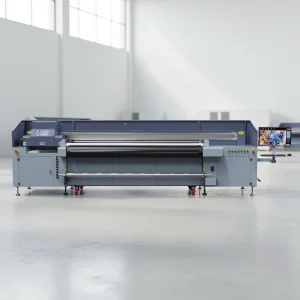
Continuous heavy-duty industrial platforms engineered for large-format rigid plastic sheets, hybrid roll-to-roll banners, and multi-functional high-output manufacturing.