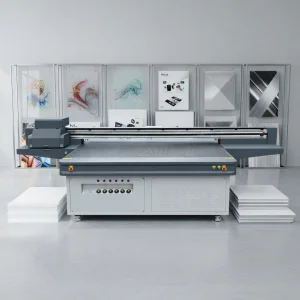
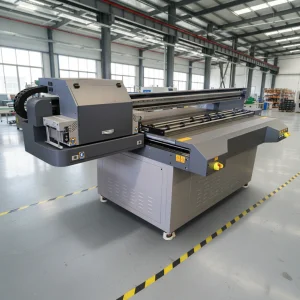
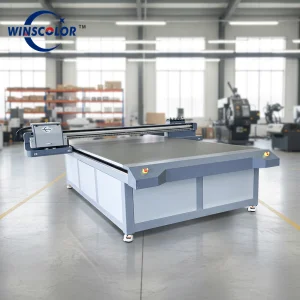
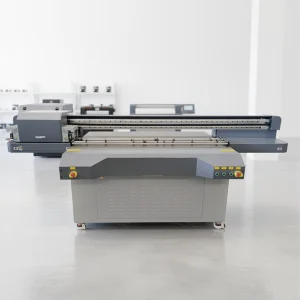
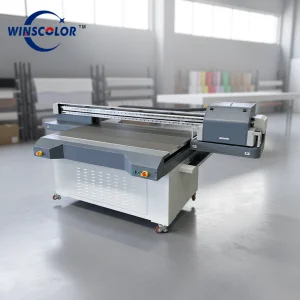
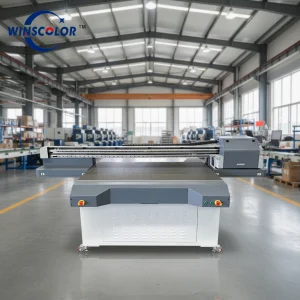
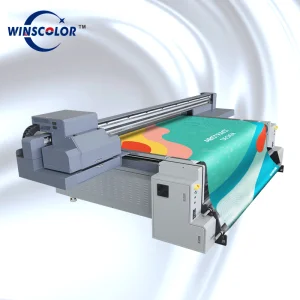
Explore our export-certified flatbed, roll-to-roll, and hybrid digital UV platforms engineered for flawless ink adhesion on extruded and cast acrylic substrates.
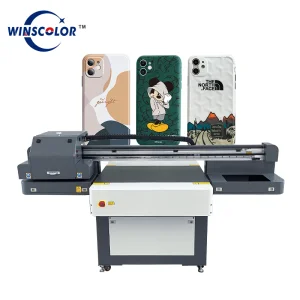
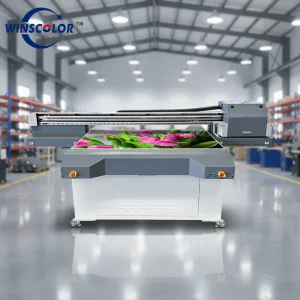
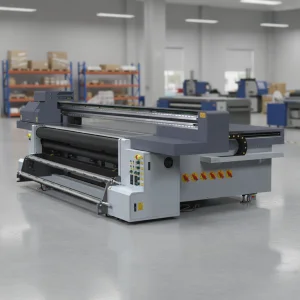
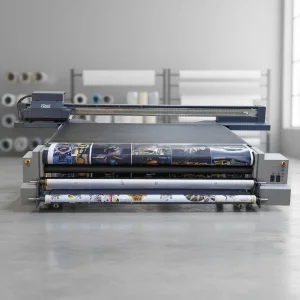
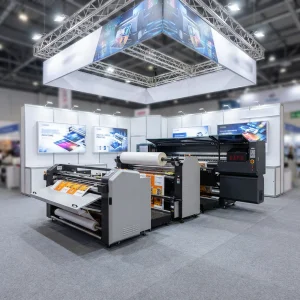
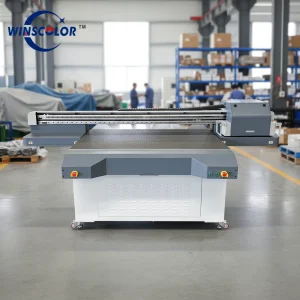
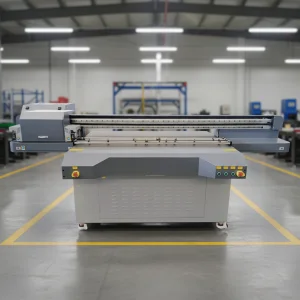
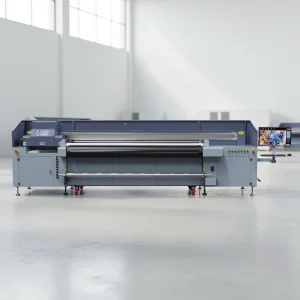
Analyzing technical barriers in surface tension, photon polymerization, and next-generation grayscale piezoelectric printheads.
Direct printing on polymethyl methacrylate (PMMA) acrylic requires micron-level fluid droplet accuracy. Winscolor digital flatbeds deploy industrial Ricoh Gen6 and Konica Minolta printheads running dynamic drop-on-demand (DoD) variable dot firing from 5pl to 12pl.
By modulating electrical waveforms through our high-speed FPGA board architectures, satellite ink droplets are completely suppressed. This guarantees laser-sharp vector edges, sub-millimeter micro-text legibility, and continuous-tone gradient fidelity without banding on ultra-smooth acrylic surfaces.
Standard UV curing lamps emit broad-spectrum infrared heat, leading to substrate warp, thermal edge stress, and micro-cracking across thin acrylic panes. Winscolor utilizes calibrated dual UV-LED arrays radiating narrow 395nm wavelength photon beams.
Water-cooled solid-state LED chillers regulate core junction operating temperatures within ±0.5°C. This guarantees that acrylic panels maintain flat geometric dimensional tolerances while photoinitiators achieve >98% complete polymer chain cross-linking within 0.15 seconds of ink landing.
Acrylic sheets are non-conductive insulators prone to accumulating severe static surface charges exceeding 15,000V during protective masking peel-off. This static field can deflect airborne ink micro-droplets, triggering heavy overspray and fuzzy edges.
Our OEM printing configurations integrate industrial active ion-bar neutralizing systems directly adjacent to the printhead carriage. Constant dual-polarity corona discharging brings surface potential under 50V immediately prior to jetting, safeguarding pristine photographic clarity.
Purchasing teams across North America, the European Union, and the Middle East prioritize durability, color fidelity, chemical adhesion, and operational Total Cost of Ownership (TCO).
Industrial sign fabricators, luxury cosmetic point-of-sale display makers, and architectural glazing houses face stringent quality metrics. Direct printing on PMMA acrylic cannot tolerate delamination, scratch vulnerability during transport, or outdoor UV discoloration. Procurement directors evaluate equipment based on four critical technical vectors:
| Evaluation Vector | Legacy / Entry-Level Equipment | Winscolor Industrial OEM Platform | Operational Impact & ROI Advantage |
|---|---|---|---|
| Ink Adhesion Mechanics | Requires manual chemical wipe priming; uneven dyne levels; high odor and hazard risks. | Native acrylic ink formulation or integrated inline automated piezo primer delivery. | Eliminates manual pre-treatment labor; achieves 5B cross-hatch rating; reduces cycle time by 45%. |
| White Ink Stability | Static gravity ink feed; TiO2 pigments settle and cause chronic nozzle clog and banding. | Continuous multi-stage circulating system with timed sub-tank pulsation and degas valve. | 99.6% nozzle uptime; consistent high-opacity white base backing for reverse-printed transparent acrylic. |
| Table Flatness & Registration | Segmented stamped sheet metal; >0.25mm deviation over 2.5m; edge focal shift. | Aviation-grade honeycomb aluminum with multi-zone digital vacuum partitions (≤0.03mm). | Zero focal plane drift; prevents head strikes against warped acrylic; ensures microscopic register on multi-layer runs. |
| Multi-Layer Spot Finishes | Single-pass CMYK only; glossy varnish requires secondary offline screen or spray coat. | Synchronous Triple-Layer Firing: Color + White + Gloss Varnish in a single mechanical pass. | Enables tactile 3D embossed finishes, ADA-compliant Braille signage, and selective spot-gloss accents instantly. |
Inside our Jinan advanced manufacturing base: 20,000 square meters of precision robotic gantry milling, thermal stress relief, and lean assembly lines.
The structural backbone of every Winscolor UV printer utilizes a custom structural welded hollow-section steel frame. Frames undergo a five-stage high-temperature tempering and annealing cycle inside industrial heat-treatment ovens to dissipate internal molecular material stress.
Following thermal treatment, our 5-axis CNC portal milling centers mill the dual THK linear rail surfaces to within ±0.01mm across the entire 3.3-meter gantry span. This structural rigidity prevents micro-torsion or thermal sag during continuous 24/7 production environments.
X-axis carriage movement relies on industrial Japanese Megadyne / Misumi timing belts or direct magnetic levitation linear drives paired with German IGUS drag chains. Dual high-torque Panasonic AC servo drives govern sub-micron Y-axis stepping with zero backlash.
The printhead carriage features dual-sided optical crash-protection sensors. If an operator places an uncalibrated acrylic panel on the vacuum table, optical sensors stop carriage travel in milliseconds, safeguarding high-precision Ricoh Gen6 printheads against impact damage.
Situated in the heart of Shandong’s high-end industrial equipment cluster, Winscolor leverages end-to-end component sourcing within a 60km industrial perimeter. Machined parts, dynamic balancing rollers, pneumatic valving, and digital controllers undergo synchronized JIT fabrication.
This localized supply-chain density minimizes component procurement bottlenecks. We maintain a full inventory of replacement printheads, mainboards, power supplies, and UV cure modules for rapid 48-hour global air dispatch to international partners.
From architectural edge-lit acrylic glazing to tactile ADA museum signage, discover how our industrial UV configurations meet specialized print requirements.
Transparent acrylic sheets deployed in luxury retail lightboxes demand day/night color consistency. Winscolor printers utilize a synchronized five-layer printing sequence: Color + White + Blackout Blocker + White + Color.
This automated routine ensures daylight graphics retain rich saturated color without looking washed out when high-lumen edge-lit LED fixtures activate behind the acrylic panel.
Public infrastructure, corporate headquarters, and medical centers mandate strict dimensional compliance for ADA tactile signage. Conventional production requires rotary CNC engraving or bead insertion.
Our micro-droplet UV spot varnish configuration builds high-density, rounded Braille dots up to 0.85mm height in multi-pass registration, fully conforming to ADA Title III requirements while printing high-contrast background iconography simultaneously.
Thick, diamond-polished cast acrylic blocks (10mm to 100mm) used in corporate awards demand second-surface reverse printing. Operators print reverse color with an opaque white backing directly onto the back face.
The printhead carriage features adjustable Z-axis clearance up to 100mm (with optional 400mm expansion). Automatic electronic height measurement registers clearance within 0.05mm, preventing edge scattering while protecting polished acrylic surfaces.
Direct answers from our senior mechanical and print application engineers regarding inks, maintenance, OEM branding, and cross-border logistics.
Explore our heavy-duty flatbed, hybrid, and specialized multi-substrate digital printing machines designed for global factory integration.