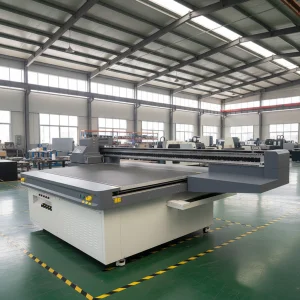
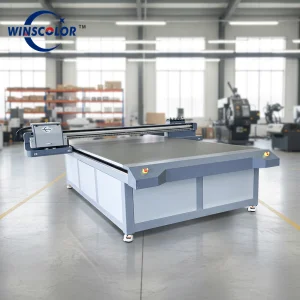
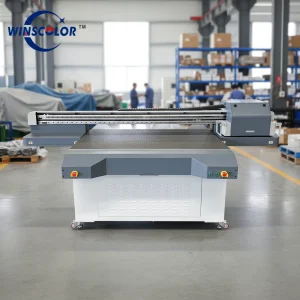
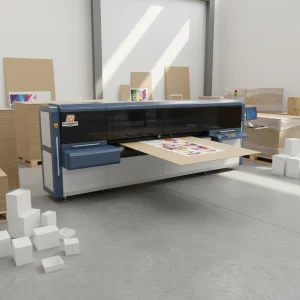
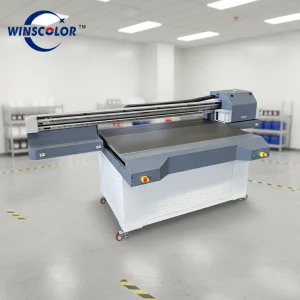
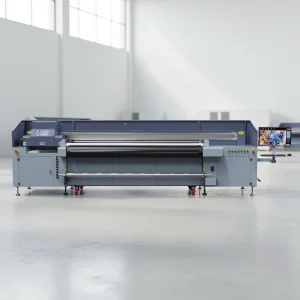
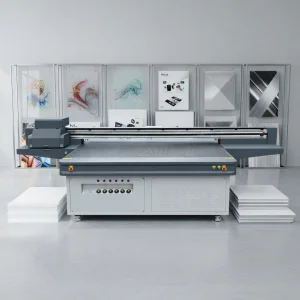
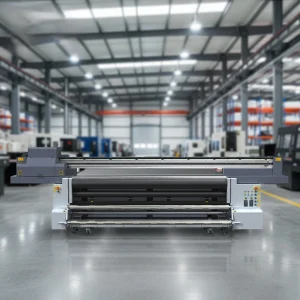
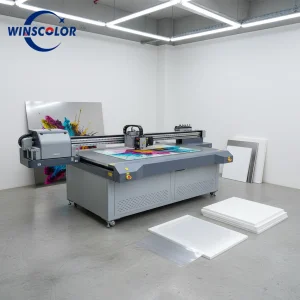
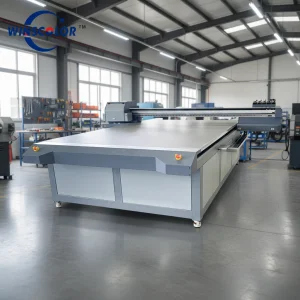
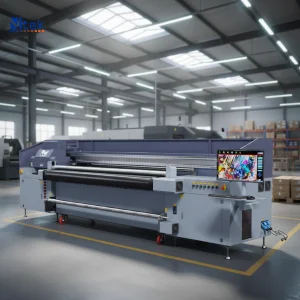
Turnkey printing units calibrated for ultra-rigid acrylics, architectural glass, dynamic packaging, and high-tensile media.
Evaluating engineering shifts from conventional mercury discharge systems to sub-5-micron piezoelectric jetting matrices.
Moving beyond uniform droplet firing, our custom dynamic waveform architecture throttles piezo transducers between 5pl, 10pl, and 15pl multi-drop sizes. This eliminates mechanical banding during high-frequency pass modes and maintains sub-pixel visual accuracy across non-porous media.
Cold UV-LED array integration operating at a tight 395nm spectrum. By modulating wattage output dynamically against carriage scanning velocity, substrates with high thermal sensitivity like honeycomb boards and lightweight PVC evade deformation while maintaining full monomolecular crosslinking.
Equipped with internal nozzle pressure normalization, our white ink recirculation manifold circulates pigments continually from individual sub-tanks through the nozzle plate chamber. This resolves titanium dioxide precipitation, preventing nozzle clogs and carriage purge downtime.
Engineered ink surface tension and crosslinking protocols designed for demanding fabrication environments.
Overcoming low surface free-energy on vitrified surfaces through proprietary silane-coupling nano-primers applied inline. Capable of surviving ISO 2409 Cross-Hatch adhesion Grade 0 parameters, hot water immersion tests, and deep architectural abrasion without delamination.
Addressing the on-demand packaging market with single-pass and continuous-feed mechanisms. Replaces expensive plate setups for corrugated cartons and POS displays, reducing setup scrap to zero while achieving complete color match across kraft and bleached liners.
Leveraging high-viscosity structural gloss varnishes to create selective 3D textures, braille typography, and structural tactile reliefs. Eliminates the cost of traditional screen embossing on polycarbonate, acrylic sheets, and aluminum front panels.
Inside our 20,000 m² Jinan industrial hub: high-precision machining, standardized testing, and scaled supply resilience.
The machine structural base uses tempered double-beam steel frames, stress-annealed and machined with a high-precision five-axis CNC gantry milling tool. Flatness tolerances along the full carriage path are kept within ≤0.02mm, ensuring stable ink drop flight trajectory at production speed.
Key mechanical motion uses dual Japanese THK ultra-quiet linear guideways, Panasonic AC digital servo drives, and German IGUS drag chains. This hardware setup keeps high-speed shuttle tracking accurate to sub-pixel levels under high production workloads.
Before leaving the plant, every system undergoes 72 hours of uninterrupted electrical stability checks, laser interferometer gantry alignment, and test runs across diverse substrates to verify mechanical and color stability before international crating.
International export conformity, multi-tiered support systems, and proactive field diagnostics.
Every machine series complies with European CE electromagnetic compatibility (EMC) and Low Voltage (LVD) requirements. Our chemical ink sets comply with RoHS, REACH, and UL GREENGUARD Gold low-emission standards for indoor commercial graphics.
To reduce logistics wait times, primary wearable components—including secondary ink tanks, negative pressure controllers, solenoid valves, and power boards—are warehoused with overseas partners across Europe, North America, and Southeast Asia.
Factory-certified field application engineers deliver 24/7 remote desktop telemetry diagnostics. We build custom multi-layer ICC profiles for specialty substrates, optimizing printhead firing curves, white underbases, and ink consumption efficiency.
Operational parameters, configuration choices, and technical criteria addressed by our field engineers.
Engineered for wide-format signage, continuous banner rolls, and flexible packaging substrates.