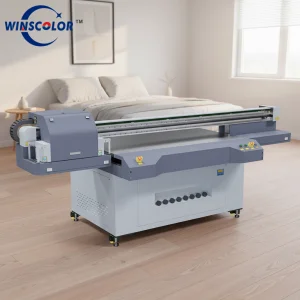
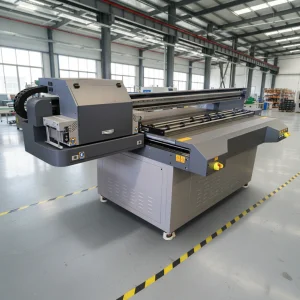
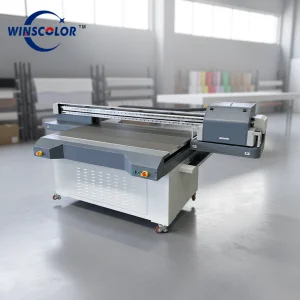
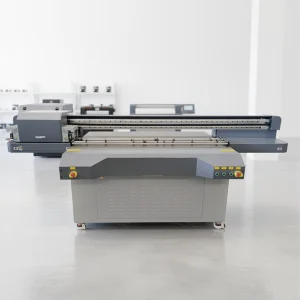
Precision manufacturing platforms calibrated for high-volume rigid substrate output, corrugated digital conversion, and heavy-duty direct-to-object marking.


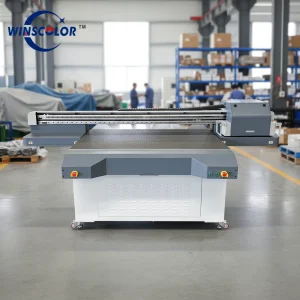
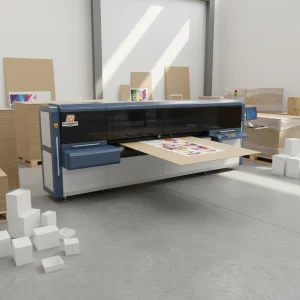
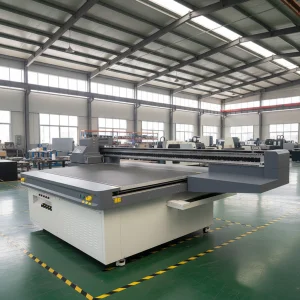
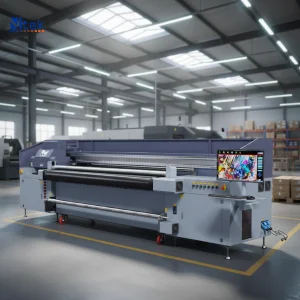


Transitioning from conventional screen printing and eco-solvent machines to multi-axis UV-LED direct digital curing on non-porous rigid materials.
Traditional mercury vapor arc lamps imposed high thermal loads onto heat-sensitive media such as thin foam PVC and styrene. Modern 395nm wavelength UV-LED cold curing emits negligible radiant heat, protecting substrate dimensional stability while cutting system warm-up latencies to zero seconds.
Direct printing eliminates vinyl self-adhesive films and manual mounting lamination. Direct-to-substrate digital deposition on toughened glass, engineered timber, architectural ceramics, composite aluminium (Dibond), and corrugated board streamlines workflows from days into minutes.
Next-generation piezo arrays jet drops ranging from 5pl to 12pl variable grayscale droplets. Combined with constant-pressure recirculating circuits across White and Spot Varnish lines, industrial systems avoid nozzle precipitation and maintain continuous drop placement integrity.
Procurement directors and plant engineers must analyze capital equipment beyond raw sticker price. Evaluating the True Cost of Ownership (TCO) ensures decade-long machine profitability.
Structural stability under rapid carriage deceleration determines longevity. Welded, tempered heavy steel chassis and milled aircraft-grade aluminum gantries mitigate harmonic vibrations that induce fine micro-banding on photographic passes.
Evaluating industrial heads like Ricoh Gen6/Gen5 or Kyocera KJ4A against lower-tier consumer heads. Native steel nozzle plates withstand aggressive automated suction wipe cycles, chemical flushes, and accidental surface abrasion.
Total cost per square meter depends heavily on ink efficiency and maintenance waste. Automated micro-purging, continuous white ink sub-tank agitation, and precision capping preserve up to 22% of ink over legacy priming stations.
Seamless compatibility with Onyx, Caldera, and ColorGATE enables closed-loop spot color matching, automated white layer generation, nesting optimization, and ICC profiling tailored for diverse multi-layer varnish effects.
Engineered solutions for challenging substrates requiring precise chemical pretreatments, specialty UV formulations, and certified mechanical durability.
Non-porous silicates normally resist ink bonding. NTEK systems integrate automated silane primer jetting and inline corona treatments, yielding cross-hatch tape test ratings of 5B (ASTM D3359), moisture barrier resistance, and fade-free interior partitions.
Replacing flexographic plate setup costs for short-to-medium runs. High-speed single-pass and automated flatbed feeds print corrugated fluting directly without flute crush, delivering high-chroma shelf-ready packaging (SRP) and custom e-commerce mailers.
Road traffic signs, acrylic point-of-sale displays, membrane switches, and aluminum instrument panels require intense UV lightfastness. Our pigmented UV inks withstand up to 5 years outdoor exposure without delamination or chromatic shift.
Inspect the subsystem architecture behind industrial-grade 24/7 continuous duty cycles.
| Subsystem | Technical Specification | Engineering Benefit | Operational Impact |
|---|---|---|---|
| Motion Control | Dual Japanese THK Silent Linear Guides + Panasonic AC Servo Drives | Carriage travel repeatability within ±0.01 mm | Zero pitch-error banding during high-speed bidirectional printing |
| Ink Supply Chain | Closed-loop Dual Negative Pressure Regulators with Digital Display | Maintains meniscus tension at every printhead nozzle | Prevents ink starvation on solid floods and eliminates ink dripping |
| Vacuum Platen | Multi-Chamber Independent Zoned Suction Bed with Reverse Air Float | Turbine-driven high-pressure suction holds warped rigid boards | Fast repositioning of heavy sheets up to 100 kg without surface friction |
| Curing Engine | Dual Water-Cooled Variable Output UV-LED Arrays (up to 16 W/cm²) | Instant polymerization without IR radiant heat transfer | Prevents substrate deformation on thin acrylic, fluted PP, and soft PVC |
| Safety Interlocks | Dual Anti-Crash Laser Collision Sensors + Emergency Carriage Brakes | Halts carriage within 2 milliseconds of substrate contact | Protects expensive piezo nozzle surfaces from irreversible impact damage |
Full regulatory compliance and responsive after-sales support give global distributors and plant managers total operating confidence.
All NTEK large format printing hardware and auxiliary curing units comply with CE Machinery Directives, RoHS hazardous material limits, FCC Class A, and UL electrical compliance. Ink chemistries conform to REACH regulations for volatile organic emissions.
We maintain regional spare parts inventories—including printhead boards, encoder strips, peristaltic pumps, and filters—across hubs in Europe, North America, Southeast Asia, and the Middle East to ensure swift replacement turnaround.
Every overseas installation is supported by factory-trained field technicians. We provide live multi-lingual remote diagnostics, comprehensive operator certification, on-site commissioning, and continuous color management calibration training.
Pioneering tomorrow's digital printing standards through continuous research and advanced industrial integration.
Transitioning from scanning gantry architectures to fixed, high-density printhead bars. Capable of continuous linear speeds up to 1.5 meters per second, bringing digital printing directly into inline automated cardboard folding lines.
Embedded high-resolution optical cameras detect substrate positioning, skew angle, and surface warp in real time. The software compensates digitally across RIP raster files, achieving register accuracy within fractions of a millimeter on irregularly shaped cutouts.
Developing non-petroleum, sustainable UV-curable monomers that retain flexible elongation and adhesion on challenging plastics. These green formulations deliver ultra-low odor output ideal for healthcare environments and food secondary packaging.
Detailed answers to critical technical, environmental, and operational inquiries compiled by our senior application engineering team.
Ricoh Gen6 printheads are built with all-metal construction and internal silicone heat exchangers that withstand aggressive industrial environments, high jetting frequencies (up to 50 kHz), and continuous operation. In contrast, commercial piezo heads feature bonded plastic housings and lower drop throw distance, making them more vulnerable to nozzle clogging, heat-induced deflection, and physical surface abrasion during high-speed production runs.
White UV ink incorporates dense titanium dioxide (TiO2) particles that naturally settle over time. NTEK systems combine an automated continuous recirculation circuit through the sub-tank and printhead manifold with an independent negative pressure regulator. This maintains constant meniscus tension at the nozzle face, prevents fluid dripping, and eliminates micro-air bubble ingestions during heavy-ink print cycles.
Yes. By laying down successive passes of UV-curable white ink or selective gloss varnish before the color layer, the printer builds physical relief up to multiple millimeters thick. This process adheres to ADA (Americans with Disabilities Act) braille standards and creates tactile oil-painting replicas, embossed wood grain, leather textures, and luxury packaging accents directly without mechanical embossing dies.
Because glass and glazed ceramic tiles exhibit high surface energy and low porosity, we apply specialized chemical silane coupling agents (primers) via wiping or automated dedicated primer printheads. This creates a durable covalent molecular bridge between the inorganic silicate substrate and the organic UV polymer matrix, guaranteeing 5B cross-hatch adhesion and scratch resistance.
Facilities require single-phase or three-phase 220V AC (±10%) at 50/60Hz with dedicated earth grounding (<4Ω) to suppress static interference. The operating room should maintain a stable temperature between 20°C and 28°C with relative humidity from 40% to 65% to prevent ink viscosity changes. A clean, oil-free, dry compressed air supply delivering 0.6–0.8 MPa is also required for pneumatic media alignment pins and anti-static bars.
From custom cylindrical printers to large-scale 2030 flatbed engines, choose the configuration optimized for your specific shop floor footprint and production capacity.