Engineered for high-duty cycle 24/7 manufacturing operations across rigid sheet goods, architectural glass, structural composites, and continuous roll media.
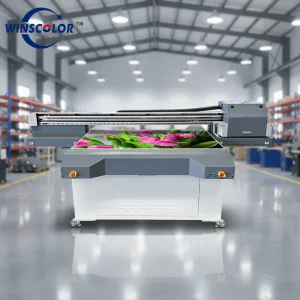
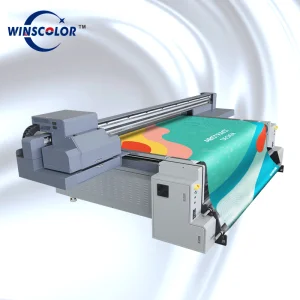
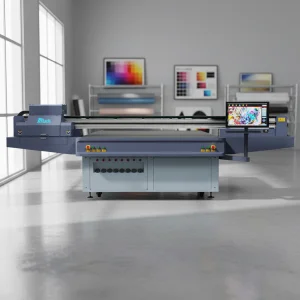
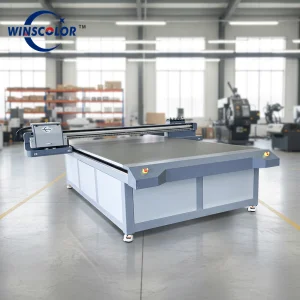
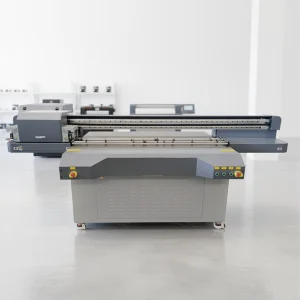
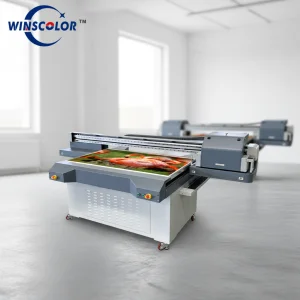
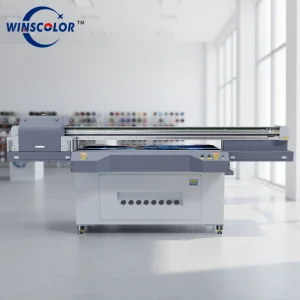
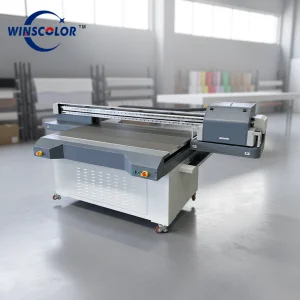
A technical deconstruction of stainless steel piezo MEMS durability, variable drop jetting waveforms, and high-viscosity ink rheology management.
In high-throughput industrial UV printing environments, the piezoelectric printhead serves as the primary determinant of continuous yield rates, chromatic fidelity, and operational expenditure. The integration of Ricoh Gen5 (MH5420/5440 series) printheads within NTEK export-class digital platforms represents an engineered balance between raw mechanical robustness and photographic droplet placement. Unlike conventional silicon MEMS printheads vulnerable to aggressive solvents and mechanical abrasion, the Ricoh Gen5 architecture features an isolated stainless steel housing and metallic nozzle plate configured to withstand continuous industrial printing environments.
Each Ricoh Gen5 head accommodates 1,280 individual nozzles arranged across 4 separate rows of 320 nozzles. The hydraulic chamber allows dual-color delivery (2 × 640 nozzles) at a native 300 dpi pitch per line, or quad-color low-viscosity configurations reaching a combined physical density of 600 dpi. This provides scalable throughput across multi-head stagger arrays.
Operating with multi-pulse jetting protocols, the Gen5 actuator modulates acoustic chamber pressure to produce 4-level grayscale drops ranging from 7 pL for ultra-crisp micro-text and flesh tone gradients up to 35 pL for rapid high-density solid fills, white underbase saturation, and thick varnish tactile layering.
UV-curable inks require strict viscosity containment (typically 10 to 12 mPa·s). Each printhead integrates dual internal thermistors and an auxiliary heating manifold. By maintaining chamber operating temperatures within ±0.5°C tolerance, flight path deviations and satellite misting are eliminated across extended industrial shifts.
A critical engineering parameter in continuous UV flatbed operation is ink meniscus stability at the nozzle faceplate. The NTEK fluid distribution architecture deploys closed-loop dual digital negative pressure regulators. Separate vacuum systems isolate color ink lines from dense titanium dioxide (TiO2) white inks. By stabilizing backpressure within a tight tolerance of -3.5 kPa to -4.2 kPa, fluid weeping is prevented during high-acceleration gantry turnaround movements (up to 1.8 m/s²), while nozzle starvation is eliminated during high-frequency firing sequences up to 30 kHz.
| Evaluation Parameter | Ricoh Gen5 (MH5420) | Ricoh Gen6 (MH5320) | Conventional Piezo MEMS |
|---|---|---|---|
| Chassis Construction | Reinforced Stainless Steel Alloy | Stainless Steel + Compact MEMS | Etched Silicon / Polymer Bonding |
| Native Drop Velocity | 7.0 – 8.0 m/s | 8.5 – 9.5 m/s | 5.5 – 6.5 m/s |
| Firing Frequency | Up to 30 kHz | Up to 50 kHz | 15 – 18 kHz |
| Drop Size Range | 7 pL to 35 pL (Variable Grayscale) | 5 pL to 21 pL (High-Definition) | 3.5 pL to 12 pL (Fixed/Binary) |
| Operational Lifespan | 12,000 – 18,000 Hours | 12,000 – 16,000 Hours | 3,000 – 6,000 Hours |
| Industrial Substrate Compatibility | Glass, Metal, Acrylic, Ceramics, Corrugated | High-End Graphics, Packaging, Films | Lightweight Signage, Paper, Foamboard |
Evaluating Capital Expenditure (CapEx) against long-term Operating Expenditure (OpEx), ink yield metrics, and structural machine depreciation.
When multi-facility converting enterprises and print service providers evaluate industrial digital equipment, the purchase order represents merely 25% to 35% of the aggregate lifecycle cost. A rigorous procurement framework analyzes Total Cost of Ownership (TCO) over a standard 5-year operating window, integrating consumable efficiency, printhead replacement cycles, electrical load draw, and Overall Equipment Effectiveness (OEE).
Procuring directly from NTEK’s Jinan production base reduces intermediary distributor margins by 30% to 45%. Capital is redirected into high-yield hardware options including linear magnetic motor gantries, Renishaw optical scales, and dual UV-LED curing chillers, yielding higher structural asset valuation from day one.
Due to Ricoh Gen5's precision multi-drop waveform firing, ink laydown efficiency averages 7.5 to 9.2 mL per square meter at 100% CMYK coverage, compared to 12.5 mL/m² on legacy binary systems. Across an annual capacity of 120,000 m², ink fluid savings alone exceed $18,000 to $24,000 USD annually.
Replacing mercury vapor UV curing with solid-state Gallium Nitride (GaN) UV-LED arrays lowers curing power consumption from 7.5 kW/hr to 1.8 kW/hr. Furthermore, cold-cure LED minimizes substrate heat distortion, allowing zero-scrap printing on 0.2 mm heat-sensitive styrene and PVC films.
Procurement directors can evaluate their planned investment via the standardized industrial digital printing model:
Total Cost of Ownership (5-Yr TCO) = C_CapEx + (A_m2 × C_Ink) + (H_Cycles × C_Head) + (E_kWh × R_Power) + C_Maint - S_Residual
Where A_m2 is cumulative surface area produced, C_Ink represents dynamic ink cost per square meter calibrated against ICC profiles, H_Cycles accounts for physical printhead lifespan (averaging 3 to 4 years under rigorous ultrasonic purge protocols), and S_Residual is the high salvage resale value sustained by our annealed, heavy-duty welded gantry frame.
How Jinan’s industrial machinery cluster empowers NTEK with five-axis gantry milling, stress-relieved steel annealing, and high-precision mechanical manufacturing.
The performance of a wide-format UV printer relies on the geometric stability of its underlying chassis. Operating from Jinan, Shandong—the capital of heavy industrial CNC tooling and digital cutting machinery in China—the NTEK manufacturing complex leverages a deeply integrated industrial ecosystem. Our 20,000 m² factory environment enforces strict precision manufacturing protocols that elevate output consistency above fragmented assembly workshops.
Every NTEK structural steel base frame undergoes an 800°C electric thermal annealing process followed by high-frequency vibration aging. This thermal treatment relieves all residual internal weld stresses, ensuring zero mechanical warping or structural deflection across 10+ years of high-speed carriage cycling.
Our dual-rail gantry beams are machined in a single setup using oversized five-axis gantry CNC milling centers. Mechanical planar tolerances for THK dual mute guide rails are verified under 0.015 mm per 3,000 mm run using Renishaw dual-axis laser interferometers before carriage assembly.
With domestic component integration including Panasonic high-torque AC servomotors, Leadshine microstepping digital drives, Omron optical sensors, and German Igus low-friction energy chains, parts availability is guaranteed with 48-hour international dispatch protocols.
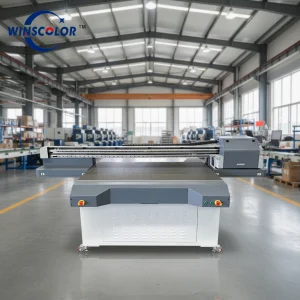
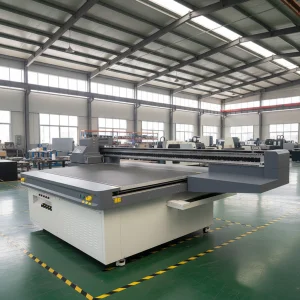
The vacuum print bed uses an internal aerospace-grade aluminum honeycomb core encased by hard-anodized, fluorocarbon-coated surface plates. Multi-zone independent suction partitions allow operators to lock down irregular sheets—from tiny promotional acrylic blanks up to 2.0 × 3.0 meter architectural glass slabs—without tape masks or manual clamping systems. Bed flatness is diamond-milled to within ±0.03 mm across the entire 3.2-meter working envelope.
Expanding manufacturing frontiers: From architectural facades and ceramic wall cladding to precision electronics housing and corrugated display converting.
Industrial UV curing is not merely an imaging technique; it is a cross-linking polymer chemistry process. Photoinitiators within the liquid ink absorb focused ultraviolet energy (385 nm–395 nm wavelength), triggering a near-instantaneous chain reaction that transforms fluid monomers into a durable polymer matrix. The NTEK Ricoh Gen5 equipment family addresses specialized global manufacturing requirements:
Deploying specialized silane nano-primers, our flatbeds print directly on annealed or tempered float glass. The software-controlled "Sandwich Print" mode (Color + White + Color) produces double-sided visual transparency for illuminated structural dividers, privacy walls, and museum vitrines.
Corrugated board converting requires fast setup for short-run personalized packaging. Without costly flexographic plates or lengthy setup times, our large-format hybrid and flatbed series run test cartons, retail POP displays, and seasonal runs with zero make-ready waste.
By synchronizing high-capacity white channels with multi-pass clear gloss varnish, our printers build physical 2.5D tactile relief up to 1.5 mm. Natural stone grains, wood knots, oil painting brushwork, and tactile Braille symbols (ADA compliant) are cured on demand.
Non-porous plastics, composite aluminum sheets (Dibond), stainless steel plates, and treated acrylics present low surface energy challenges (typically below 36 dynes/cm). NTEK addresses this through automated onboard inline flame treatment or micro-droplet piezo primer deposition. By raising effective surface energy past 48 dynes/cm prior to color deposition, finished products achieve a 5B rating under ASTM D3359 cross-hatch adhesion tape testing, resisting outdoor UV fading and chemical exposure.
In-depth technical answers addressing operational throughput, printhead longevity, RIP software profiles, and preventative maintenance protocols.
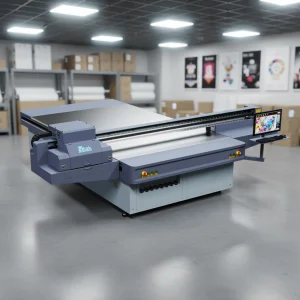
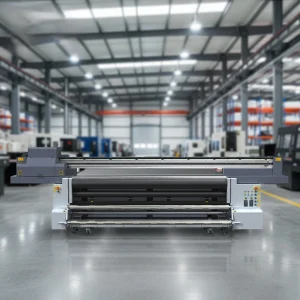
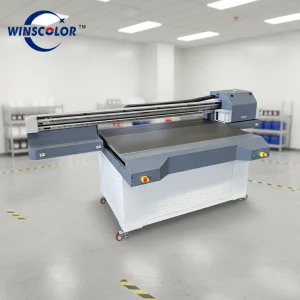
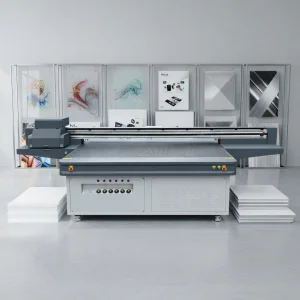
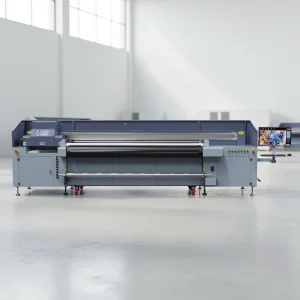
Heavy-duty gantry engineering, roll-to-roll feeding units, and high-precision short-run packaging printers configured for demanding industrial output.

Connect with our technical engineering team in Jinan for complete machine custom configurations, substrate adhesion feasibility testing, and export container freight quotations.
