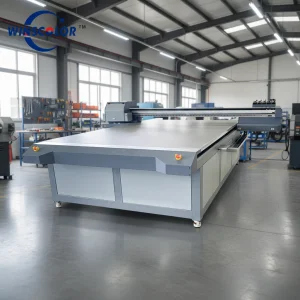
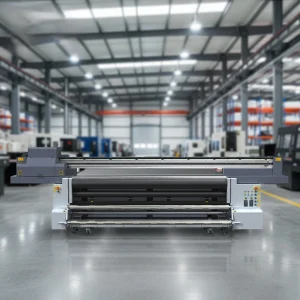
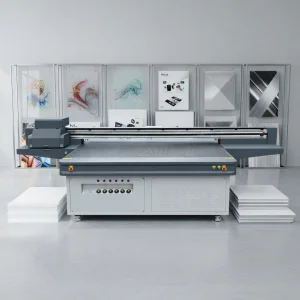
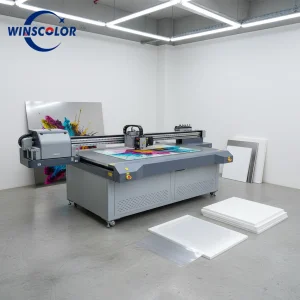
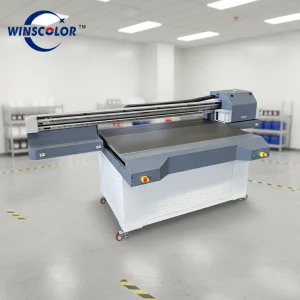
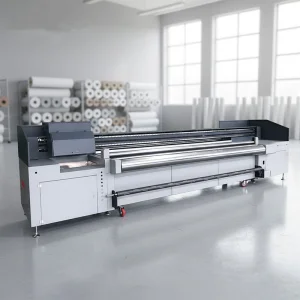
Discover our best-in-class UV LED flatbed and hybrid digital systems tailored for rigid PVC foam sheets, composite boards, and flexible industrial production.


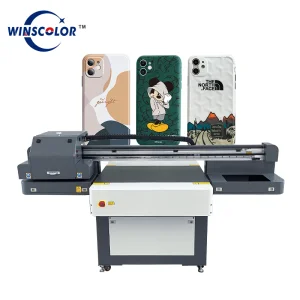
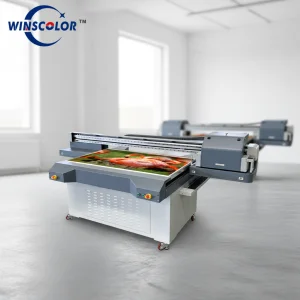


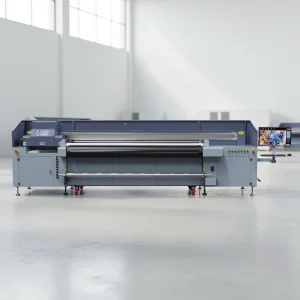

How state-of-the-art Chinese manufacturing clusters redefine total cost of ownership, mechatronic precision, and scalable supply chains for global print service providers.
Situated in the industrial heartland of Jinan, Shandong, our facility leverages localized deep-tier component clusters. From high-torque Japanese Panasonic AC servo motors and THK dual linear rails to heavy-duty tempered steel gantries, our integrated sourcing optimizes production cycle times and yields a 35%–45% procurement cost benefit compared to European and North American assemblies.
Polyvinyl Chloride (PVC) printing involves critical static and surface energy variables. Our machines integrate intelligent negative pressure recirculating ink circuits paired with constant-temperature heating manifolds. This completely mitigates micro-bubble coalescence and pigment sedimentation, ensuring continuous CMYK + W + V jetting without nozzle clogging during prolonged 24/7 manufacturing cycles.
Every PVC printing chassis undergoes 72-hour continuous dynamic aging, laser-interferometer precision gantry calibration, and strict thermal dissipation profiling. We maintain a zero-tolerance policy against micro-stepping deviations, ensuring that long-span printing on expansive 2500×1300mm and 2000×3000mm PVC panels maintains micrometer-level drop registration accuracy across millions of impressions.
In-depth engineering analysis on polymer ink crosslinking, variable droplet control, and the transition from traditional solvent screen-printing to green LED UV direct-to-substrate technologies.
The global commercial and industrial printing landscape is undergoing an irreversible structural transition. In the domain of Polyvinyl Chloride (PVC) fabrication—spanning rigid expanded PVC foam boards (Forex, Sintra), micro-cellular sheets, flexible banners, and laminated decorative architectural skins—traditional screen printing and eco-solvent roll methods are rapidly being displaced by industrial-grade UV LED direct-to-substrate (DTS) digital printing machines.
Historically, printing on rigid PVC encountered significant technical hurdles: static charge accumulation causing ink misting, plasticizer migration resulting in surface tackiness, substrate heat warping under high-intensity mercury discharge lamps, and brittle ink film cracking during post-print CNC routing or die-cutting. As a premier Chinese manufacturer, our R&D team has systematically resolved these thermodynamic and polymer-adhesion challenges through cutting-edge mechatronic innovations.
Traditional mercury arcs emit high infrared heat (>80°C), deforming PVC foam sheets. Our high-flux 395nm UV LED water-chilled systems cure ink instantly while maintaining substrate surfaces below 35°C, preventing warpage.
PVC generates intense electrostatic charges during handling. Our machines feature integrated bi-directional active ion bars that neutralize surface charges prior to jetting, eliminating overspray and satellite misting.
Our tailored UV curable ink sets feature balanced photoinitiators and high-flexibility oligomers. Prints can withstand V-grooving, 90-degree bending, and CNC edge routing without micro-cracking or delamination.
High-power regenerative vacuum turbines equipped with multi-zone matrix manifolds securely clamp bowed or irregular PVC sheets perfectly flat against the aviation-grade hard-anodized honeycomb platform.
| Technical Parameter | Legacy Eco-Solvent / Screen | Entry-Level Converted Systems | Winscolor Industrial UV Platform |
|---|---|---|---|
| Curing Temperature | Thermal Heat Tunnel (60°C–90°C) | Air-Cooled LED (High heat decay) | Chilled Water-Loop UV LED (< 35°C) |
| Ink Adhesion on PVC | Requires pre-coating/lamination | Variable, edge peeling during routing | Direct Chemical Bonding (ASTM 5B Cross-Hatch) |
| Droplet Size Control | Fixed 14–35 pL (Grainy gradients) | Micro-Piezo 7–12 pL | Variable Grayscale 5–15 pL (Ricoh Gen6) |
| Volatile Organic Compounds (VOC) | High Solvent VOC emissions | Medium Odor Formulations | Zero VOC, REACH & RoHS Compliant |
| Structural Frame Rigidity | Lightweight Sheet Metal Framing | Bolted Aluminum Profiles | Heavy Annealed Carbon Steel Gantry Beam |
Examining how high-performance PVC printing machinery drives throughput, tactile value, and rapid ROI across key global commercial verticals.
Interior decorators utilize UV flatbeds (such as the YC2513L and YC2030H) to print high-definition faux Italian marble, hyper-realistic timber textures, and geometric wall finishes directly onto high-density PVC composite panels. By jetting high-gloss varnish with micro-registered embossed reliefs, factories replicate natural materials at one-tenth of the weight and quarry installation costs, fully compliant with commercial fire-retardant standards.
Global fast-fashion and consumer electronics brands demand rapid turnaround on retail signage. Our fast-drying flat UV LED printers allow operators to direct-print 3mm–10mm white and colored PVC foam boards at speeds topping 45–65 m²/h. The printed sheets feed directly into automated flatbed digital cutting tables without drying dwell-time, reducing delivery workflows from 72 hours down to same-day dispatch.
In electronic manufacturing and automation hardware, rigid PVC, polycarbonate, and acrylic are used extensively for equipment front panels, membrane backplates, and safety signage. Winscolor printers utilize high-density opaque white ink foundations followed by photographic CMYK layers and abrasion-resistant matte varnish, passing stringent ASTM alcohol-rub and scratch tests required by global Tier-1 OEMs.
A strategic decision-making framework designed for enterprise C-level executives and plant operations directors evaluating capital expenditures in digital UV printing.
Selecting an industrial PVC printing machine requires evaluating three critical operational dimensions: Substrate Thickness / Dimension Envelope, Duty Cycle & Throughput Requirements, and Total Cost of Print Head Operation (TCO). Below is the decision framework our systems engineering group utilizes when tailoring production lines for international converters:
For dedicated rigid board shops handling standard 4×8 ft (1220×2440mm) PVC sheets, the YC2513L / YC2513H series offers the highest mechanical rigidity and fastest load-unload efficiency. If your order book contains a 50/50 mix of rigid boards and flexible PVC flex banners, our hybrid systems (YC2513R, YC2500HR, YC3200HR) eliminate redundant floor footprints by consolidating both operations into a single chassis.
High-volume commercial plants running 16+ hours daily should select the Ricoh Gen6 (MH5320) printhead architecture. Operating at a firing frequency of up to 50 kHz with a minimal 5 pL droplet size, Gen6 achieves a 35% productivity leap over earlier generations, producing razor-sharp 2-point micro-text on PVC serial plates without sacrificing speed.
Evaluating an equipment supplier extends beyond FOB machinery costs. Buyers must examine consumption curves (mL per m²), electronic component standardization, and real-time remote telemetry. Winscolor maintains fully documented spare parts warehousing, certified factory engineering dispatch, and encrypted cloud remote diagnosis to protect your production uptime.
Comprehensive engineering insights addressing pre-purchase, technical integration, and day-to-day operation of industrial PVC printing machinery.
Explore our super-wide format, corrugated packaging, and heavy-duty hybrid UV digital printing machinery designed for global manufacturing enterprises.