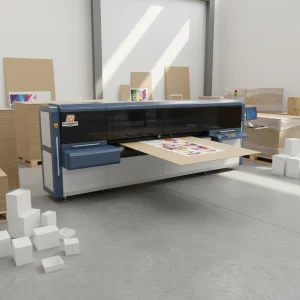
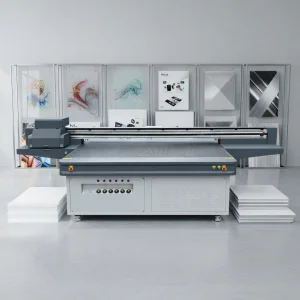
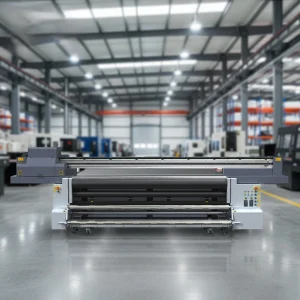
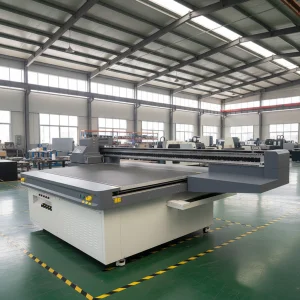

Traditional rotogravure and flexo require costly photopolymer stereos, high makeready waste, and extensive plate storage. Our single-pass corrugated printing engines allow rapid SKUs switching, variable barcodes, personalized e-commerce packaging, and cost-effective ultra-short print runs directly onto brown or bleached kraft liners.
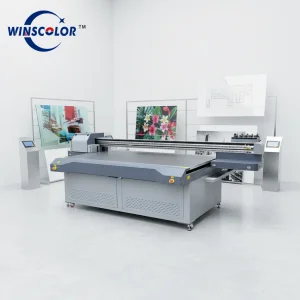
Direct-to-substrate flatbed platforms eliminate the requirement for lamination film or fragile intermediate transfers. Utilizing nano-particle inorganic ceramic inks or high-adhesion organic UV inks with silane coupling agents, fabricators can deposit hyper-realistic stone textures, tactile wood grains, and optical switchable backlights on glass and tiles.
Precision micrometric gantry positioning systems combined with sub-drop grayscale modulation (down to 5 pL) allow direct digital printing of membrane switch overlays, back-lit dials, flame-retardant polycarbonates, and heat-resistant anodized aluminium chassis without photographic stencil preparations.
Focused on heavy industrial automation, ADA-compliant tactile Braille sign fabrication, architectural grade Dibond printing, and UL-certified electrical assembly integration.
Prioritizing strict chemical safety: low-odor, zero-VOC formulations compliant with REACH and RoHS, along with minimal carbon footprints supported by low-power UV-LED arrays.
Driven by rapid high-volume turnarounds in e-commerce secondary packaging, high-speed corrugated digital conversion, electronic casing personalization, and textile roll processing.
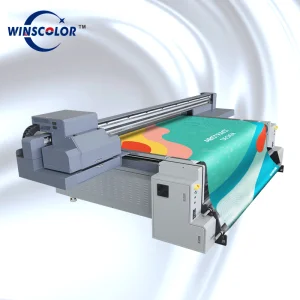
Demanding heavy-duty machine frames resilient to wide ambient temperature shifts, high relative humidity variations, and dual-purpose hybrid versatility across rigid and roll media.
Every inkjet machine complies fully with the European Machinery Directive 2006/42/EC, Low Voltage Directive 2014/35/EU, and Electromagnetic Compatibility Directive 2014/30/EU. All pneumatic systems, electrical harnesses, and emergency fail-safes undergo optical and insulation testing before dispatch.
Integrated digital printhead heaters, secondary ink-sub-tank thermal loops, and precision circulating water chillers stabilize ink viscosity at 8–12 mPa·s. Whether operating in Dubai's summer climate or Canadian winters, droplet flight trajectory remains accurate within ±3 microns.
Our tier-1 global dispatch centers in East Asia, Europe, and Latin America stock original Ricoh, Kyocera, and Epson printheads, dampers, linear encoders, and PCB driver boards. We offer 24-hour remote video diagnostics backed by certified Field Service Engineers (FSEs).
| Substrate Category | Material Types | Surface Treatment / Primer | Recommended Printhead / Ink | Adhesion Class |
|---|---|---|---|---|
| Rigid Non-Porous | Float Glass, Mirror, Ceramic Tile, Glazed Granite | Silane Coupling Wipe Primer (Dyne > 48) | Ricoh Gen6 / Rigid UV Ink (CMYK+W+V) | 5B (ASTM D3359) |
| Thermoplastics | Cast Acrylic, Extruded Polycarbonate, Fluted PP, PVC | Corona discharge or pure IPA degreaser | Ricoh G5i / Kyocera KJ4A / Flexible UV Ink | 5B (Cross-Hatch) |
| Metals & Composites | Brushed Aluminium, Dibond, Stainless Steel, Brass | Direct print or Metal Wipe Bonding Promotor | Piezo DOD / Scratch-Resistant LED-Curable | 4B-5B Adhesion |
| Paper & Packaging | Corrugated E/B/C-Flute, Honeycomb, Kraft Liners | No primer required (High porous absorption) | Single-Pass High Speed / Water-based or UV LED | Fiber Tear Adhesion |
| Flexible Polymers | PU / PVC Synthetic Leather, Backlit Vinyl, TPU | Pre-heat vacuum suction tension control | High-Elongation UV Ink (>200% flexibility) | No Micro-Cracking |
Integrating multi-spectrum line scan sensors directly on the gantry carriage allows real-time detection of deviated or missing nozzles mid-print. Algorithms automatically adjust adjacent firing channels to compensate and prevent white banding, eliminating operator intervention.
To support secondary food packaging regulations, our single-pass roadmap includes certified water-based pigment inks compliant with Swiss Ordinance and Nestlé guidance for contact food packaging, eliminating photoinitiator migration hazards.
Deploying segmented UV-LED arrays running at both 365nm and 395nm wavelengths. The shorter 365nm wavelength cures the ink surface instantly for higher scratch hardness, while the penetrating 395nm wavelength ensures complete bottom cross-linking, optimizing total UV ink adhesion on non-porous plastics.
Industrial Ricoh Gen6 printheads (MH5320/MH5340) feature an all-metal chassis with silicon MEMS manufacturing, delivering an isolated ink path capable of withstanding aggressive industrial solvent and UV chemistries. Unlike light-duty plastic printheads, Gen6 features high firing frequencies (up to 50 kHz), native drop sizes down to 5 pL with multi-drop grayscale capabilities, and integrated fluidic recirculation. This ensures continuous 24/7 industrial production with an operational lifespan often exceeding 3–5 years under regular maintenance.
White ink contains heavy titanium dioxide (TiO2) particles that naturally settle under gravity, creating sediment that can block micro-nozzles. Winscolor printers employ a dual-stage circulation system: continuous motor agitation in the main white ink tank combined with negative-pressure micro-recirculation running directly through the printhead damper and manifold. This keeps pigment particles evenly dispersed even when the machine is idle.
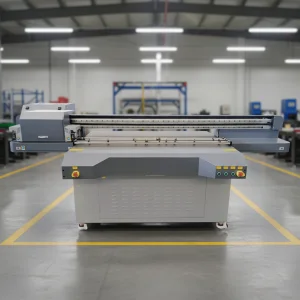
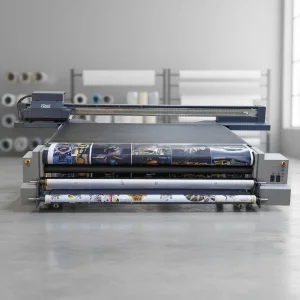
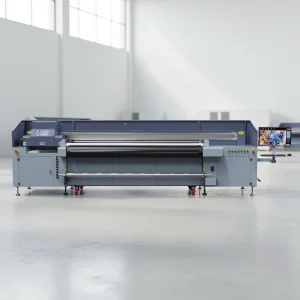
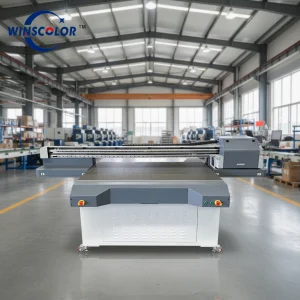
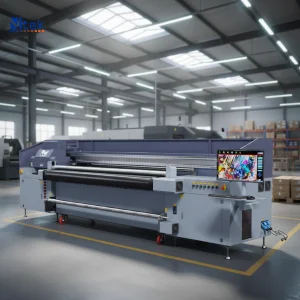
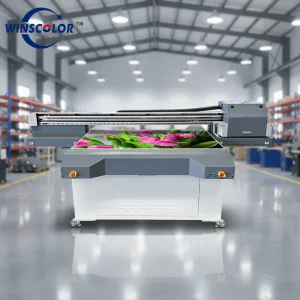
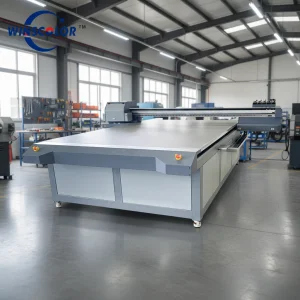
A Flatbed secures heavy, rigid substrates (glass, stone, thick wood) onto a stationary zoned vacuum table while the gantry traverses along the X and Y axes, maximizing registration precision. A Hybrid uses an industrial vacuum conveyor belt with extension tables to handle both rigid sheets and roll-to-roll banners on a single footprint. A Single-Pass engine uses fixed arrays of printheads spanning the entire printing width; the substrate moves continuously beneath the stationary print bar at high linear speeds (30–80 m/min), making it ideal for packaging line volumes.
Tactile effects are created using layered digital jetting. The printer lays down successive passes of high-opacity white ink or dedicated clear gloss varnish directly over the target vector coordinates, building physical height up to 5mm. UV-LED lamps can be set to pin the varnish immediately for a textured matte look or delayed to let the liquid level out under a secondary pass for a high-gloss, mirror-like finish.
Facilities require a stable 220V/380V (±10%) 50/60Hz grounded power supply with an independent voltage stabilizer, oil-free dry compressed air running at 0.6–0.8 MPa for pneumatic valves, a clean, dust-controlled environment with ambient temperatures between 20°C and 28°C, and relative humidity kept between 40% and 65% to minimize static electricity buildup on plastics.
We offer bilingual on-site installation, machine calibration, and RIP color profiling (ICC generation) directly at our customers' facilities worldwide. Every machine is backed by an enterprise warranty, remote desktop screen-sharing diagnostics, and life-cycle supply of original mechanical and electronic replacement components dispatched within 24 hours.
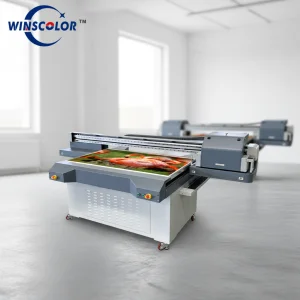

Consult directly with our inkjet systems engineering group. Provide your target substrates, daily output requirements, and ink chemistry needs to receive a comprehensive hardware configuration proposal and sample print assessment.
