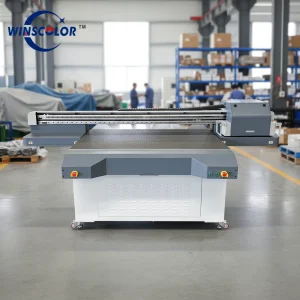
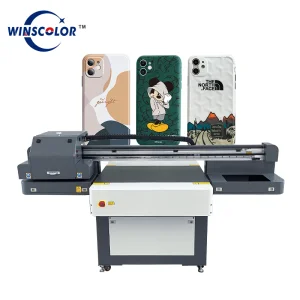
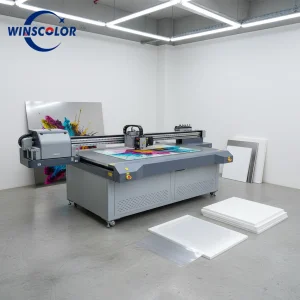
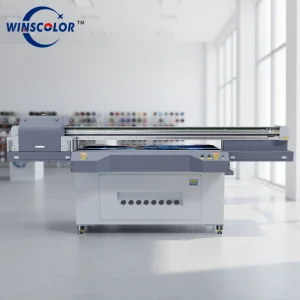
Explore Tier-1 industrial flatbed, hybrid, and roll-to-roll digital UV systems built with high-rigidity gantries, industrial Ricoh Gen6 piezo printheads, and multi-zone vacuum adsorption.
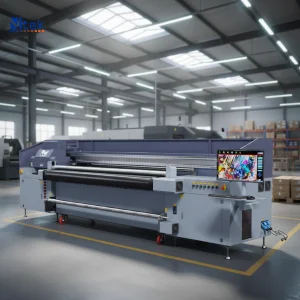
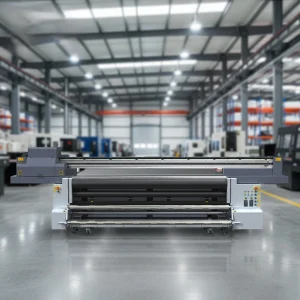
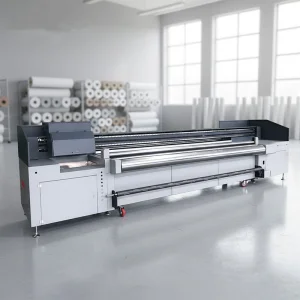


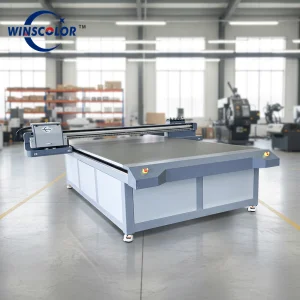
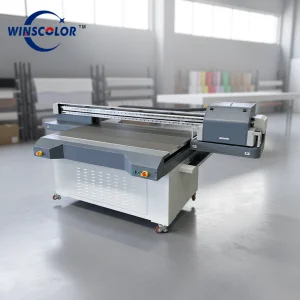
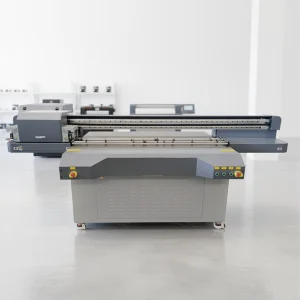
A technical analysis of how cold ultraviolet light-emitting diodes (UV-LED), micro-electromechanical piezo drop generation, and volatile organic compound (VOC)-free photopolymerization inks are supplanting traditional analog screen printing and solvent-based printers.
Traditional arc-discharge mercury vapor lamps emit vast amounts of infrared radiation, generating localized surface temperatures exceeding 80°C. Modern industrial UV-LED systems emit narrow-band ultraviolet light (typically centered strictly at 395nm or 365nm), providing instantaneous photopolymerization without thermal distortion on heat-sensitive thermo-expandable PVC, polyolefin films, and ultra-thin styrenes.
Global regulatory protocols—including European REACH compliance, RoHS directives, and stringent clean-air initiatives in North America—have placed severe restrictions on solvent evaporation. UV digital LED inks formulate with 100% reactive solids consisting of photoinitiators, functional monomers, and oligomers, releasing virtually zero volatile organic compounds during full cure.
Supply chain velocity demands fast turnarounds. Offset lithography, gravure, and flexography require cost-prohibitive prepress platemaking and prolonged changeover wash-downs. UV digital inkjet architecture enables on-demand, individualized file processing via raster image processors (RIP), allowing commercial print packaging operations to turn round micro-runs profitably within hours.
How Jinan Yingcai Digital Technology Co., Ltd (Winscolor / NTEK) harnesses Shandong’s industrial heavy machinery cluster to manufacture high-yield, vibration-damped UV printing platforms for global markets.
Industrial digital printing precision begins at the structural steel frame. Located in the Jinan E-commerce Logistics Park, Winscolor’s 20,000 m² manufacturing plant applies five-axis CNC gantry milling to machine unified dual-rail steel chassis. Thermal stress relief annealing prevents micro-torsion across a 3.3-meter carriage pass, guaranteeing printhead-to-bed parallel planarity within a strict tolerance of ±0.02 mm.
Unlike assembled modular sheet-metal frames that resonate during high-speed bidirectional scanning, our all-welded, heat-treated framework absorbs inertial force up to 1.8G accelerations generated by high-frequency magnetic linear drive motors.
The industrial ecosystem in Shandong and the greater Bohai economic belt enables complete localized vertical integration. From precision aerospace-grade honeycomb aluminum vacuum tables to in-house wiring harnesses, servo drives, and dual negative pressure ink circuit modules, our plant reduces build lead times from the industry average of 45 days down to just 12–15 business days.
Every industrial printer manufactured across our six specialized assembly lines undergoes an extensive 72-hour continuous burn-in procedure before packaging:
Evaluating capital expenditures (CapEx) against long-term operational expenditures (OpEx), ink yields per square meter, nozzle longevity, and piezo acoustic wave dynamics.
| Evaluation Parameter | Ricoh Gen6 (MH5320) Industrial Platform | Epson i3200-U1 Commercial Platform | Kyocera KJ4A High-Speed Single-Pass |
|---|---|---|---|
| Target Output Class | 24/7 Heavy Industrial Production (Boards/Hybrids) | Short-Run / Commercial Entry to Mid-Duty | Ultra-High-Speed Packaging & Corrugated Lines |
| Droplet Size & Grayscale | 5 pl – 15 pl (Multi-drop variable grayscale) | 3.8 pl – 12 pl (Fine micro-piezo drop) | 3.5 pl – 14 pl (High-frequency jetting) |
| Firing Frequency | Up to 50 kHz (High carriage scan speed) | Up to 21.6 kHz | Up to 64 kHz (Instantaneous web delivery) |
| Physical Durability & Nozzles | Stainless steel orifice plate, 1,280 nozzles (4x320) | MEMS silicone faceplate, 3,200 nozzles | Ceramic monolithic construction, 2,656 nozzles |
| Ink Compatibility Range | UV Curable, Solvent-UV, Water-UV, Primers | Low-viscosity UV-LED formulations | Custom industrial low-viscosity UV chemistries |
| Typical Lifespan | 3 to 5 Years (with routine clean & purge) | 1 to 2 Years (under continuous industrial shifts) | 3 to 5 Years (cleanroom-grade ink filtration) |
| Average Ink Cost / m² | $0.45 – $0.85 USD (depending on ink coverage & white) | $0.55 – $0.95 USD | $0.40 – $0.75 USD (bulk drum supply) |
Industrial UV systems cannot rely on gravity feed. Independent dual negative pressure chambers—one managing colored inks (CMYK+LC+LM) and another regulating higher-density titanium dioxide (TiO₂) White ink—maintain vacuum equilibrium within ±0.1 kPa, preventing head strikes, dripping, and starvation during high-speed bidirectional carriage passes.
Titanium dioxide pigments utilized in opaque white formulations possess high specific gravity and settle rapidly, risking nozzle clogging. Winscolor implements continuous secondary-tank peristaltic circulation combined with internal printhead micro-flushing, maintaining white pigment suspension through idle standbys and multi-shift runs.
Traditional stepper timing belt mechanisms suffer from tooth wear, micro-stretching, and acoustic resonance over multi-year runs. Our industrial models feature metal optical linear encoder scales paired with magnetic levitation drive motors, delivering positional feedback accuracy down to 1 micrometer across high-volume production cycles.
From architectural glass partitions to flexible packaging films and high-adhesion metal dial plates, explore real-world material chemistry and process workflows.
Direct printing on float glass, mirrors, backsplashes, and ceramic tiles requires specialized silane coupling primers. Using high-intensity pinning cures and spot varnish, systems create tactile textures resistant to humidity and scratching in residential and commercial decor environments.
Digitally jetting onto multi-ply corrugated paper, honeycomb board, and rigid greyboards eliminates costly flexographic cutting dies and plate preparation. Perfect for seasonal e-commerce packaging, customized retail point-of-sale displays, and rapid prototyping.
Industrial marking on anodized aluminum chassis, stainless steel nameplates, and polycarbonate control panels. Flexible UV ink chemistries resist post-print metal stamping, micro-shearing, solvent wipe-downs, and salt-fog corrosion across extended field operations.
Equipped with motorized rotary chuck fixtures and multi-axis synchronizers, machines like the 1610 and YC2513 print 360-degree continuous seamless wraps on insulated drinkware, thermal tumblers, wine bottles, cosmetics containers, and industrial tubes.
By depositing micro-registered successive passes of UV white ink underneath transparent CMYK inks, Winscolor printers generate high-density 3D embossed reliefs up to 1.5mm thick. Applying a final layer of LED gloss varnish with selectable specular or matte curing angles creates museum-grade tactile finishes, Braille-compliant ADA signage, and luxury cosmetic finishes.
Comprehensive solutions and operating parameters prepared by Winscolor application engineers and field service technicians for production directors worldwide.
From dedicated fast-drying PVC board units to high-load architectural stone printing tables, explore the remaining models engineered for specialized manufacturing.