Explore our export-certified digital printing engines engineered for continuous duty-cycle manufacturing across rigid, flexible, corrugated, and irregular substrates.
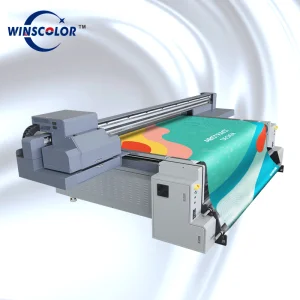
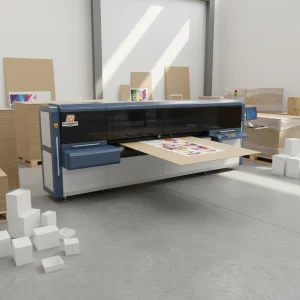
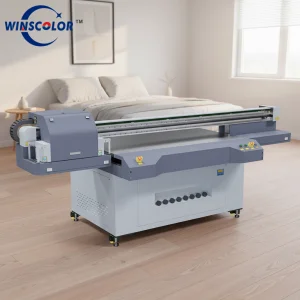
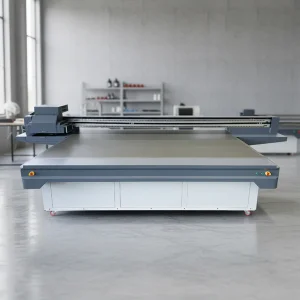

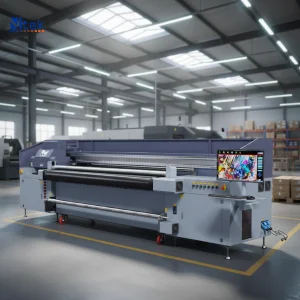
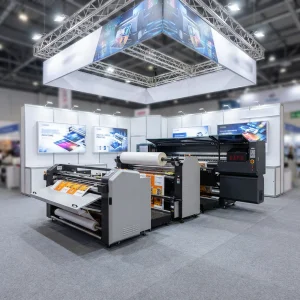
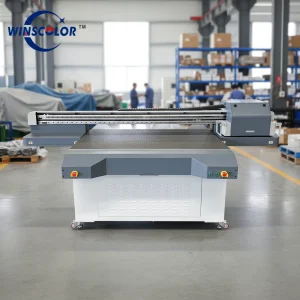
An authoritative analysis of piezoelectric droplet dynamics, photonic polymerization wavelengths, and the industrial transition from legacy analog screening to agile digital platforms.
The global industrial printing sector is undergoing an unprecedented restructuring. Traditional screen printing and analog offset workflows—long constrained by exorbitant pre-press setup costs, chemical plate generation, and lengthy turnaround cycles—are systematically yielding market share to industrial piezoelectric UV flatbed machines. This technical transition is fundamentally powered by major breakthroughs in three core scientific domains: variable droplet micro-piezoelectric actuation, ultraviolet narrow-spectrum LED photopolymerization, and multi-axis closed-loop linear motion synchronization.
Unlike aqueous, eco-solvent, or thermal sublimation systems which require evaporative heat tunnels and permeable media coatings, UV-curable flatbed printing relies on immediate photochemical transformation. Upon exposure to targeted UV irradiation (typically focused between 365 nm and 395 nm), liquid photoinitiators embedded within monomers and oligomers undergo free-radical generation. This reaction triggers hyper-fast molecular cross-linking, solidifying liquid ink droplets into an ultra-durable, cross-linked thermoset polymer network in under 20 milliseconds. The resultant print film exhibits exceptional chemical resistance, outdoor UV stability, mechanical abrasion tolerance, and superior interfacial adhesion across virtually non-absorbent engineering materials including float glass, cast acrylic, anodized aluminum, and rigid ceramics.
Modern industrial printheads (such as the Ricoh Gen6/Gen5 and Kyocera KJ4A series) utilize high-frequency PZT (lead zirconate titanate) piezoelectric ceramic actuators. By modulating bipolar voltage waveforms, the ink micro-chamber contracts and expands with sub-micron precision. This enables native multi-drop grayscale firing ranging from 2.5 pL to 15 pL, achieving hyper-smooth photographic gradients without compromising solid ink density or throughput velocity.
Traditional medium-pressure mercury arc lamps emit extreme radiant heat (>80°C) and substantial ozone, creating significant risks of thermal deformation on heat-sensitive thin films, polystyrene, and cellular PVC. Advanced cold-cure LED-UV arrays deliver narrow-band photonic irradiance (395 nm ± 5 nm) with negligible infrared emission. Water-cooled recirculating chillers maintain diode junction temperatures below critical degradation thresholds.
Titanium dioxide (TiO₂) particles used in industrial white inks have significant specific gravity (~4.2 g/cm³), making them inherently prone to gravity-induced sedimentation and nozzle starvation. Advanced flatbed platforms integrate dual closed-loop continuous ink recirculation directly through the printhead manifold and sub-tank. This eliminates micro-clogging and guarantees steady print densities across 24/7 continuous cycles.
| Architecture Class | Printhead Technology | Native Drop Volume | Max Firing Freq | Gantry Drive System | Substrate Capability | Primary Industrial Sector |
|---|---|---|---|---|---|---|
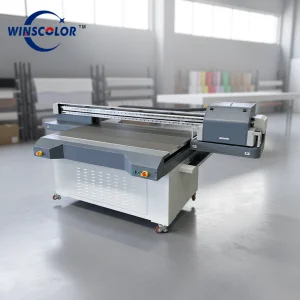
| Industrial High-Speed Flatbed | Ricoh Gen6 (MH5320) Piezo | 5 pL – 15 pL (Multi-drop) | 50 kHz | Dual THK Linear Guides + Magnetic Maglev | Rigid Slabs up to 100mm, 50kg/m² | Architectural Decor, Metal Panels, Glass |
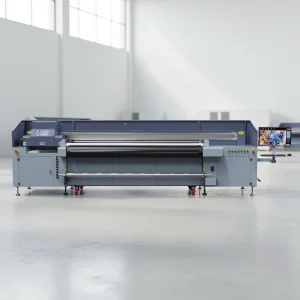
| Heavy-Duty Hybrid (Roll & Board) | Ricoh Gen5 / Gen6 Array | 7 pL – 21 pL | 30 – 45 kHz | Conveyor Vacuum Belt + Dual Servos | Rigid Boards & Continuous Heavy Banners | Exhibition Signage, Large Wallcoverings |
| Precision Small-Format (1610 / 6090) | Epson i3200-U1 / XP600 | 3.5 pL – 12 pL | 21.6 kHz | Leadshine Integrated Closed-Loop Servo | Objects up to 150mm + Rotary Devices | Personalization, Electronics, Promo Cylinders |
| Single-Pass Carton Converter | High-Density Industrial Array | 3 pL – 9 pL | 60 kHz | Ultra-High-Precision Feeder Belt | Corrugated Board, Kraft Liners, Honeycomb | Plate-Free Fast-Run Custom Packaging |
A comprehensive technical checklist for multinational distributors, large format print houses, and factory procurement directors evaluating Chinese UV flatbed OEM manufacturers.
Procuring industrial capital equipment from an overseas source factory requires balancing initial purchase pricing (CAPEX) with daily operational reliability and maintenance expenses (OPEX). A machine offered at an artificially depressed FOB rate often incorporates compromised drive components, substandard sub-tank electronics, and lower-tier linear rails that inevitably trigger costly production halts, substrate waste, and recurring head crash damages. Industrial procurement specialists evaluate prospective equipment against rigorous mechanical, electronic, and fluidic benchmarks:
The carriage of an industrial UV flatbed machine carrying four to eight metal printheads, dual LED lamp cooling blocks, and sub-tanks can weigh upwards of 35–60 kg. Accelerating this mass to 1.2–1.5 m/s and executing bi-directional deceleration requires immense mechanical damping:
Drop-on-demand ink delivery requires precise micro-baric fluid control across varying room temperatures and duty frequencies:
Total Cost of Ownership (TCO) over a 36-month industrial window is expressed as:
TCO = CAPEX (Machine + Shipping + Import Tariffs) + OPEX [Fluidics (CMYK+W+V) + Consumables (Filters, Wipers, UV Lamps) + Energy Consumption (kWh) + Maintenance Labor] − Salvage Residual Value.
Factory-direct procurement from high-standard Chinese manufacturers delivers a typical ink cost reduction of 45–60% ($18–$28/kg versus $65–$120/liter for European OEM-rebranded inks), enabling high-volume converters to fully amortize their capital machinery investment within 5.5 to 8 months of full two-shift operation.
Why Jinan, Shandong has evolved into the premier global engineering epicenter for heavy-duty industrial UV printing equipment and high-speed CNC gantry fabrication.
Over the past decade, the global manufacturing landscape has recognized that the highest tier of Chinese industrial printing machinery does not simply compete on price—it leads in continuous mechanical engineering improvements, agile vertical supply-chain responsiveness, and rapid integration of modern motion components. Centered within northern China's industrial manufacturing hub of Jinan, Shandong, an entire high-precision ecosystem of heavy machine fabrication, specialized precision casting, high-stress heat treatment facilities, and advanced electro-mechanical software integration has emerged.
This localized supply density creates decisive competitive advantages for overseas importers, wholesale distributors, and industrial enterprise buyers:
Rather than purchasing pre-fabricated aluminum extrusions from third-party suppliers, top-tier Jinan factories maintain specialized laser cutting, automated robotic welding cells, and dedicated annealing furnaces. Every gantry undergoes strict ultrasonic flaw detection and 5-axis CNC portal milling under temperature-regulated workshop conditions.
Leading Chinese UV printer exporters strictly integrate top international standard components: Japanese Ricoh printheads, German Igus energy drag chains, Italian Megadyne Kevlar timing belts, Japanese Panasonic/Delta servo systems, and Omron optical sensors. This hybrid architecture pairs global component reliability with cost-effective Chinese chassis manufacturing.
Every exported UV printer is subjected to an unbroken 72-hour mechanical burn-in cycle, including continuous high-acceleration dry sweeps, full vacuum pressure decay verification, environmental chamber curing tests, and dual-layer electronic alignment calibration using Renishaw laser interferometers before crating.
Analyzing key commercial drivers, regulatory frameworks, and market adaptations across primary international trading territories.
The US and Canadian markets are witnessing rapid growth in custom short-run corrugated packaging and ADA-compliant architectural signage. Printers configured with specialized tactile varnish channels can produce Grade 2 Braille dots and dimensional textured lettering that meet strict ICC/ANSI A117.1 specifications in a single pass without manual raster insertion.
In Germany, France, and Scandinavia, stringent environmental legislation (RoHS, REACH, and low-VOC emissions) drives rapid conversion away from solvent-based graphics. Demand favors flatbeds utilizing Greenguard Gold-certified UV curable inks for custom printed acoustic panels, kitchen splashbacks, and commercial wall décor.
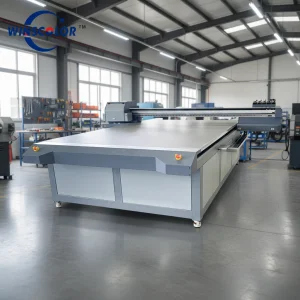
Rapid architectural infrastructure projects in the UAE, Saudi Arabia, and Brazil drive substantial investments in wide-format (2000 × 3000 mm and 3300 × 2100 mm) flatbed units equipped with silane-based chemical adhesion primers. Direct printing on heavy tempered architectural glass and ceramic wall facades provides high weather resistance in demanding desert and tropical climates.
Mastering surface tension (dynes/cm), interfacial chemical adhesion, and ink flexibility profiles across standard industrial materials.
Multi-layer White + Color + White sandwich configurations print transparent lightboxes with high day/night balance. Integrated anti-static ionizing bars neutralize static charges, eliminating ink droplet misting.
Direct printing using wiped silane coupling agents or digitally jetted primer channels creates chemical covalent bonding, easily passing cross-hatch adhesion tests (ASTM D3359 Class 5B).
High-viscosity multi-layer gloss varnish printing builds deep tactile 3D relief textures and structural mock-carvings for high-end interior and exterior wall panels.
Plate-free non-contact inkjet printing eliminates flute crushing on E, B, and double-wall kraft fluting, providing cost-effective digital production for customized short-run carton runs.
Direct jetting on aluminum composite material (ACM) provides exceptional weatherability and salt-spray resistance for exterior facade signage without additional lamination.
Adaptive height sensors handle surface variances up to 100mm. Selective white under-printing highlights natural wood grains for premium artistic, architectural, and furniture components.
High-elongation (>220%) flexible UV ink formulations allow repeated bending, stretching, and thermal embossing without surface cracking or white ink separation.
Precision stepper-driven rotary expansion modules print continuous 360-degree seamless graphics on drinkware, thermos flasks, acrylic cylinders, and glass bottles.
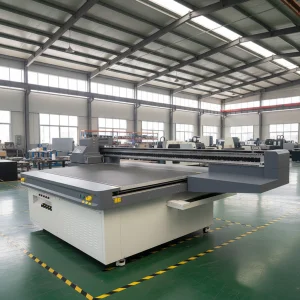
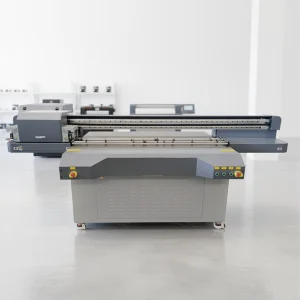
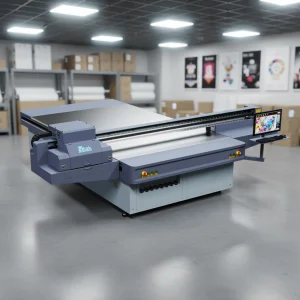
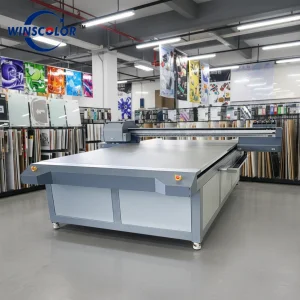
Engineered to handle complex commercial workflows: from super-wide hybrid platforms to high-precision customized printing stations.
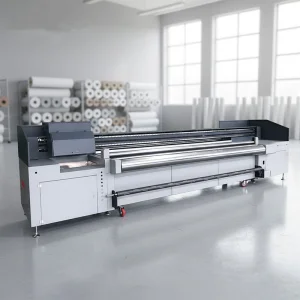
In-depth technical answers addressing printhead maintenance, fluidics, factory-direct OEM services, overseas logistics, and installation training.
