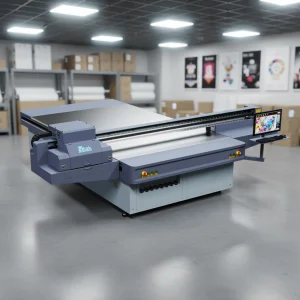
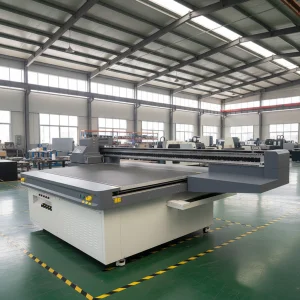
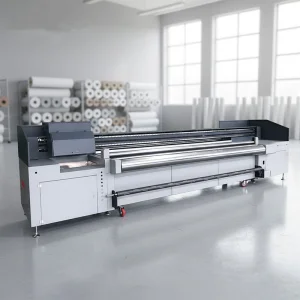
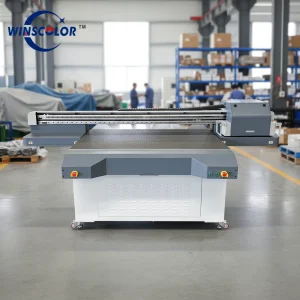
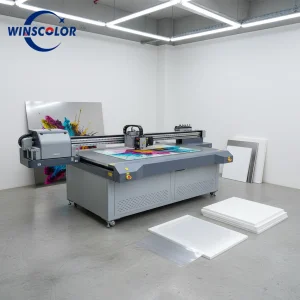
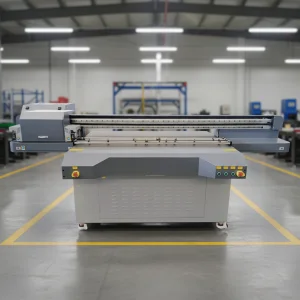
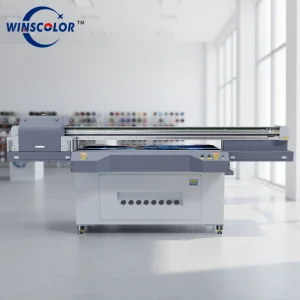
High-speed, multi-channel Ricoh Gen6 / Konica printhead configurations built for precision rigid substrate processing, round containers, and roll-to-roll continuous conversion.

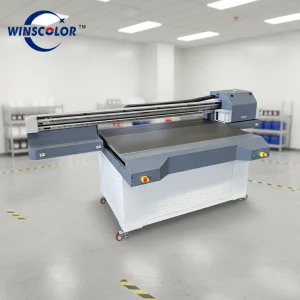

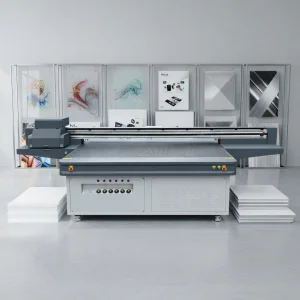
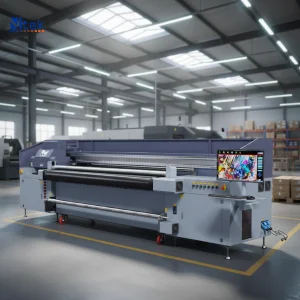

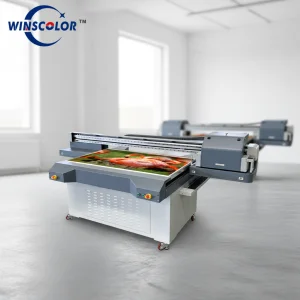

Procuring a 2000 × 3000 mm (2030) UV flatbed printer represents a critical operational pivot for industrial converters, contract printers, and sign manufacturing conglomerates seeking balance between footprint, capacity, and total cost of ownership (TCO).
Global standard building and advertising panels are manufactured in 4×8 ft (1220×2440 mm), 5×10 ft (1524×3048 mm), and 2000×3000 mm sheets. Smaller flatbeds (such as 2513 or 1610) require panel cutting prior to printing, creating labour bottlenecks.
Enterprise procurement teams look past machine sticker prices to evaluate consumable yield, printhead lifespan, energy consumption, and maintenance overheads across a 5-year operating envelope.
The 2030 platform utilizes a tempered, milled heavy-duty steel bridge gantry with dual THK silent linear rails and magnetic linear encoder feedback to prevent step displacement during heavy passes.
From UV gloss finishes on architectural glass to high-volume corrugated cardboard conversions, discover how the 2030 UV platform delivers precise adhesion, UV resistance, and variable data printing.
Glass processing requires industrial pre-treatment and thermal shock resistance. Our direct printing solutions allow bespoke interior partitions, splashbacks, and external glass balustrades with high resistance to UV weathering and humidity.
Used widely for commercial fascias, petrol station canopies, and transport signage. The 2030 print bed allows whole-sheet processing without cutting, delivering seamless brand continuity.
Eliminate costly flexo plate setups and prepress lead times. Short-run folding boxes, heavy-duty honeycomb boards, and point-of-sale display towers can be printed on demand.
Custom furniture fabricators and commercial millwork shops leverage the 2030 format for natural timber doors, MDF veneer tabletops, and high-gloss resin panels.
For high-spec industrial manufacturing, the 2030 flatbed delivers registered micro-printing on polycarbonate, polyester (PET), and acrylic control instrument panels.
Every Winscolor / NTEK 2030 UV Flatbed is assembled in our Jinan manufacturing plant on a high-rigidity annealed monocoque chassis to eliminate vibration-induced banding.
| System Architecture | Winscolor 2030 Platform Specification | Operational Value & Engineering Gain |
|---|---|---|
| Frame Chassis | Heavy-Duty Annealed Steel Monocoque, CNC Planer Milled | Zero bed warping across 10-year lifespan; supports up to 100 kg/m² load. |
| Printhead Core | Industrial Ricoh Gen6 (MH5320) Piezo Drop-on-Demand | 50 kHz firing frequency; 5 pL variable drop for photographic skin tones and micro-text. |
| Gantry & Motion | Dual THK Japan Silent Linear Guides + Renishaw Metal Scale | Sub-micron level bi-directional scanning stability; zero stepping banding. |
| Curing System | Dual Water-Cooled LED-UV Curing Lamps (Adjustable 2-16 W/cm²) | Instant curing without thermal deformation on heat-sensitive PVC, foam, and PET. |
| Vacuum Platen | 6-8 Independent Reversible Vacuum Zones with Air Flotation | Effortless loading and repositioning of bulky sheets; strong hold-down for warped stock. |
| Ink Circulation | Closed-Loop White Ink Stirring & Negative Pressure Balancing | Completely eliminates pigment sedimentation and nozzle clogging during idle intervals. |
Integrated high-resolution overhead camera arrays automatically detect substrate boundaries, rotation angles, and pre-cut contour lines. Reduces manual jig registration time to under 10 seconds.
Real-time piezo waveform auto-tuning monitors ink viscosity fluctuations caused by ambient room variations, ensuring stable dot placement density from morning shifts to night cycles.
Development of zero-VOC, bio-renewable reactive monomers that preserve adhesion on non-porous glass and plastics while lowering environmental carbon footprints for export compliance.
Operating from our 20,000 m² factory in Jinan, China, Winscolor delivers turnkey industrial digital inkjet systems to over 100 countries across Europe, North America, Latin America, and Southeast Asia.
Commercial print houses in the US and Canada are replacing ageing solvent roll setups and undersized flatbeds with 2030 UV units to manage the surge in short-run personalized retail packaging and ADA-compliant architectural signage.
Strict energy efficiency guidelines and corporate carbon footprint reporting (CSRD) have made LED curing UV printers the primary capital expenditure for European graphics producers.
In Southeast Asia, the Middle East, and Latin America, expanding urban infrastructure drives surging demand for architectural ceramics, decorated elevator interiors, and road safety signage.
We view the initial machine shipment as step one in a long-term enterprise partnership. Our global service network ensures your operators master colour management, routine head maintenance, and production uptime.
Live one-on-one video commissioning with factory design engineers. We assist your team in unpacking, levelling the optical rail, setting RIP linearization profiles, and performing test print validation.
Critical failure components—including mainboards, negative pressure gauges, UV lamp power supplies, and ink pumps—are stocked in overseas satellite depots for immediate courier dispatch.
Every unit undergoes a comprehensive 48-hour continuous burn-in and print testing cycle prior to crating. Exported machinery comes standard with localized voltage transformers and EMC filtering.
Clear, engineering-backed answers compiled from real procurement inquiries, industrial distributors, and shop technicians.
The 2030 UV flatbed handles virtually any rigid or semi-rigid substrate up to 100 mm (optionally 400 mm) in thickness, including acrylic, PVC foamboard, polycarbonate, wood, aluminum composite panels (Dibond), corrugated cardboard, stone, ceramic tile, and glass. For non-porous and ultra-smooth surfaces like glass, stainless steel, and glazed ceramics, applying a chemical wipe primer or utilizing our in-line automated primer jetting is recommended to achieve maximum scratch and water adhesion ratings (Grade 0 on cross-hatch test).
While the 2.5 × 1.3 m (2513) bed fits standard 4×8 ft panels, it cannot accommodate 2×3 m oversize architectural glass, acoustic ceiling tiles, or twin 1.5×2 m signage panels simultaneously. The 2030 table (2000 × 3000 mm) offers an expansive working platen that allows operators to print full-bleed oversize panels or run two standard boards side-by-side. The multi-zone vacuum configuration allows one zone to be loaded while the other is printing, providing higher throughput in continuous industrial shifts.
The industrial Ricoh Gen6 printhead is engineered for 24/7 demanding factory environments with an all-steel nozzle plate and isolated ink paths that are resistant to solvent and aggressive UV chemical bases. Compared to Epson i3200 printheads, which are lighter and more cost-effective for medium duty, Ricoh Gen6 operates at up to 50 kHz jetting frequency with 5 pL variable drop sizes, offering faster linear carriage speed, superior ink drop precision, and an average operating lifespan of 3–5 years under proper maintenance.
Yes. With our multi-channel ink configuration—supporting CMYK, Light Cyan, Light Magenta, dual White channels, and dual Gloss Varnish channels—the machine can deposit successive layers of high-density UV white and clear varnish in a single pass. This produces tactile textures, wood grain simulation, oil painting brushwork replication, and raised Braille dots compliant with strict ADA (Americans with Disabilities Act) dimensional elevation standards.
Daily maintenance involves a 5-minute automated carriage wipe, checking the waste ink bottle, and cleaning the optical encoder strip. Weekly maintenance includes inspecting the negative pressure fluid balance and cleaning the LED lamp water chiller radiator filters. Monthly checks include lubricating the THK linear rails and inspecting ink filters. The machine is equipped with automated flash-curing during idle mode and an active white ink recirculation circuit that prevents nozzle clogging during downtime.
Direct factory manufacturing: high-resolution 2030 flatbeds, all-in-one digital packaging units, and industrial roll-to-roll machinery exported worldwide.