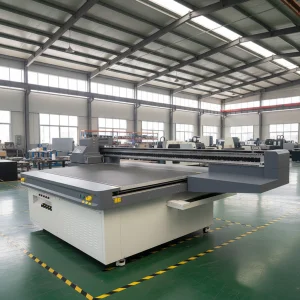
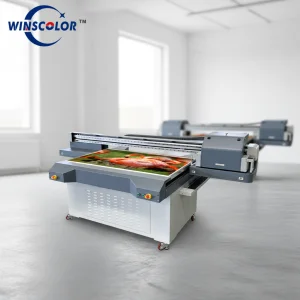
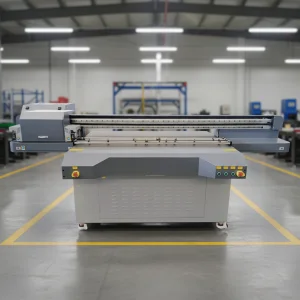
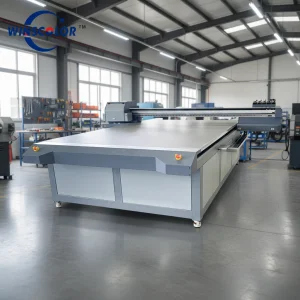
Explore our top-tier industrial UV flatbed machines equipped with variable grayscale micro-piezo printheads, dual-rail magnetic gantries, and intelligent UV-LED curing engines.

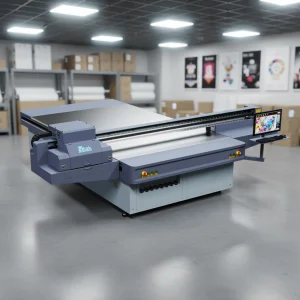
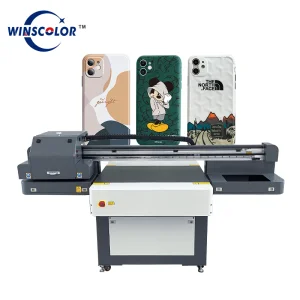
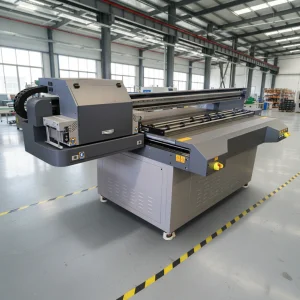
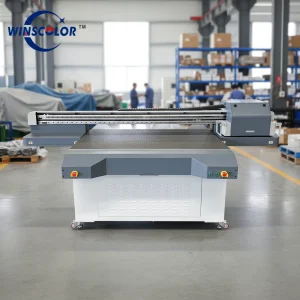
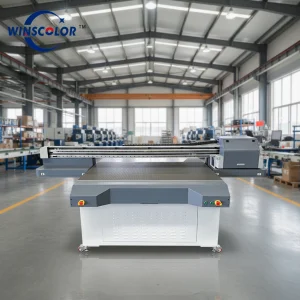
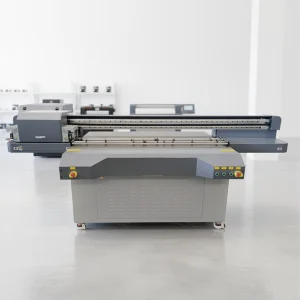
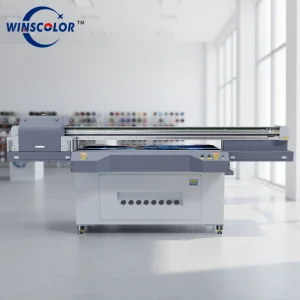
Modern industrial manufacturing requires digital inkjet systems to transition beyond basic graphic visual communication into micron-accurate surface coating, tactile microstructure deposition, and multi-layer chemical adhesion.
The adoption of Ricoh Gen6 and Gen5i industrial printheads delivers true native resolutions exceeding 1200 × 1200 dpi up to 2880 dpi. By utilizing multi-drop waveform modulation from 3.5 to 14 picoliters, operators achieve photorealistic skin tones, fine 2pt micro-text, and smooth vignettes without graininess.
Mechanical positioning errors directly impact registration between White, CMYK, and Gloss Varnish layers. Our high-resolution gantries integrate dual THK silent linear guides combined with Renishaw optical metal encoders, ensuring bidirectional carriage repeatability within ±0.01 mm across 3.2-meter expanses.
Traditional mercury vapor lamps generate excessive infrared heat, warping heat-sensitive substrates like thin PVC, fluted polypropylene, and PMMA sheets. Our water-cooled UV-LED curing modules emit calibrated 395nm UV waves with instantaneous step-less energy regulation, conserving up to 75% electricity.
International buyers evaluating OEM UV flatbed printing machines must look beyond the initial capital expenditure (CAPEX). True return on investment is governed by total operational cost (OPEX), maintenance uptime, ink fluid efficiency, and spare-parts standardization.
A transparent OEM partner balances printhead replacement cycles, LED lamp efficiency, and ink consumption rates. High-density pigments coupled with intelligent RIP halftoning reduce square-meter ink usage by up to 28% compared to generic aftermarket setups.
Industrial production lines running double or triple shifts demand MTBF ratings exceeding 4,500 hours. This is achieved through Japanese negative pressure systems, German IGUS drag chains, and hardened Panasonic AC servo motor drives.
White titanium dioxide pigments precipitate rapidly if stagnant. Our integrated sub-tank dual circulation system circulates white ink continuously through the main manifold, lines, and nozzles, completely eliminating sediment clogging during weekend standbys.
Procuring machines directly from the Jinan manufacturing headquarters allows global distributors to request custom frame sizing, automated pin registration, dual-zone or multi-zone vacuum zones, integrated rotary chucks, and custom-branded software interfaces.
| Evaluation Parameter | Commercial Grade UV Flatbed | Winscolor Industrial OEM Platform | Competitive Manufacturing Advantage |
|---|---|---|---|
| Printhead Technology | Consumer Epson DX5 / XP600 | Industrial Ricoh Gen6 / Gen5i / Konica | 3× to 5× extended operational lifespan under industrial 24/7 load |
| Ink Droplet Control | Fixed drop size (7-12 pL) | Variable grayscale drop matrix (3.5 - 14 pL) | Sharper vector edges, smooth transitions, lower ink usage per m² |
| Carriage Propulsion | Belt-driven stepper / standard motor | Panasonic AC Servo + Dual THK Linear Rails | Eliminates micro-jitter, stepping artifacts, and carriage deflection |
| Curing System | Mercury UV lamp / Low-output LED | Dynamic water-cooled UV-LED (up to 16 W/cm²) | Immediate substrate dry time without heat warp; zero ozone output |
| Vacuum Table Build | Thin sheet aluminum, single chamber | Hard-anodized honeycomb alloy, 4-8 zones | Zero warping under heavy glass or stone slabs; selective zone suction |
From architectural glass to aerospace control fascias, our UV flatbed systems are configured with tailored chemical primers, specific ink flexibilities, and specialized printing passes.
High-adhesion silane primers sprayed inline or pre-wiped allow ceramic tiles and splashbacks to withstand 4B cross-cut tape adhesion standards, high humidity, and direct sunlight without delamination. Layered gloss varnish replicates wet stone or glossy glaze effects.
Printing directly on polycarbonate (PC), polyester (PET), and anodized aluminum faceplates. The extreme micro-droplet placement allows registration across fine conductive traces, embossed tactile buttons, and scratch-resistant matte window finishes.
By programming multi-pass localized UV cure cycles with specialized high-viscosity clear ink, our machines build precise, rounded Braille dots and raised architectural lettering compliant with US ADA Title III and European accessibility safety regulations.
Configured with high-elasticity UV inks capable of 200% to 350% mechanical stretching during post-print vacuum thermoforming. The cured ink layer maintains color saturation and will not crack, peel, or craze over tight compound contours.
Direct-to-board production on honeycomb card, micro-flute corrugated, and wooden luxury packaging. Eliminates flexographic plate costs and enables rapid prototyping, custom SKU versioning, and variable-data QR code numbering with zero setup downtime.
Using synchronized pneumatic rotary clamp fixtures, printers seamlessly apply full 360-degree wrap graphics to stainless steel thermal tumblers, cosmetic glass bottles, and industrial aluminum tubes without overlap seams or optical distortion.
Operating out of our 20,000 square meter Jinan industrial base with over 16 years of engineering experience, Winscolor provides robust compliance, logistical assurance, and localized support worldwide.
Every machine complies strictly with the European Machinery Directive (CE-MD 2006/42/EC), Low Voltage Directive (LVD), and Electromagnetic Compatibility (EMC). Electrical cabinets feature UL94-V0 fire-retardant wiring harnesses, and ink formulations are certified non-toxic under RoHS, REACH, and California Proposition 65.
Our multilingual technical response division provides 24/7 remote cloud diagnostics via embedded IoT control boards. Onsite installation, operator training, and calibration service engineers are dispatched to over 100 export destinations across Europe, North America, Southeast Asia, and the Middle East.
We maintain regional spare parts warehouses stocking genuine printheads, ink pumps, solenoid valves, optical filters, and driver boards. Critical components ship within 24 hours via DHL/FedEx Express, minimizing unplanned shop floor downtime to negligible levels.
As digital transformation merges with smart factory initiatives (Industry 4.0), our Jinan R&D center is pioneering cutting-edge hardware-software synergies for next-decade digital printing.
High-speed CCD cameras detect substrate edge skew, surface camber, and micro-defects in real-time, instantly adjusting coordinate algorithms to print on randomly placed items without physical jigs.
Piezo sensor feedback monitors droplet back-pressure. When a clogged nozzle is detected mid-print, adjacent micro-nozzles automatically adjust pulse amplitude to cover the dot without banding lines.
Advancing non-fossil monomer UV inks that cure at ultra-low irradiance (under 4 W/cm²), eliminating volatile organic compounds completely and fulfilling strict cradle-to-cradle packaging circularity standards.
Hybrid conveyance beds combining high-speed single-pass bar modules for bulk background deposition with multi-pass scanning carriages for ultra-fine micro-text and 3D textured tactile finishes.
In-depth answers curated directly by our chief application engineers to assist procurement managers and production supervisors during technical vetting.
Consumer heads (such as DX5 or XP600) utilize plastic internal manifolds and glued nozzle plates designed for water-based or eco-solvent inks. When exposed to reactive UV monomers, their seals deteriorate within months. In contrast, Ricoh Gen6 industrial printheads feature an all-metal stainless steel structure, isolated ink chambers, integrated temperature sensors, and silicon heater blocks that maintain ink viscosity at 45°C. They fire droplet volumes down to 5 pL at up to 50 kHz, providing an operational lifespan often exceeding 3 to 5 years under heavy production schedules.
Non-porous substrates have high surface tension and smooth finishes that prevent mechanical ink anchoring. We resolve this through chemical functionalization. For architectural glass and metals, our printers use dedicated silane-based or titanate bonding primers that can be wiped manually or applied automatically via a dedicated printhead channel. When cured under UV-LED light, the cross-linking monomers form covalent chemical bonds with the substrate surface, achieving a 5B rating in ISO 2409 cross-hatch adhesion tests.
Yes. Our printers incorporate independent White and Gloss Varnish channels controlled by specialized RIP software (such as Onyx, Caldera, or Photoprint). By laying down multiple micro-layers of high-opacity white ink or clear varnish before or after the CMYK color pass, the machine builds physical relief up to 2.5 mm in height. This capability allows the reproduction of wood grain, leather grain, oil painting brushstrokes, and ADA-compliant Braille dots with spherical crowns.
With variable droplet technology, normal full-coverage CMYK graphic printing consumes approximately 8 to 11 ml of ink per square meter at 720 × 1200 dpi. When printing multi-layer applications (such as Color + White + Color sandwich modes for transparent acrylic), ink consumption increases to 18-24 ml/m². Given the factory-direct supply price of industrial UV inks, the direct ink cost typically ranges between $0.40 and $1.20 per square meter, delivering significant profit margins compared to traditional screen printing or vinyl wrapping.
Large format machines (e.g., 2500 × 1300 mm or 2000 × 3000 mm beds) require a dedicated single-phase 220V ±10% AC (50/60Hz, 30A) or 3-phase power supply depending on total vacuum pump ratings. Ambient production room temperatures should be maintained between 20°C and 28°C with relative humidity of 40% to 65% to prevent ink viscosity fluctuations and static electricity buildup. The concrete floor must be level within ±2 mm across the machine footprint to maintain optical gantry calibration.
Explore our extended factory catalogue of wide-format flatbed, hybrid roll-to-roll, and multi-function packaging systems manufactured for high throughput and long-term reliability.