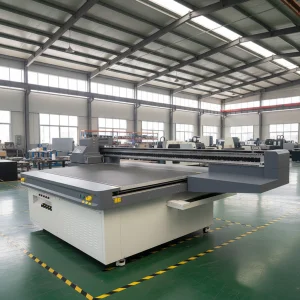
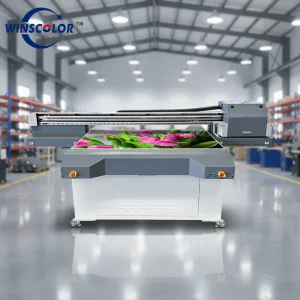
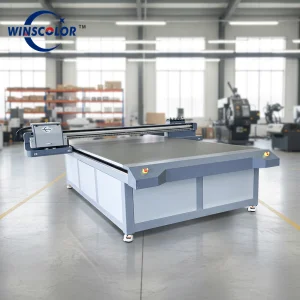
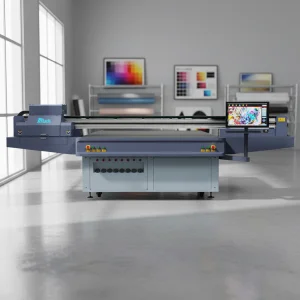
Direct factory supply of high-definition, multi-substrate industrial UV digital flatbed printers equipped with Ricoh Gen6 and industrial piezo printheads.
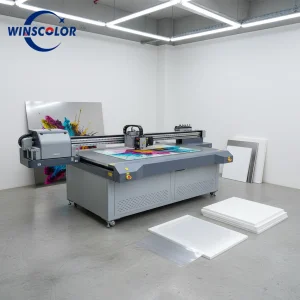
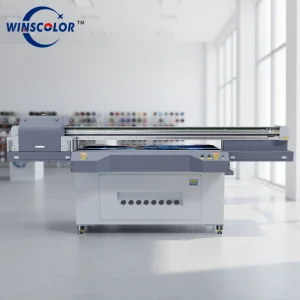
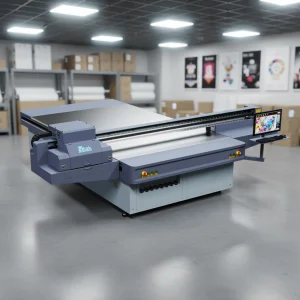
A comprehensive examination of transitioning analog printing lines toward agile, sustainable, and variable-data digital UV curing architectures.
The global manufacturing, visual merchandising, and architectural decoration sectors are undergoing an unprecedented digital transition. Traditional screen printing and eco-solvent roll workflows, which dominated the early 2000s, are increasingly marginalized by escalating compliance mandates, surging labor expenditures, and changing customer expectations for just-in-time delivery. Modern enterprise buyers require on-demand custom runs without the financial burdens of photopolymer screen fabrication, color separation setup times, chemical washouts, and extensive floor space dedicated to drying racks.
UV curable flatbed printing represents the definitive response to these operational bottlenecks. By deploying photocurable polymers combined with ultraviolet photoinitiators, ink droplets transition instantly from liquid state to cross-linked solid film upon exposure to specific UV wavelengths (typically 385nm to 395nm). This instantaneous polymerization eliminates VOC degassing, eradicates substrate warping induced by thermal drying, and permits immediate secondary processing—such as digital routing, laser beveling, diamond polishing, or thermoforming—straight off the print vacuum bed.
Furthermore, the economic threshold between analog mass production and digital micro-runs has crossed a historic tipping point. While rotary screen presses historically provided lower unit costs for batches exceeding 5,000 identical items, the emergence of multi-row staggered industrial piezoelectric printheads (such as Ricoh Gen5/Gen6 and Kyocera KJ4A) has empowered digital UV flatbed systems to deliver sustained throughput speeds of 60 to 120 square meters per hour. Paired with variable droplet technology (Grayscale ranging from 3.5pl to 21pl), companies achieve photorealistic photographic rendering, crisp 4pt micro-typography, and seamless color gradations on non-absorbent surfaces without any pre-press tooling costs.
How Jinan’s industrial machinery cluster enables world-class OEM UV flatbed printer engineering at unbeatable capital expenditure yields.
Unlike light sheet-metal desktop assemblers, Tier-1 Chinese OEM manufacturers utilize 12mm–16mm tubular carbon steel chassis frames. Frames undergo high-temperature thermal stress relief annealing (600°C) followed by secondary natural vibration aging to eliminate internal structural torque, preventing any microscopic chassis deformation over 10+ years of continuous 24/7 industrial service.
Machine guideway beds are milled in a single setup using imported German and Taiwanese 5-sided gantry CNC centers. This achieves rail parallelism within ±0.015mm over a 3.2-meter span. Matched with double THK or Hiwin silent guide rails and dual Japanese Panasonic AC servo loops, the printhead carriage glides with zero micro-flutter, eliminating stepping banding completely.
Situated in Jinan—China’s epicenter for CNC cutting tables, fiber lasers, and heavy industrial automation—our facilities command immediate access to precision cast aluminum vacuum chambers, magnetic linear motor drivers, and specialized UV electronic components, condensing prototyping cycles from months to under 14 working days.
| Evaluation Parameter | European / US Tier-1 Brands | Winscolor OEM / Chinese Tier-1 Factory | Strategic Advantage for Global B2B Importers |
|---|---|---|---|
| Initial Capital Investment (CAPEX) | $140,000 – $280,000+ | $22,000 – $58,000 | 70%–80% Capital Savings: Faster ROI amortization (under 9 months). |
| Printhead Architecture | Proprietary locked printhead chips | Authentic Ricoh Gen5/Gen6, Konica 1024i, Epson i3200 | Open Supply Chain: Spare heads sourced at factory cost without regional DRM locks. |
| Ink Chemistry Ecosystem | Proprietary RFID chipped cartridges ($120/L) | Universal bulk sub-tank, open chemistry ($22–$38/L) | 65% OPEX Reduction: Drastically decreases unit cost per square meter. |
| OEM / ODM Bespoke Tailoring | Rigid, standard SKU catalogs | Custom table sizing, dual gantry, rotary, automation | Customizable: Custom livery, firmware, pneumatic pin locators, & robotic loading. |
From architectural cladding to micrometric membrane switches, explore how industrial LED-UV flatbeds transform raw substrates into finished commercial products.
By pre-treating float glass or toughened structural glass with nano-silane primers, our UV flatbed machines deposit ultra-dense high-opacity White (W) underbases followed by CMYK photo imagery and high-gloss protective Varnish (V). Applications include kitchen backsplashes, bespoke glass partitions, elevator interior walls, and backlit institutional murals resilient against humidity and UV solar yellowing.
The standard visual communications workhorse. Precision vacuum zoning holds down heavy 3mm to 6mm ACP panels, extruded acrylic, and expanded foam PVC without flutter. Enables five-layer sandwich printing (White + Color + Black + White + Color) for double-sided transparent day-and-night backlit advertising banners and airport navigational graphics.
Direct printing on natural solid hardwood, veneered plywood, and engineered MDF boards. The selectable white ink layer allows designers to preserve natural timber wood grain aesthetics while laying opaque branding or geometric patterns, ideal for custom cabinet doors, acoustic wall panels, tabletop art, and retail point-of-sale fixtures.
Printing directly onto polycarbonate (PC), PET films, anodized aluminum chassis, and molded ABS electronic enclosures. Our flexible UV ink sets maintain elongation up to 220% without micro-fissuring, enabling post-print vacuum forming, deep stamping, embossing, and punch-cutting for industrial control faceplates.
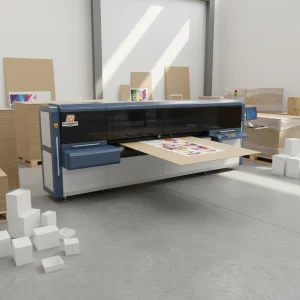
Plate-free digital short-run box packaging. Replaces costly flexographic plate preparation for seasonal promotions, e-commerce personalized cartons, and heavyweight point-of-purchase displays. Single-pass or high-speed scanning flatbeds print fluted craft paperboard without crush damage.
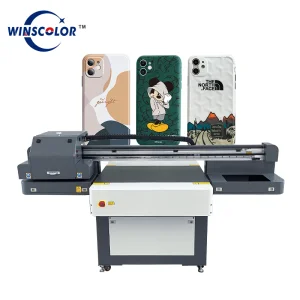
By repeatedly layering high-viscosity UV clear varnish and micro-droplet white underbase, the printer creates physical 3D relief up to 2.0mm in height. Ideal for ADA-compliant tactile Braille architectural signage, luxury smartphone protective cases, leather goods, and oil painting reproduction with authentic brushstroke textures.
Analyzing key advancements: magnetic levitation drives, intelligent vision registration, and hybrid conveyor ecosystems.
While traditional mechanical timing belts and lead screws provide reliable service, high-speed industrial printing is shifting toward Maglev linear drive technology. By eliminating mechanical friction between the drive pulley and belt, linear encoders achieve sub-micron positioning repeatability (±1µm) at speeds up to 2.0 m/s. This completely eliminates belt wear stretch, minimizes motor vibration harmonics, and guarantees pinpoint dot placement accuracy across a 3.2-meter gantry even after 50,000 hours of operation.
Manual board alignment using mechanical pins is being superseded by high-definition CCD vision registration cameras mounted on the carriage gantry. The optical system automatically scans arbitrarily positioned substrates on the table, computes rotational yaw and origin offsets in real-time, and dynamically recalibrates the RIP job orientation. Combined with pneumatic loading pushers and automated robotic arm loading/unloading interfaces, flatbeds function as uncrewed 24/7 printing cells within smart factories.
Conventional metal-halide mercury lamps generated massive infrared heat (up to 80°C on the substrate bed), making thin polystyrene, PVC film, or corrugated flutes buckle. Modern OEM UV platforms deploy solid-state LED-UV arrays cooled by closed-loop industrial chillers. These provide instant on/off switching without warm-up delays, operate below 35°C on the substrate face, and deliver over 30,000 hours of curing output with zero mercury disposal hazards.
Titanium dioxide (TiO₂) particles used in white UV inks possess high mass density, making them prone to settling, coagulating, and clogging micro-nozzles. Winscolor OEM machines integrate dual-chamber independent negative pressure regulators (separated for color and white/varnish channels) combined with continuous timed mechanical agitation, peristaltic bypass loops, and ink degassing membranes. This ensures effortless droplet firing without ink starvation even during long print runs.
A rigorous engineering framework for global purchasing directors, plant managers, and equipment distributors evaluating OEM UV machinery.
Assess native physical nozzle resolution (300dpi vs 600dpi per channel) and maximum drop firing frequency (kHz). Ricoh Gen6 delivers 50kHz firing speeds with 5-15pl droplets, ensuring over 3-4 years of industrial service life when maintained with filtered, degassed ink formulations.
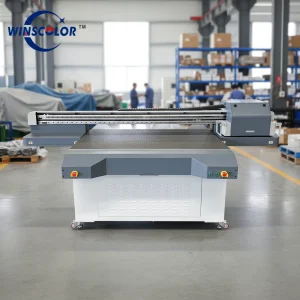
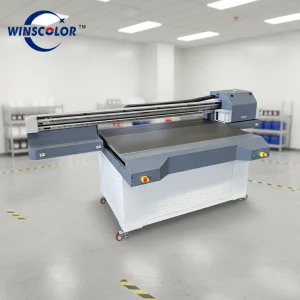
Inspect the vacuum table construction. Our aviation-grade honeycombed aluminum tables are hard-anodized with sub-0.03mm surface planarity across 2500x1300mm. Multi-chamber independent valve switching allows operators to concentrate suction on smaller panels without masking open zones.
Standard CMYK density requires approximately 8ml to 12ml of UV ink per square meter at 100% full coverage. Bulk system architectures sourcing industrial ink at $25/Liter achieve raw consumables costs of $0.20 to $0.35/m², maximizing gross profit margins on commercial jobs.
Ensure seamless postscript processing compatibility with professional RIP suites: Onyx Graphics, Caldera, SAI PhotoPrint, or ColorGATE. Factory pre-built ICC color profiles for acrylic, PVC, and backlit glass accelerate deployment, reducing commissioning waste to near zero.
We empower international equipment distributors and manufacturing enterprises to deliver customized digital print systems tailored to precise regional market specifications.
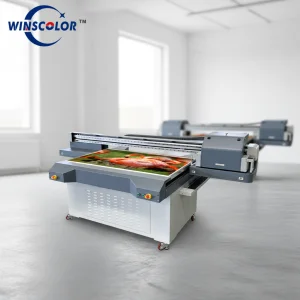
From compact prototyping tables (600x900mm) for specialty items to mid-range formats (1600x1000mm, 2500x1300mm) and oversize production beds (2000x3000mm, 3300x2100mm), our mechanical engineers modify gantry spans, table heights, and vertical Z-axis clearance (up to 400mm) for thick packaging cartons and custom industrial enclosures.
We deliver complete turnkey brand integration. This includes bespoke sheet-metal exterior styling, electrostatic powder-coat RAL color schemes matching your corporate identity, customized touch-screen HMI control interfaces, translated software localizations, and branded equipment manuals and export shipping crates.
Tailor your head carriage layout: configure entry-level 2-head setups (CMYK + W) or high-volume 8-head staggered arrays delivering CMYK + Light Cyan + Light Magenta + Double White + Dual High-Gloss Varnish. We engineer custom UV-LED shutter sequences for matte, semi-gloss, or ultra-gloss finishes in a single print sweep.
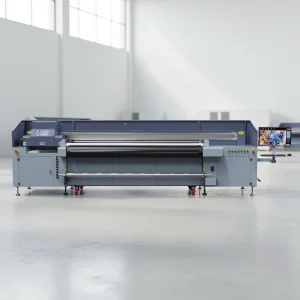
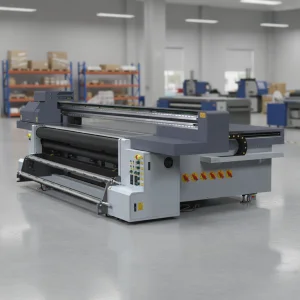
Explore our high-speed roll-to-roll, hybrid roller transport, and high-volume single-pass corrugated board machinery lines.

Authoritative technical insights compiled by senior application and field service engineers for international purchasers.
