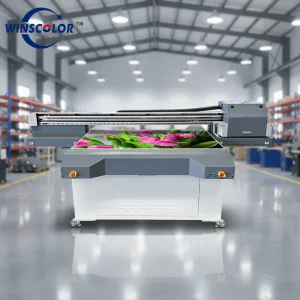
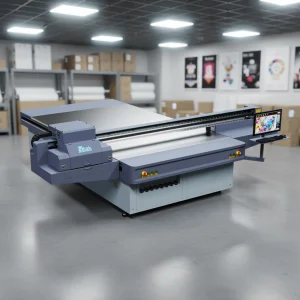
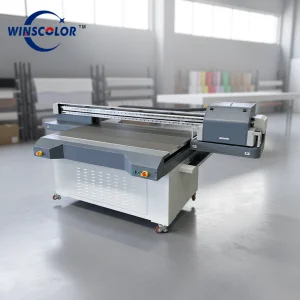
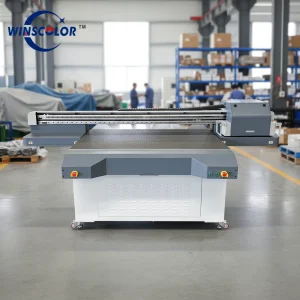
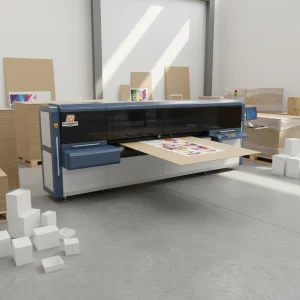
Direct factory supply of precision-machined industrial UV printers featuring piezoelectric drop-on-demand Ricoh Gen6 printhead architectures, zoned vacuum adsorption, and instant cold LED UV curing.
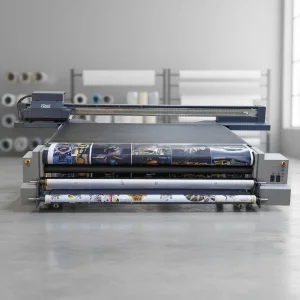
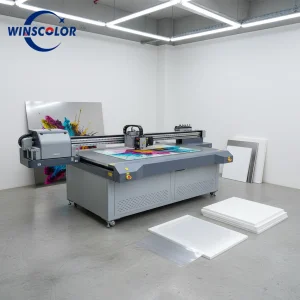
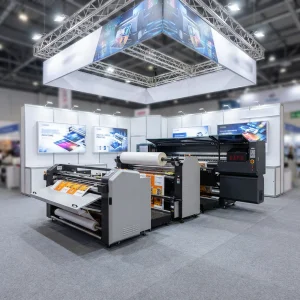
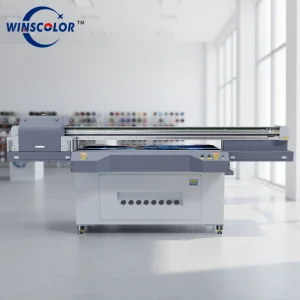
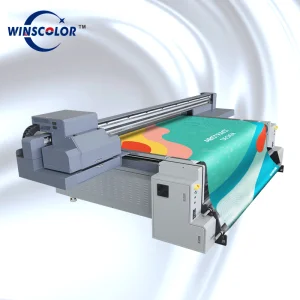
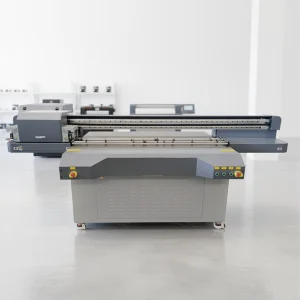
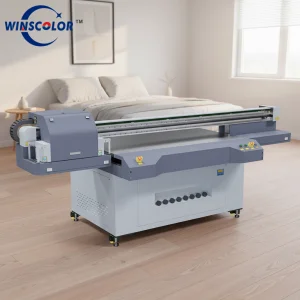
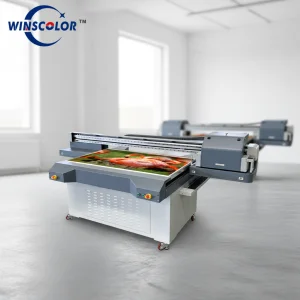
The global manufacturing footprint is experiencing a rapid migration from analog screen printing, pad printing, and solvent-based roll systems to automated, zero-VOC digital UV flatbed deposition technologies.
Traditional screen and pad printing workflows generate immense pre-press overhead: mesh preparation, photographic emulsion exposure, stencil washout, and multi-liter chemical solvent purging. Digital UV flatbed printing bypasses analog toolmaker dependencies entirely. High-volume runs and bespoke single-unit prototypes share identical per-unit print unit costs, eliminating minimum order quantity constraints and scrap waste.
Supply chain shocks across North America, the European Union, and Southeast Asia have accelerated the localization of finished product customization. Instead of importing pre-printed decorative panels or screen-printed industrial enclosures, manufacturers deploy compact and wide-format UV flatbeds on factory assembly lines, enabling synchronized mass personalization within domestic distribution hubs.
International environmental protocols, including EU REACH, RoHS 3, and California Proposition 65, mandate strict operational caps on Volatile Organic Compounds (VOCs) and hazardous air pollutants (HAPs). Our photocurable UV-LED formulations cure instantly under narrow-band ultraviolet light (395nm/365nm), polymerizing 100% of the liquid ink into solid resin without toxic evaporative solvent emissions.
Industrial UV flatbed platforms provide an estimated 31% to 54% operational savings over five fiscal years when benchmarking consumable loss, electrical draw, labor overhead, and changeover downtime against legacy solvent systems. Instantaneous LED curing eliminates the multi-kilowatt gas drying tunnels and massive make-ready waste inherent to gravure or flexographic setups.
A deep architectural dive into the high-rigidity structural frameworks, micro-piezo fluid dynamics, and closed-loop motion control that guarantee industrial 24/7 duty cycles.
Equipped with industrial stainless steel nozzle plates supporting multi-drop gray-scale jetting (5pl to 15pl variable volume). Operating at a high jetting frequency of up to 50kHz, the Gen6 piezo system maintains straight droplet trajectories over extended throw distances, preventing satellite misting on uneven substrates such as fluted boards, embossed tiles, or textured leather.
Our dual-circuit negative pressure manifold decouples white ink from colored channels. White ink utilizes an automated secondary recirculation circuit running continuously through the sub-tank and internal printhead chambers. This active agitation halts titanium dioxide (TiO₂) particle sedimentation, preventing micro-nozzle clogging and density drift during standby cycles.
The gantry beam is milled from high-tensile aviation aluminum alloy and subjected to secondary vibration stress relief annealing. Combined with dual THK silent linear guide rails and an optional magnetic levitation linear motor drive, the X-axis carriage moves with micron-level bi-directional repeat accuracy (±0.015mm), eliminating banding across multi-pass transitions.
| System Dimension | Legacy UV Flatbed Printers | Winscolor Next-Gen Industrial Flatbed | Production Benefit Impact |
|---|---|---|---|
| Motion System (X/Y) | Standard Stepper / Single Lead Screw | Dual Japanese Panasonic AC Servo + THK Dual Rails | Zero registration drift on pass overlaps at >120 m²/hr |
| Curing Architecture | Metal Halide / Mercury Vapor Lamps | Water-Cooled Narrow-Spectrum UV-LED (395nm) | No thermal substrate deformation on thin acrylic or PET film |
| Vacuum Platen Bed | Single-Chamber Manual Damper | Multi-Zone Independent High-Flow Inverter Vacuum | Holds warped wood and heavy metal sheets perfectly flat |
| Color Channel Matrix | CMYK Only | CMYK + Lc + Lm + White + Gloss Varnish (8 Channels) | Photographic transitions, opaque back-strike, tactile embossing |
| Printhead Reliability | Consumer Modified Heads (Plastic Manifold) | Native Industrial Ricoh Gen6 (All-Steel Cavity) | Substantial life extension; compatible with aggressive primers |
From fragile float glass partitions to heavy structural aluminum composite and rotational drinkware, our UV flatbed systems are calibrated to maximize surface adhesion and colorfastness.
By pairing optical-grade silane coupling agent primers with specialized rigid UV inks, our machines deposit scratch-proof murals, kitchen splashbacks, and storefront glass. The white ink density allows complete opacity for back-lit architectural installations that withstand 1,000+ hours of ASTM B117 salt-spray and humidity testing.
Heavy-gauge sheet metal, brushed aluminum, and anodized instrument enclosures receive high-definition schematics, CE certification badges, and variable serialized DataMatrix codes directly. Cured ink films exhibit 4H+ pencil hardness and resist grease, ethanol wipe tests, hydraulic lubricants, and UV sun fading.
Short-run corrugated e-commerce mailer boxes, litho-laminated cartons, and honeycomb paper displays require swift turnaround. Our non-contact inkjet delivery preserves flute integrity without crush damage, while spot gloss varnish adds tactile luxury to retail packaging runs without die tooling costs.
Equipped with our synchronous rotary jig accessories, flatbeds convert instantly into high-speed bottle and tumbler printers. Continuous 360-degree seamless overlap printing enables full-wrap designs, tapered compensation, and selective 3D braille-embossed tactile varnish on insulated stainless-steel mugs, glassware, and cosmetic bottles.
Purchasing capital equipment internationally requires ironclad adherence to legal electrical directives, hazardous substance compliance, safe export packaging, and field-level support.
Every Winscolor machine build integrates an electrical cabinet constructed in strict compliance with the European Machinery Directive (2006/42/EC) and Low Voltage Directive (2014/35/EU). High-grade Omron safety interlocks, independent emergency braking relays, shielded wiring harnesses, and cUL-compatible components ensure seamless workplace safety sign-offs across North America and Europe.
Our global technical team provides full factory-acceptance testing (FAT) videos prior to dispatch, followed by remote desktop RIP calibration, ICC color profile tuning, and direct on-site technician deployment across primary international shipping hubs. Multilingual support manuals cover English, Spanish, Russian, French, German, and Arabic.
Critical consumable components—including secondary ink sub-tanks, piezoelectric drive boards, negative pressure sensors, diaphragm pumps, and optical encoder strips—are pre-staged through regional distributor nodes. This network guarantees replacement dispatches within 24–48 hours, reducing unplanned factory downtime.
Our Jinan R&D center is leading pioneering engineering initiatives that merge artificial intelligence, ultra-high-viscosity fluidics, and sustainable photocuring chemistry.
Next-generation carriage heads incorporate high-speed CMOS line-scan cameras that monitor nozzle health on the fly. Real-time edge AI models analyze droplet trajectory deviations, automatically triggering localized micro-purges or shifting droplet compensation algorithms across adjacent functional nozzles to eliminate pass banding without operator intervention.
Traditional inkjet heads are restricted to low ink viscosities (8–14 mPa·s). Our upcoming hydraulic manifolds and temperature-stabilized ink paths expand operating limits to 35+ mPa·s. This enables the direct deposition of functional electronic conductive inks, heavy-particle ceramic glazes, and bio-based plant oligomers without solvent dilution.
To reduce surface energy barriers and achieve mirror-flat, scratch-resistant matte finishes without secondary varnish coats, our technical roadmap integrates auxiliary 172nm excimer lamps. This cold excimer micro-matting treatment restructures the top monomer boundary layer, achieving anti-glare, anti-fingerprint, and soft-touch tactile properties on architectural plastic and metal sheets.
Comprehensive technical and commercial responses to critical inquiries submitted by plant engineers, plant procurement directors, and international distributors.
The industrial Ricoh Gen6 piezo head operates with an optimal jetting distance between 1.5mm and 3.5mm. When printing textured wood, fluted plastic, or stepped metal nameplates, our carriage height sensor automatically calculates surface topology. If throw distance exceeds 4.5mm, aerodynamic draft causes satellite droplet dispersion. We counter this via software pulse-frequency tuning and high-viscosity ink configurations that sustain drop-landing accuracy up to 5.0mm.
White UV ink relies heavily on micronized titanium dioxide (TiO₂) particles to achieve high optical opacity. Because TiO₂ exhibits roughly four times the specific gravity of standard organic pigments, it naturally settles in stationary ink lines. Our secondary negative pressure recirculation circuit pulls white ink through sub-tanks, delivery manifolds, and the internal head cavity 24 hours a day, preventing nozzle clogs, density fluctuations, and premature head failure.
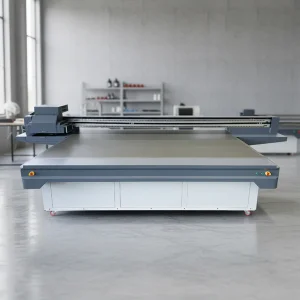
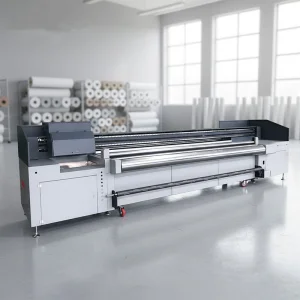
A pure flatbed (e.g., YC2513L) features a heavy, cast-iron or milled aluminum stationary table equipped with zoned vacuum suction. It is built for rigid, heavy sheets (up to 100 kg/m²) like thick plate glass, ceramic tiles, and heavy acrylics, delivering the highest geometric repeatability. A hybrid machine (e.g., YC3200HR) uses a continuous vacuum conveyor belt with infeed/outfeed expansion tables, allowing both flexible roll media and lightweight rigid boards to be processed in continuous multi-meter sequences.
Substrates with low dyne levels (<38 dynes/cm) such as untreated polypropylene (PP), polyethylene (PE), and float glass reject direct photocurable ink adhesion. We solve this through two methods: (1) An automated inline wipe or jetting primer channel that applies chemical silane/titanate bonding agents directly ahead of color delivery, or (2) integrating high-frequency atmospheric plasma/corona pre-treatment modules that elevate substrate surface energy to >52 dynes/cm prior to jetting.
All export shipments use heat-treated ISPM-15 compliant export fumigation wooden crates. The internal gantry is locked into custom heavy-gauge steel transport brackets that immobilize the carriage assembly along both the X and Y axes, preventing shock damage to linear guide bearings. Moisture-barrier vacuum vapor foil and desiccant packs prevent condensation corrosion inside maritime shipping containers during trans-oceanic voyages.
Our industrial cold UV-LED lamp modules are rated for 20,000 to 30,000 operational hours, compared to legacy metal halide or mercury lamps that degrade after 800 to 1,200 hours. Furthermore, LED arrays offer instant on/off cycling without pre-heating warm-up or cooling-down delays, generating minimal heat transfer to thin heat-sensitive films while lowering total facility electrical consumption by up to 60%.
Explore our complete export line, ranging from heavy single-pass packaging printers to high-speed oversized production flatbeds engineered for global manufacturers.