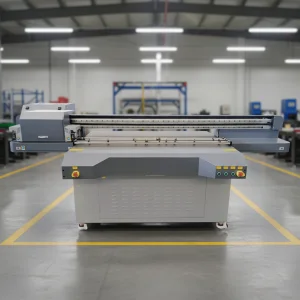
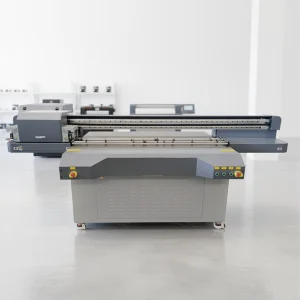
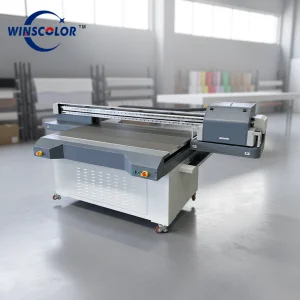
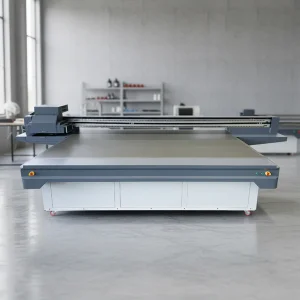
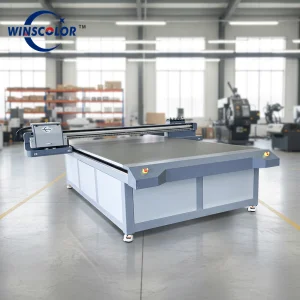
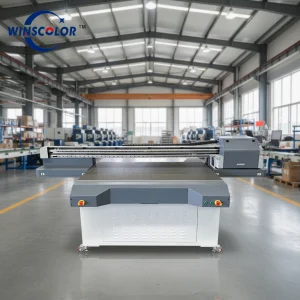
Industrial flatbed and hybrid configurations optimized for expanded PVC, KT board, foam core, acrylic, and rigid non-porous composite architectures.
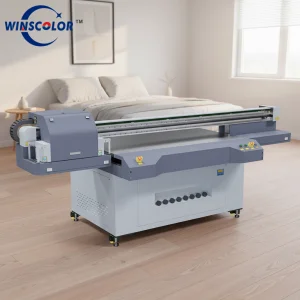
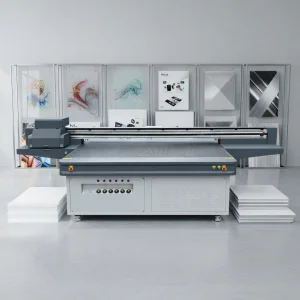
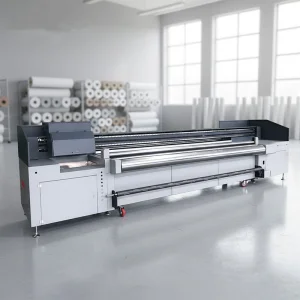
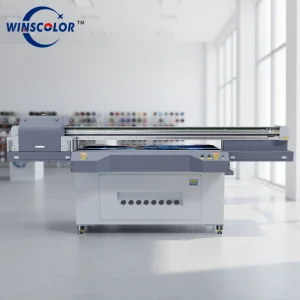
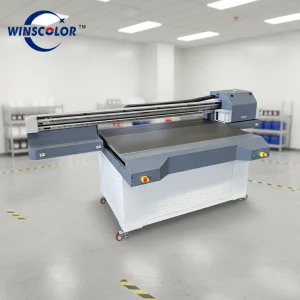
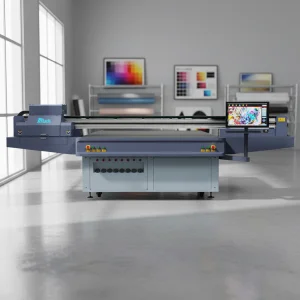
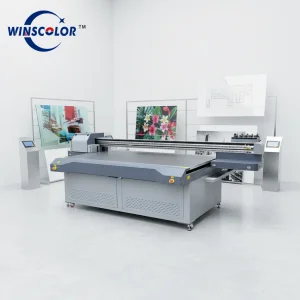
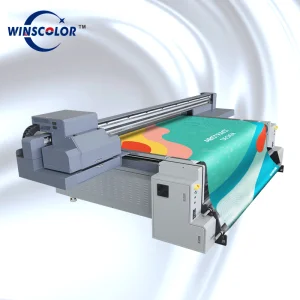
Resolving heat-induced bowing, electrostatic surface repulsion, and mechanical micro-deflection in high-speed digital UV inkjet operations.
Closed-cell PVC foam boards (expanded foam sheets like Sintra, Forex) and polystyrene core substrates (foam-core, KT boards) exhibit a remarkably low heat distortion threshold, often warping when thermal exposure exceeds 55°C (131°F). Legacy UV mercury-arc lamps radiate wide-spectrum infrared (IR) heat that causes irreversible edge warping and head-strike catastrophes. Factory-engineered UV LED systems emit a narrow-spectrum 395nm wavelength with cold-curing profiles, keeping bed-level temperature below 36°C.
Extruded polystyrene and plastic-faced rigid panels act as powerful capacitive insulators, accumulating up to 15,000V of triboelectric static during handling and unpeeling protective liners. This static field deflects micro-droplets (5–12 picoliters), generating satellite aerosol fogging around fine typographic details. Elite industrial flatbed exporters integrate active AC de-ionizing rods that neutralize surface charges down to ±50V prior to carriage pass.
Untreated PVC and expanded polystyrene boards possess a low critical surface tension (typically 34–38 dynes/cm), causing UV ink droplets to bead or flake under post-print CNC routing. High-spec OEM foam board printer factories formulate photoinitiators and monomers tailored for low-surface-energy polymers, achieving ISO 2409 Class 0 cross-hatch adhesion without costly offline flame or chemical primer treatment steps.
When industrial print operations evaluate Tier-1 Chinese manufacturers and exporters, mechanical stability and fluidic controls separate true production assets from low-duty equipment.
| Evaluation Parameter | Standard Commercial Grade | Tier-1 Industrial Factory Standard | Engineering Impact on Foam Board Output |
|---|---|---|---|
| Chassis & Gantry Milling | Bolted sheet metal, unannealed iron | Heavy-duty tempered steel bridge, 5-axis CNC planar milled | Prevents physical sag across 2.5m/3.2m widths; eliminates banding on solid color backgrounds. |
| Vacuum Platen Segmentation | Single chamber or manual ball valve | 6 to 8 automated electronic zones with high-pressure blowback | Flattens slightly bowed lightweight KT foam boards instantly without physical tape or mechanical clamps. |
| Printhead Actuation & Droplet | Fixed binary 14–24 pl drops | Ricoh Gen6 grayscale (5–15 pl variable waveform) | Renders photographic transitions on smooth matte PVC without grainy dithering or dot gain. |
| White Ink Recirculation | Intermittent head purge only | Active loop recirculation through secondary damper and sub-tank | Eliminates titanium dioxide (TiO₂) heavy pigment sedimentation, eliminating nozzle dropouts on dark/colored boards. |
| Linear Drive Mechanism | Standard step belt pulley | Dual THK linear silent rails + Japanese Panasonic AC Servo / MagLev | Ensures sub-micron carriage stability across 1.8m/s scanning velocities, avoiding step misalignment. |
Factory-tested workflows bridging UV flatbed hardware, automated print-to-cut finishing, and specialized ink sets for high-margin market verticals.
Instant production of high-impact visual stands, branded endcaps, and life-size cutouts on 5mm–10mm feather foam boards. CMYK + Lc + Lm + White setups deliver brand-accurate corporate pantone matches, while inline dual-varnish modules construct high-gloss spot accents that attract retail foot traffic.
Non-reflective matte UV formulations applied directly to high-density PVC foam boards eliminate the labor, bubbles, and lamination film peel inherent to traditional vinyl-mounting methods. Exceptional scratch resistance ensures graphics withstand inter-city crating and modular trade-show assemblies.
Sub-millimeter scale rendering and layered 3D structural builds on lightweight foamcore sheets. Architects and structural engineers leverage 1200 × 1200 DPI micro-piezo drop placement for contour mapping, spatial interior models, and realistic simulated finishes like stone, brushed aluminum, and fine timber.
Direct printing onto high-density polyurethane and foam cushioning inserts for presentation boxes, tooling cases, and electronic packaging mockups. Elastic flexible inks flex upon impact without cracking, enabling prototyping without the extensive tooling lead times of flexographic processes.
Deploying advanced Chinese CNC digital printing machinery into European, North American, and Latin American industrial hubs with zero friction.
All exported machinery features full CE Machinery Directive 2006/42/EC compliance, UL508A certified industrial electrical enclosures, dual-channel emergency stop circuitry, and shielding compliant with FCC Part 15 Class A. Low-odor inks comply with REACH Annex XVII and GREENGUARD Gold certifications, permitting immediate indoor installation in schools and medical environments.
Collaborating with regional distributor networks across 100+ countries, Winscolor provides English, German, and Spanish speaking remote field-service diagnostics via encrypted IoT telemetry. Factory-stocked spare part warehouses across Europe and North America guarantee express delivery on essential assemblies: negative pressure pumps, Ricoh Gen6 manifolds, and encoder decoders.
Prior to departure from our 20,000 m² Jinan manufacturing complex, every platform undergoes a non-stop 48-hour continuous stress run and full Factory Acceptance Testing (FAT). Shipments are locked using solid steel vibration-damping turnbuckles, desiccant vacuum moisture barriers, and heavy export fumigation-free timber cases designed for rough multimodal transits.
Where materials science, artificial intelligence, and ultra-high-frequency piezo printing converge to redefine production speeds and operating margins.
Integrating high-speed laser line-triangulation profilometers onto the carriage bridge. As the carriage traverses, the system real-time 3D scans the foam board topography, dynamically modulating Z-axis printhead clearance down to ±0.05 mm on uneven boards. This micro-level height adjustment completely prevents edge strikes while preserving drop placement precision.
Combining 365nm and 395nm UV-LED matrices with software-controlled irradiance curves. The short 365nm wave cures the surface layer instantly to freeze drop expansion (dot gain control), while the deep-penetrating 395nm wavelength polymerizes the inner ink matrix against the foam skin, maximizing elasticity for downstream digital die-cutting.
Moving beyond manual platen loading toward modular push-pull automated roller tables and pneumatic suction gantry feeders. In tandem with smart optical QR registration systems, single operators can manage dual 3.2m flatbed lines producing up to 350 full-sized 4×8 ft foam boards per eight-hour industrial shift.
Detailed answers from our chief engineers to help you evaluate capacity, chemistry, and equipment architecture.
Expanded polystyrene (KT) and low-density PVC foam boards naturally carry slight manufacturer curvature across large sheet dimensions (such as standard 1220 × 2440 mm or 2050 × 3050 mm boards). Without isolated multi-chamber vacuum zoning, suction pressure leaks across open sections of the platen, reducing downward pull. A dedicated 6–8 zone turbine vacuum system concentrates full vacuum draw directly underneath the active board footprint, flattening edges without requiring mechanical clamps that risk carriage collisions.
Edge flaking and micro-chipping occur when the cured UV ink cross-linking density is overly brittle, or when excessive heat from high-temperature curing lamps degrades the board's polymer surface. Factory-engineered UV LED systems feature narrow-band 395nm curing that matches the absorption spectrum of elastomeric monomers in the ink formulation. The resulting cured film maintains a 180% elongation elasticity index, allowing high-speed spiral CNC router bits and oscillating tangential knives to slice through the printed edge cleanly without hairline fracturing or peeling.
The Ricoh Gen6 (MH5320) head operates with a substantially higher piezo drive frequency (up to 50 kHz compared to the Gen5's 30 kHz) and drops minimum dot size down to 5 picoliters from 7 picoliters. For foam board converters, this provides two major production advantages: carriage speed can increase by roughly 35% without density drop-off, and fine text (down to 2-point micro-type) renders with crisp sharpness directly on smooth-surfaced Forex and Sintra panels.
Color consistency across modular wall backdrops requires consistent ink drop mass, linear carriage velocity, and constant platen temperature. Winscolor production platforms integrate temperature-controlled printhead manifolds, closed-loop sub-tank heating (maintaining 42°C ink viscosity), and an internal linear encoder with 1 µm optical precision. In conjunction with custom ICC color profiles generated via spectrophotometer profiling across each specific foam board substrate brand, Delta-E variance is held below 1.2 across full multi-panel graphic arrays.
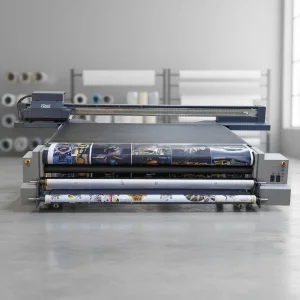
Engineered for multi-shift commercial environments requiring high square-meter output across rigid sheets and flexible roll media.