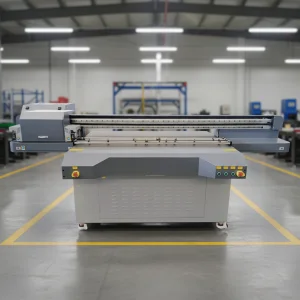
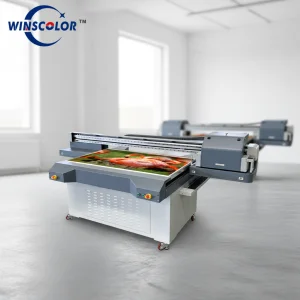
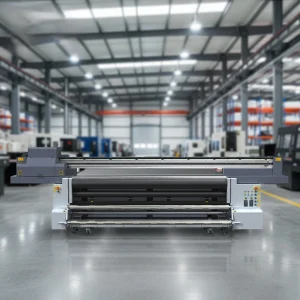
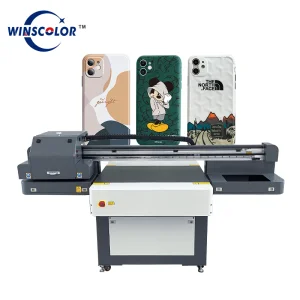
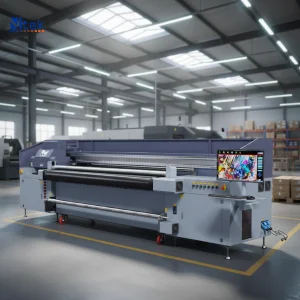
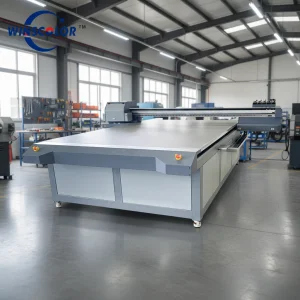
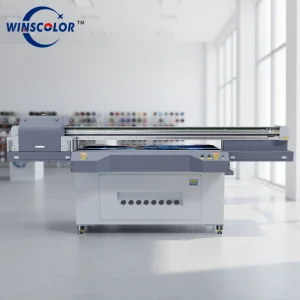
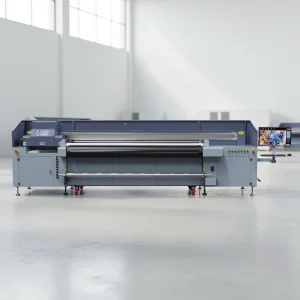
Engineered with industrial Ricoh Gen6/Gen5 printheads, magnetic linear drive motors, and multi-zone vacuum beds for maximum substrate versatility and continuous 24/7 duty cycles.
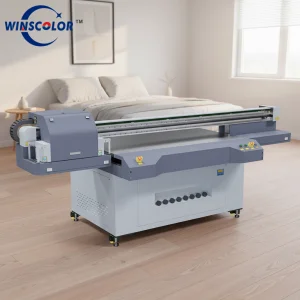
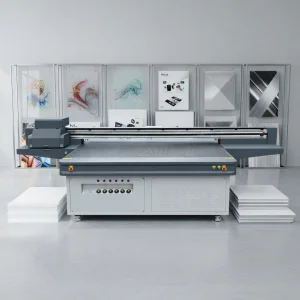
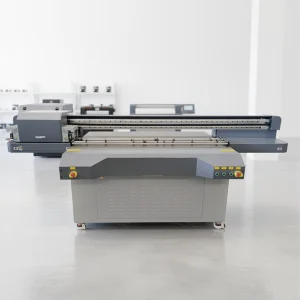
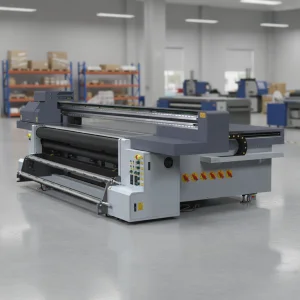
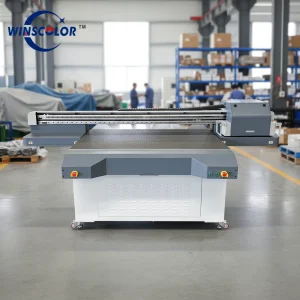
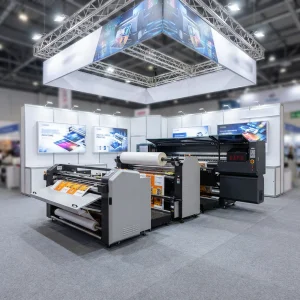

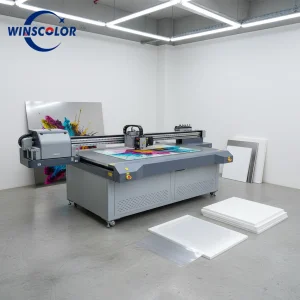
A rigorous engineering perspective on the physical, chemical, and computational systems governing modern large-format digital flatbed printing machinery.
Modern UV digital flatbed printing relies on industrial drop-on-demand (DoD) piezo printheads, such as Ricoh Gen6 and Konica Minolta 1024i. By applying precisely calibrated voltage waveforms to lead zirconate titanate (PZT) ceramic elements, ink micro-chambers contract to eject multi-level grayscale droplets (from 5 to 15 picoliters). This acoustic pressure-wave modulation ensures droplet velocity consistency up to 8 m/s without satellite drop formation, even at jetting frequencies exceeding 30 kHz.
Unlike legacy medium-pressure mercury arc lamps, state-of-the-art flatbed platforms utilize narrow-band ultraviolet LED curing modules operating at 395nm or 365nm wavelengths. Photoinitiators within the UV-curable ink absorb radiant flux to trigger instantaneous free-radical polymerization. This cross-links monomers and oligomers into a tough polymer film in milliseconds, preventing substrate thermal deformation while achieving total zero-VOC emissions.
Precision droplet placement within ±5 microns demands extreme gantry rigidity. Industrial-grade models incorporate heavy-duty aerospace-grade milled aluminum beams, dual Taiwanese THK or Hiwin linear silent guide rails, and Renishaw metal optical linear encoders. Coupled with high-torque Panasonic or Yaskawa AC digital servo systems, bidirectional scan stability is maintained over multi-year continuous duty cycles under 24/7 operating loads.
Analyzing structural disruptions across packaging converting, architectural fabrication, sign craft, and custom electronic serialization worldwide.
The global industrial flatbed digital printing sector is witnessing an aggressive structural shift. What was once predominantly an outdoor advertising and billboard reproduction mechanism has transformed into an indispensable direct-to-object manufacturing technology. The accelerated contraction of conventional offset setup times and screen plate costs has forced brand owners to seek localized, distributed, and agile short-run workflows. With minimum order quantities (MOQs) approaching unit-level customization, large-format UV flatbed printers empower converters to bypass plate preparation fees, setup waste, and inventory warehousing bottlenecks.
In mature European and North American manufacturing hubs, stringent environmental covenants (such as the EU Green Deal, REACH legislation, and California Proposition 65) have severely penalized solvent-based volatile organic compound (VOC) emissions. Energy-intensive thermal drying tunnels are rapidly being replaced by instant cold-curing UV-LED flatbeds that consume up to 75% less electrical power. Concurrently, high-growth developing economies across the Middle East, Southeast Asia, and Latin America are leveraging wide-format UV printing machinery to build domestic home décor, high-end retail shopfitting, and architectural cladding industries without requiring decades of legacy printing infrastructure.
Supply chain shocks have catalyzed a sharp acceleration in on-demand, regionalized fulfillment. Point-of-Sale (POS) display converters and industrial packaging fabricators are utilizing high-throughput flatbed systems (such as the 2.5×1.3m and 2.0×3.0m platforms) to deliver finished architectural signage, printed wood panels, and corrugated mockups within 24 to 48 hours of design sign-off, rendering overseas containerized printed goods commercially uncompetitive.
Electronics contract manufacturers and automotive OEM suppliers are integrating automated UV flatbed printers directly into production lines. Capable of jetting durable, chemical-resistant QR codes, tactile instrumentation overlays, and functional conductive inks onto curved, recessed, or textured injection-molded components, digital flatbeds are replacing pad printers and silkscreen jigs permanently.
Why Jinan's advanced digital equipment cluster delivers unparalleled structural performance, rapid BOM scaling, and exceptional total cost of ownership (TCO).
The manufacturing prowess of Chinese high-tier CNC and digital printing machinery is rooted in an unparalleled regional industrial ecosystem. Located in Jinan, Shandong Province, the equipment production clusters unite high-precision metal smelting, computer-controlled 5-axis gantry milling, precision surface grinding, and domestic electronic servo integration within a 50-kilometer radius. This deep supply chain cohesion insulates production timelines from international maritime volatility while ensuring rapid mechanical iteration cycles.
Unlike lightweight assembled aluminum extrusions prone to harmonic vibration at speeds above 800 mm/s, our factory frames are fabricated from thick-walled industrial steel tube trusses. Every chassis undergoes thermal stress-relief annealing followed by high-speed gantry planomilling to preserve planarity within 0.03 mm across the full 3.3-meter bed length over years of continuous operation.
We blend domestic precision fabrication with globally verified critical motion hardware: Japanese Ricoh and Kyocera printhead engines, Italian Megadyne timing belts, Taiwanese THK linear motion guides, German Igus energy drag chains, and Schneider low-voltage protection circuitry. This hybrid engineering matrix guarantees both global spare-part interchangeability and unmatched price-to-performance equity.
Every digital flatbed machine leaves the Jinan facility only after enduring an unbroken 72-hour continuous full-coverage ink jetting torture test, 24-hour laser interferometer geometric calibration, and vacuum bed pressure decay monitoring. Substrate tolerance tests across tempered glass, 50mm acrylic, and corrugated test runs guarantee plug-and-play field commissioning.
Comprehensive surface pre-treatment, ink formulation matching, and curing regimes across industrial materials.
| Substrate Material | Surface Physics & Chemistry | Recommended Pre-treatment / Primer | Printhead & Waveform Strategy | Key Industrial Application |
|---|---|---|---|---|
| Architectural Tempered Glass | Non-porous, high surface energy, hydrophilic, moisture-sensitive | Silane coupling agent / Nanoscale wiped chemical primer | Ricoh Gen6, small drop (5pl), high ink laydown with W+V | Kitchen splashbacks, shower enclosures, elevator wall cladding |
| Anodized & Bare Aluminum (Dibond) | Dense oxide layer, thermal heat sink effect, chemical resistant | Direct printing or optional mild metal primer wipe | Medium drop (7-10pl), high LED radiant flux (395nm) | Wayfinding signage, machinery control fascias, architectural facades |
| Cast / Extruded Acrylic (PMMA) | Static-prone, optical clarity, solvent stress cracking risk | Static discharge bar neutralization, no primer needed | CMYK + White + CMYK "sandwich" back-lit mode | Luxury cosmetics displays, illuminated channel letters, edge-lit panels |
| Heavy Wood & Medium-Density Fiberboard | Porous, variable moisture content, micro-rough grain | Direct printing; dust vacuum extraction on vacuum table | Variable drop (5-15pl), selective white highlight layer | Custom acoustic baffling, bespoke tabletops, art reproduction |
| Corrugated Flute & Honeycomb Board | High ink absorption, surface warp tendency, lightweight | High-suction vacuum zone isolation, anti-crash sensor active | High-speed bidirectional draft or production multi-pass | Short-run transit packaging, point-of-sale dump bins, promotional booths |
| Industrial Ceramics & Porcelain Slabs | Extremely hard, low surface roughness, scratch exposure | High-adhesion ceramic primer with thermal post-bake (optional) | Multi-layer tactile gloss varnish (raised 3D embossing) | Textured interior tiles, commercial floor medallions, feature walls |
By executing controlled multi-layer deposition of high-viscosity UV varnish and white ink channels, our systems produce structural tactile reliefs, simulated leather grain, wood textures, and fully compliant ADA tactile Braille dots without mechanical stamping dies.
Equipped with synchronized servo-driven rotary mandrels, machines such as the 1610 and 2513 handle tapered drinkware, stainless steel vacuum flasks, glass cosmetic bottles, and acrylic cylinders with seamless 360-degree registration and gapless seams.
Integrated bipolar ionizing air bars neutralize up to 20kV of surface electrostatic charge on plastic substrates like PVC and acrylic before ink droplet release, preventing airborne droplet deflection, fuzzy edge definition, and ink mist buildup.
A strategic blueprint detailing micro-fluidic development, artificial intelligence closed-loop control, and sustainable curing mechanisms through 2030.
Integration of ultra-high-resolution line-scan CCD cameras positioned directly on the carriage assembly. In real time, computer-vision models detect failed or deflected nozzles on the fly. The RIP controller automatically dynamically adjusts adjacent functioning nozzle drop weights via algorithmic redundancy interpolation, eliminating visual banding and scrap material without operator intervention.
Phasing out standard timing belts in favor of linear magnetic levitation motors (MagLev) for the carriage axis. Delivering acceleration rates exceeding 2.5G and scan velocities up to 1.8 m/s with virtually zero mechanical friction, MagLev drives virtually eliminate microscopic gantry shudder, significantly extending printhead life while cutting periodic mechanical servicing costs.
Collaborative chemical engineering initiatives targeting bio-derived plant monomers and hybrid water-based UV inks. These cutting-edge fluids dramatically reduce skin-sensitizing hazards and carbon footprints, while maintaining instant LED cross-linking density and ASTM cross-hatch adhesion on non-absorbent plastics and alloys.
Ensuring frictionless import logistics, regional electrical compatibility, and guaranteed post-commissioning technical uptime across all continents.
Exporting high-precision industrial machinery requires comprehensive regulatory compliance and robust protective logistics. Winscolor digital flatbed machines are engineered from the circuit board level upward to conform to rigorous international directives:
We safeguard your production uptime with a comprehensive field service model tailored for international distributors and large-scale manufacturing plants:
Integrated secure IoT gateways enable our factory software engineers to analyze motherboard logs, calibrate head waveforms, and troubleshoot firing errors remotely within minutes.
Strategic hubs across Europe, North America, and the Middle East maintain dedicated inventories of ink pumps, sub-tank solenoids, linear encoders, and replacement printheads for rapid dispatch.
Multilingual field service technicians provide on-site installation, facility leveling, ICC color profiling calibration, and comprehensive operational training for your operators.
Comparative engineering data to guide CapEx procurement and production throughput sizing.
| Evaluation Metric | Ricoh Gen6 (MH5320) | Ricoh Gen5 (MH5420) | Kyocera KJ4A Series | Epson i3200-U1 HD |
|---|---|---|---|---|
| Physical Nozzle Count | 1,280 (4 × 320 nozzles) | 1,280 (4 × 320 nozzles) | 2,656 nozzles | 3,200 (4 × 800 nozzles) |
| Native Native Drop Size | 5.0 pl (Variable 5-15pl) | 7.0 pl (Variable 7-35pl) | 3.5 pl (Variable 3.5-12pl) | 3.8 pl (Variable 3.8-12pl) |
| Max Jetting Frequency | Up to 50 kHz | Up to 30 kHz | Up to 60 kHz | Up to 43.2 kHz |
| Ink Compatibility Matrix | UV Curable, Solvent, Aqueous | UV Curable, Solvent, Aqueous | UV Curable, High Viscosity | UV Curable (Filtered) |
| Physical Body Construction | Stainless Steel Housing, Isolated PZT | Stainless Steel Housing | High-Density Ceramic Base | MEMS Silicon Micro-Machined |
| Design Service Lifespan | 3 - 5 Years (Under industrial maintenance) | 3 - 4 Years | 3 - 5 Years | 1 - 2 Years |
| Recommended Production Role | High-speed industrial flatbeds (2513, 2030) | Standard industrial flatbeds & hybrids | Ultra-high-speed single-pass & roll lines | Compact flatbeds (6090, 1610 entry) |
In-depth responses authored by application engineers regarding machine selection, maintenance routines, and ink physics.
Explore our complete export line engineered for high-volume advertising, industrial packaging, personalized promotional fabrication, and architectural decoration.