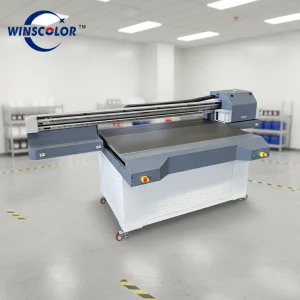
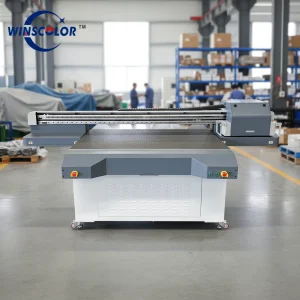
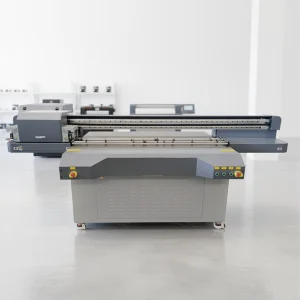
A Comprehensive Technical White Paper on Compact UV Flatbed Engineering, High-Frequency Micro-Drop Jetting, Substrate Compatibility, and Global Agile Manufacturing Solutions.
Direct-to-substrate digital UV systems engineered with micro-piezo drop-on-demand arrays, cold LED curing modules, and zero-deflection structural gantries.

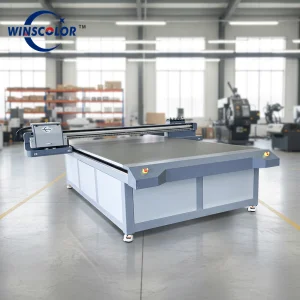
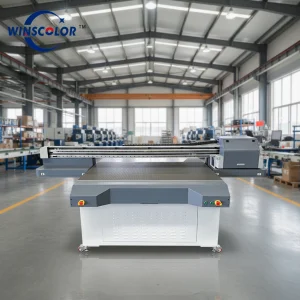

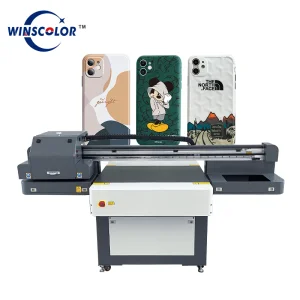


Evaluating shifting digital manufacturing economics from centralized rotogravure and screen printing to localized, on-demand photopolymer curing systems.
Modern small UV printers utilize pressurized sub-tank stabilization along with native piezoelectric crystal displacement. By orchestrating wave pulses to generate variable dot arrays down to 3.5 picoliters, operators achieve photorealistic 1440x2880 DPI resolution without thermal stress or acoustic ink misting.
Traditional mercury lamps radiate massive IR heat, distorting sensitive substrates like thin acrylic or heat-shrink PVC. Dual water-cooled 395nm UV-LED arrays achieve instant free-radical polymerization at ambient surface temperatures below 38°C, lowering electrical draw by 70% while extending lamp life beyond 20,000 hours.
Industrial firmware enables independent three-layer synchronous jetting (White + CMYK + Gloss Varnish) in a single carriage stroke. White ink circulation prevents titanium dioxide settling, providing high-opacity bases over opaque substrates, while localized high-viscosity varnish delivers tactile 3D finishes and Braille compliance.
Real-world deployment workflows configured for rigorous functional testing, chemical exposure, and mechanical surface tension resistance.
Direct marking of polyetherimide, polycarbonate, and cast aluminium instrument facias. Inks resist 500+ MEK (methyl ethyl ketone) double rubs, brake fluids, and ISO 2409 cross-hatch tape testing without pinholing or surface delamination.
High-contrast, biocompatible jetting directly onto surgical-grade stainless steel, PEEK, and cyclic olefin copolymers. Print legends remain legible through repetitive autoclaving cycles, gamma irradiation, and standard 70% isopropyl alcohol sanitization.
Short-run production of rigid setup boxes, acrylic point-of-sale displays, and coated corrugated paperboards. Eliminates analog die-plate setup costs, allowing rapid proofing of spot varnish and metallic foil simulations within hours.
Compliance with ADA and DIN 32986 standards via high-build photopolymer relief deposition. Produces resilient, raised Braille lettering and directional maps directly on brushed bronze, anodized aluminum, and architectural timber panels.
Bridging advanced CNC sub-micron fabrication with integrated component sourcing to achieve unmatched production velocity and price-to-performance stability.
Unlike pressed sheet metal gantries susceptible to harmonic vibration at speeds exceeding 700 mm/s, our frames undergo dual-stage annealing and secondary five-axis portal milling. This ensures beam planarity within 15 microns per meter, preventing banding across continuous solid ink fills.
We couple Japanese THK dual ultra-silent linear guides with dual Leadshine AC brushless servo motors and Renishaw optical linear encoders. The closed-loop positional feedback detects micron shifts on the fly, eliminating open-loop stepping slip under high-load continuous cycles.
Our Jinan manufacturing center leverages local supply clusters for electro-pneumatic valves, Igus drag chains, anti-static silicone tubing, and CNC-machined vacuum chambers. This delivers rapid prototype cycles, a consistent parts stock, and lower overall maintenance costs for global partners.
Key technical initiatives driving print head development, curing wavelengths, and edge-AI industrial printing systems.
Incorporating internal nozzle-level ink recirculation (such as Ricoh TH5241 and Epson i3200-U1 HD) directly behind the nozzle plate. This prevents nozzle drop-out when running high-pigment white inks and enables smooth jetting of functional nano-conductive and metallic suspension inks.
Developing multi-channel LED arrays that combine 365nm, 385nm, and 395nm wavelengths. Short wavelengths cure surface films quickly for high gloss and chemical resistance, while longer wavelengths penetrate deep into dense white and black layers for superior substrate bonding.
Replacing manual mechanical jigs with high-speed stereoscopic CMOS cameras mounted directly to the carriage. The onboard vision engine maps randomly placed items on the vacuum bed in real-time, automatically adjusting RIP coordinates, rotational angles, and height profiles before printing.
International standards, regional safety certifications, and responsive remote-support infrastructure for production teams worldwide.
All units carry full CE certifications compliant with Machinery Directive 2006/42/EC and Electromagnetic Compatibility (EMC) 2014/30/EU. Internal electrical looms use halogen-free, flame-retardant wiring harnesses, and our UV inks are certified compliant with RoHS 3 (EU 2015/863) and REACH SVHC thresholds.
Mainboards feature isolated IoT diagnostic gateways. With customer authorization, factory engineers can review pressure transducer curves, head thermistor logs, and waveform parameters remotely, resolving over 90% of calibration inquiries without on-site service delays.
Export machines ship in vacuum-sealed vapor barrier foil with active desiccant matrices, enclosed within IPPC-certified fumigated ISPM-15 timber crates. Structural gantry lock blocks and carriage clamps isolate printheads and linear encoders from shock during sea transport.
Detailed technical answers to common questions about industrial small-format UV printing systems.
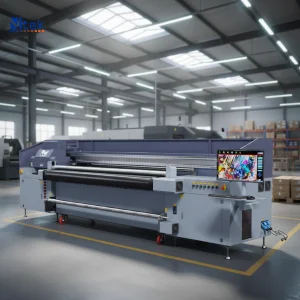
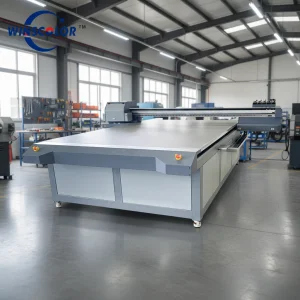
Expanded production systems optimized for architectural panels, rotary round items, and industrial substrates.