Configured with industrial Ricoh Gen6 piezo printheads, dual UV-LED variable pinning, and multi-axis synchronisation for cylindrical and rigid substrate printing.
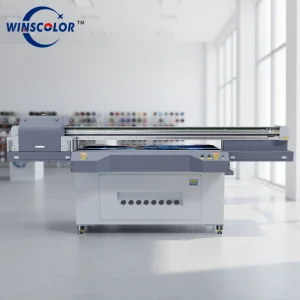
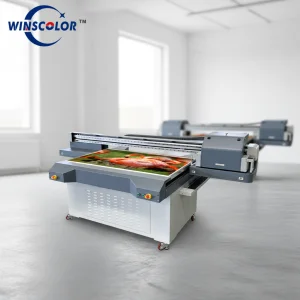
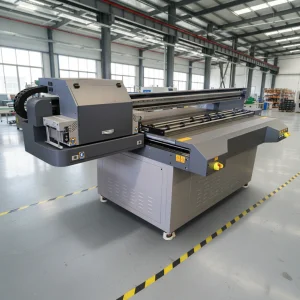
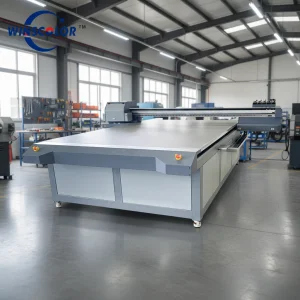


The global direct-to-shape (DTS) digital printing ecosystem is experiencing a structural paradigm shift from conventional analogue techniques toward digital UV rotary deposition systems.
For decades, container printing was dominated by analogue rotary screen printing, heat transfer labeling, and pressure-sensitive labels (PSL). These legacy workflows entail high plate expenses, protracted changeovers (2 to 4 hours), and severe inventory liability for unused pre-printed containers. UV bottle printing engines eliminate mechanical tooling completely, facilitating economical production runs as small as a single unit without sacrificing cost per container.
Global supply disruptions and just-in-time (JIT) delivery mandates in luxury personal care, nutraceutical, and craft beverage sectors require manufacturers to decouple brand decorating from container blow-molding. Leading manufacturing enterprises deploy industrial UV bottle printing systems inline or near-line, printing blank inventory on demand to slash warehousing footprints and eliminate stock-keeping unit (SKU) obsolescence.
Modern UV bottle printer manufacturers have solved historical challenges associated with drop trajectory on curved geometries. Utilizing variable grayscale piezoelectric heads (such as the Ricoh Gen6 platform with 5 pl minimum drop sizes), synchronised high-torque servo rotaries, and intelligent multi-pass algorithms, today's industrial machines achieve crisp 1200×1200 dpi imagery across straight-walled, tapered, and stepped cylindrical profiles.
Strategic advancements shaping the trajectory of cylindrical digital printing over the next decade.
Eliminating overlap witness lines through synchronized rotary axis interpolation and variable-angle UV-LED pinning lamps. Inks are partially pinned mid-spin to preserve dot morphology, followed by full 395nm curing to ensure 5B cross-hatch adhesion.
Replacing manual pre-treatment wipes and flame burners with dedicated piezoelectric inkjet channels delivering micron-level chemical primers. This guarantees optimal surface energy on non-polar plastics (PP/HDPE) and polished stainless drinkware.
Integrating high-speed CCD line-scan cameras directly into the carriage gantry. AI defect detection inspects nozzle integrity, registration shifts, and surface ovality tolerances dynamically, executing on-the-fly compensation without line halts.
Evolving from indexing rotary clamping to continuous multi-station helical transport lines. This architecture breaks throughput barriers, unlocking production speeds exceeding 60 to 120 parts per minute for automated packaging facilities.
By engineering specialized waveforms that adjust droplet firing velocity up to 8 m/s with sub-micron drop placement, advanced systems counteract centrifugal aerodynamic turbulence generated during high-speed rotation. This enables high-density white base layers, photo-realistic CMYK+Lc+Lm color gamuts, and selective, tactile 3D embossed varnish effects up to 1.5mm in structural height without thermal distortion.
Comprehensive deployment across regulated, commercial, and high-performance packaging markets.
Direct printing on luxury glass wine and spirit containers eliminates label curling and adhesive bubbling in iced presentation buckets. Supports 3D tactile crests, serialized micro-text, and variable vintage labeling across boutique production volumes.
Cosmetic tubes, cylindrical lipstick casings, and perfume flacons demand high abrasion resistance against oils and alcohol. Low-temperature UV-LED systems prevent substrate warping on thin-walled PE/PET containers while delivering metallic and high-gloss spot coats.
Double-walled vacuum tumblers and insulated sports bottles represent the fastest-expanding segment in promotional and retail markets. UV-curable formulations withstand aggressive dishwasher cycles, mechanical drops, and UV weathering without delamination.
Pharmaceutical packaging demands serialization, compliant 2D Data Matrix codes, and batch numbering directly onto HDPE or amber glass pill bottles. Digital UV eliminates label stock shedding in cleanrooms while verifying full supply chain traceability.
A successful industrial UV bottle printing installation encompasses mechanical, chemical, and software architecture engineered to operate continuously across multi-shift production environments.
Proper surface energy conditioning is vital for non-polar plastics (PP, PE, HDPE) and high-density metals. We supply inline Pyrosil, atmospheric plasma, and corona discharge pretreatment modules that elevate substrate surface tension above 48 dynes/cm, ensuring chemical bonding, abrasion resistance, and compliance with the ASTM D3359 cross-hatch standard.
Centering precision is essential when decorating non-standard or tapered vessels. We design custom pneumatic expanding mandrels, quick-change magnetic bottle fixtures, and dual-roller rotary drives that support bottle diameters from 20mm up to 250mm, preventing vibration anomalies, color drift, and mechanical runout at peak rotary velocities.
Our systems incorporate dedicated rotary RIP engines (Caldera, Onyx, or Sai FlexiPRINT) with automatic circumference recalculation, taper mesh deformation correction, and ICC color profile management. Digital files compensate for bottle conical angles in real time, preventing graphical distortion and optical skew.
Expert insights compiled by our application engineers addressing hardware capability, adhesion chemistry, and production efficiency.
Seamless rotary printing is achieved through synchronized interpolation between the X-axis linear printhead movement and the rotary axis stepper or servo motor. Software RIP algorithms implement a subtle edge-feathering gradient (interweaving dot matrix) at the circumference closure point, preventing ink buildup ridges or blank banding gaps.
Yes. By utilizing dedicated conical printing algorithms within our RIP software, the artwork is dynamically warped to match the mathematically calculated apex of the taper. Coupled with an angle-adjustable rotary fixture, the printhead carriage maintains a constant 1.5mm to 2.0mm jetting throw distance across the vessel's angled surface.
Untreated glass and stainless steel possess low surface energy, leading to ink delamination upon exposure to water or mechanical abrasion. For industrial durability, these substrates require atmospheric plasma, Pyrosil flame treatment, or a wipe/jetted silane primer prior to printing, followed by high-output 395nm UV-LED crosslinking.
Digital UV printing incurs zero pre-press plate, mesh, or film expenses and eliminates make-ready scrap. For orders ranging from 1 to 5,000 units, digital UV is substantially more economical. While rotary screen printing can achieve lower per-unit ink costs at runs exceeding 20,000 identical units, digital remains unmatched for multi-color photorealism and SKU customization.
When printed with commercial UV-curable inks onto properly pretreated metals or glass, the cured polymer film passes standard industrial dishwasher resistance protocols (up to 50+ thermal cycles) and satisfies the 4H pencil hardness standard alongside ASTM D3359 cross-hatch tape tests.
Throughput depends on diameter, resolution pass-rate, and head layout. Standard indexing rotary machines complete a 750ml bottle (CMYK + White + Varnish) in 40 to 90 seconds. Multi-spindle platforms and continuous-motion industrial machines achieve production rates from 300 to over 1,200 bottles per hour.
Heavy-duty, factory-direct manufacturing platforms engineered in our 20,000 m² Jinan plant for continuous multi-shift performance.