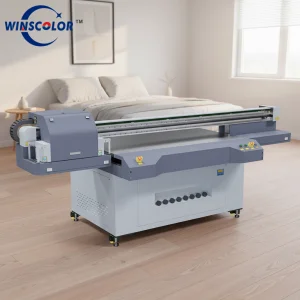
Direct factory-calibrated small and versatile UV digital printers engineered for rigid acrylic, structural glass, industrial metals, and specialized packaging.
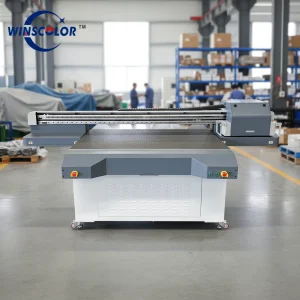
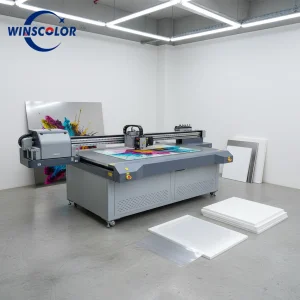
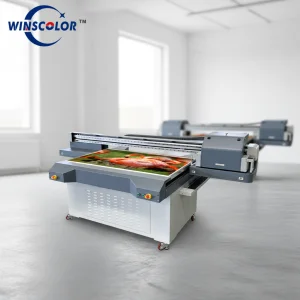
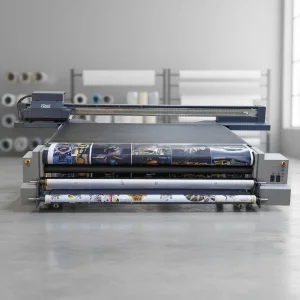
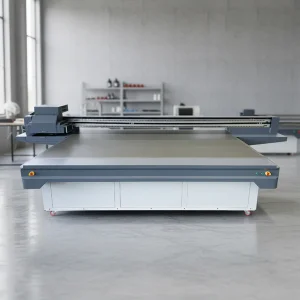
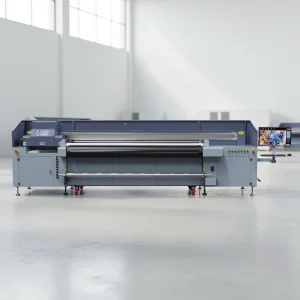
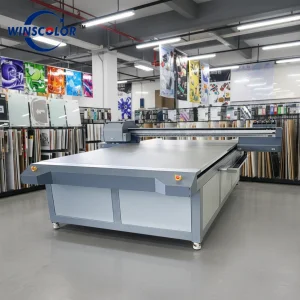

A technical examination of precision droplet jetting, cold-cure LED photochemical cross-linking, and micro-gap tolerance across compact production platforms.
Small UV flatbed printers demand higher dot precision than wide-format platforms due to the intimate viewing distances of finished items like luxury cosmetics boxes, smartphones, and membrane dials.
Modern short-arc LED arrays have phased out mercury arc discharge bulbs, removing volatile organic compounds and thermal distortion on heat-sensitive thin-gauge plastics.
Mechanical vibration is the primary cause of bi-directional deflection and fuzzy edge definition. Our small UV systems adopt industrial chassis frameworks derived from CNC milling centres.
How Jinan Yingcai Digital Technology (Winscolor) leverages a 20,000 m² production facility, modular supply networks, and strict export engineering protocols.
By producing CNC milled components, gantry weldments, sheet-metal casing, and ink manifold channels in-house, we eliminate tier-3 supplier markups. This ensures component batch uniformity and enables competitive export pricing for overseas distributors without sacrificing industrial grade steel or Japanese pneumatic components.
We configure custom bed sizes, vacuum configurations, custom negative pressure ink reservoirs, integrated rotary attachments, and customized RIP software drivers for international brands. OEM buyers can request white-label chassis paint, customized operator control consoles, and localized UI firmware within 4 weeks of engineering approval.
Every small UV flatbed machine assembled across our six manufacturing lines undergoes a mandatory 72-hour stress test prior to crating. This includes continuous raster carriage reciprocating, micro-drop nozzle firing tests, high-voltage static elimination testing, and laser interferometer bed flatness verification under vacuum load.
Printers are protected with vapor-corrosion-inhibitor (VCI) thermal shrink film, nitrogen-purged fluid paths, carriage locking brackets, and fumigated solid timber export crates. We coordinate direct sea, air, and multimodal rail freight to North America, Western Europe, Latin America, Southeast Asia, and the Middle East.
A data-backed financial perspective for print executives evaluating capital equipment investment, consumable yield, and payback timing.
| Evaluation Parameter | Winscolor Small Industrial UV Flatbed | Legacy Eco-Solvent / Screen Printing | Western Tier-1 UV Flatbed Alternative |
|---|---|---|---|
| Initial Hardware Capex | $8,500 – $22,000 (Direct Factory Tier) | $12,000 + Cost of Plate/Screen Exposers | $45,000 – $85,000 (Substantial Dealer Markup) |
| Ink Consumable Cost | $28 – $45 / Liter (Open/Configurable System) | $65 – $95 / Liter (Solvents & Emulsions) | $140 – $220 / Liter (Proprietary Encrypted RFID Chips) |
| Substrate Flexibility | Rigid Acrylic, Glass, Wood, Leather, Cylinders, Metal | Restricted to vinyl rolls or flat pre-treated plastics | Rigid & flexible sheets (often requires custom platens) |
| Make-Ready Setup Time | < 3 Minutes (Direct file-to-print RIP queue) | 45–90 min (Screens, drying racks, color separation) | < 5 Minutes via proprietary workflow software |
| Embossing / Gloss Varnish | Integrated White + Varnish sync in single pass | Requires secondary screen coating or spot laminator | Available as a high-cost optional add-on license |
| Typical Capital Payback | 3.5 to 6 Months at standard job utilization | 12 to 18 Months (Labor-intensive setups) | 22 to 34 Months due to heavy initial financing debt |
Small UV flatbeds bridge the gap between boutique custom personalization and high-volume serialized manufacturing lines.
Direct printing on polycarbonate phone cases, silicon sleeves, tablet backs, power banks, and membrane control switches with crisp 4pt micro-text and abrasion resistance.
By repeatedly layering high-viscosity UV white ink followed by clear gloss varnish, our equipment prints compliant ADA tactile raised lettering and rounded Grade 2 Braille spheres in a single unattended queue.
Synchronized friction-drive rotary fixtures enable 360-degree seamless print wraps on stainless steel drinkware, vacuum flasks, wine bottles, cosmetics jars, and taper-shaped candles.
High-adhesion primers and specialized rigid UV inks anchor onto anodized aluminum, brush-finished stainless steel, and stamped sheet-metal without flaking under vibration, salt-fog, or chemical wipes.
Short-run mockups on folding cartonboard, rigid gift boxes, textured wooden presentation caskets, and cast-acrylic awards featuring localized matte/gloss finishes and 3D textured reliefs.
Ensuring frictionless regulatory integration, electrical workplace safety, and round-the-clock technical coverage across every continent.
All Winscolor export models feature third-party verified CE certification, conforming to the Machinery Directive 2006/42/EC and Low Voltage Directive 2014/35/EU. Electrical circuitry uses UL-recognized wiring, Schneider contactors, and shielded drag-chain cabling to suppress electromagnetic interference (EMC), while our curing inks comply with RoHS and REACH standards.
To minimize factory downtime, we maintain critical parts depots—including electronic printhead boards, sub-tank floats, negative pressure sensors, UV-LED cooling chillers, and peristaltic pumps—with logistics hubs in Europe, North America, and Dubai, providing expedited 24–48 hour component dispatch.
Our control firmware integrates intelligent IoT diagnostics. Certified factory engineers can securely connect to your machine via team-share protocols to analyze waveform curves, calibrate nozzle bidirectional alignment, diagnose encoder sensor signals, and resolve RIP color profile issues in real time.
Direct technical answers from our chief engineers covering heads, media priming, and daily operational practices.
Under standard operational discipline—including daily flash jetting, proper ink degassing, lint-free capping wiper maintenance, and recommended temperature control (20–28°C)—an industrial Ricoh Gen6 head typically provides 3 to 5 years of steady production. The Epson i3200-U1 head provides an economical alternative with an expected operational lifecycle of 18 to 24 months under continuous two-shift production workloads.
Dense, non-porous surfaces like polished glass, glazed ceramic, and raw metals feature high surface tension that resists raw ink bonding. We offer automated wipe-on chemical primers and plasma discharge pre-treatments that functionalize the substrate face. Once prepped, our specialized UV inks achieve 4B/5B cross-hatch adhesion test ratings and pass fingernail scratch and boiling water submersion tests.
Unlike basic siphon feed or gravity float tanks, independent dual negative pressure systems govern White/Varnish and CMYK ink lines on separate micro-vacuums. Because titanium dioxide white pigments carry higher mass and settle quickly, separating white pressure control from standard colors prevents ink dripping during carriage deceleration and ensures nozzle stability at 40 kHz firing rates.
Yes. By mounting our optional high-speed rotary roller jig, the printer's Y-axis servo drive switches from bed-traverse to rotational-axis control. With drop firing synchronized to perimeter degrees, you can print seamless full-bleed graphics, logos, and embossed varnish bands around wine bottles, tapered tumblers, cans, and tubes.
Our small industrial flatbed models operate on standard single-phase 220V (±10%) 50/60Hz lines drawing 1.5 kW to 3.5 kW depending on UV-LED wattage and vacuum pump sizing. Because our UV inks cure via LED photopolymerization with zero ozone emission and low VOC content, standard room air exchange or a compact activated carbon fume filter is sufficient for safe operation.
Every export delivery includes a comprehensive video tutorial suite, step-by-step uncrating manuals, and tailored ICC color profiles for common RIP solutions (such as Photoprint, Onyx, and Caldera). We provide scheduled video commissioning sessions with bilingual installation engineers and dispatch factory technicians for on-site plant setup upon distributor request.
Explore our complete export line: versatile ceramic tile printers, rotary-equipped systems, high-speed wood decorators, and heavy-duty hybrid production engines.
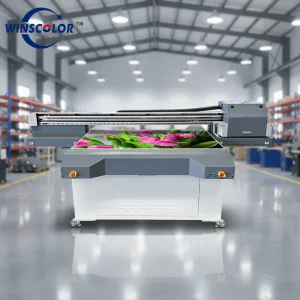
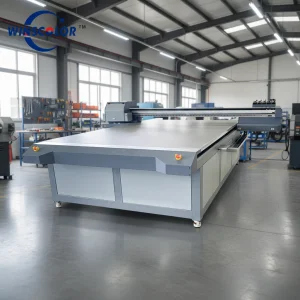
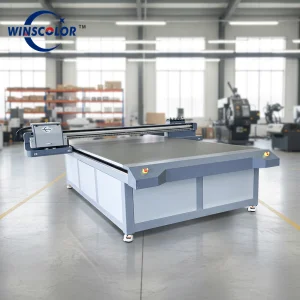
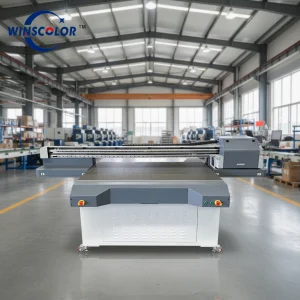

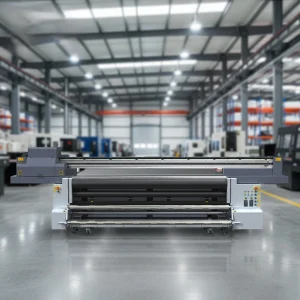
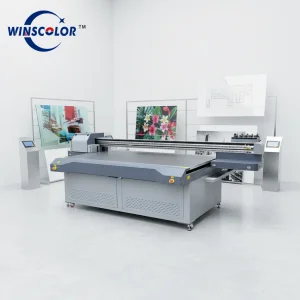
Send us your targeted substrate dimensions, daily capacity targets, and finishing requirements. Our engineering team will produce complimentary sample test prints with high-resolution microscopy validation and issue a detailed direct CIF/FOB export quotation.
