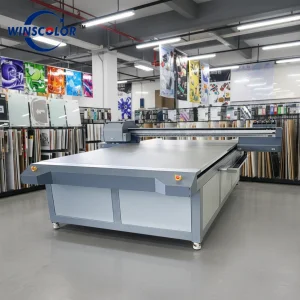
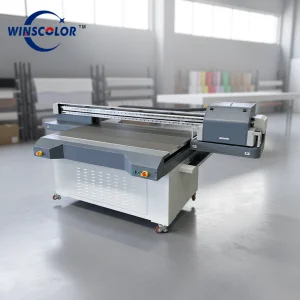
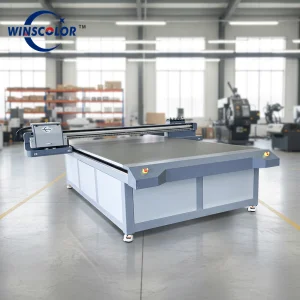
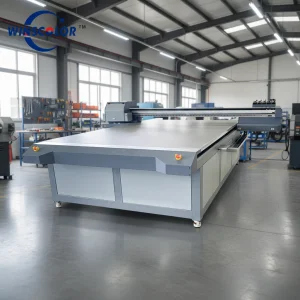
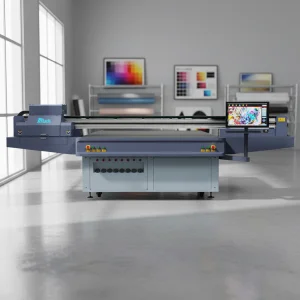
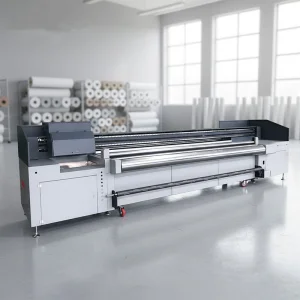
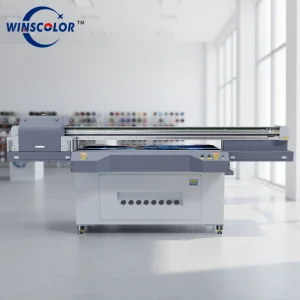
Explore our Tier-1 roll-to-roll, flatbed, and single-pass packaging systems manufactured under ISO9001 precision assembly standards.
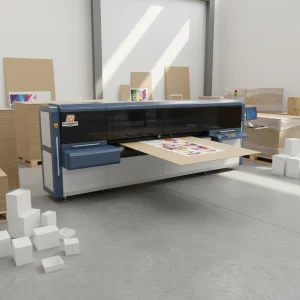
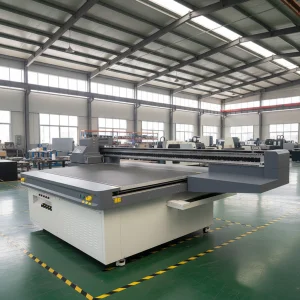
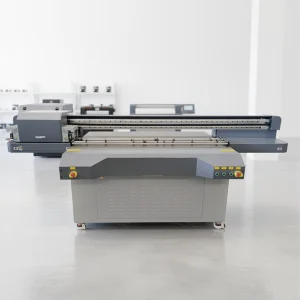
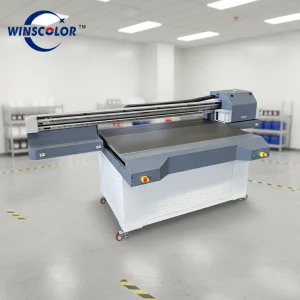
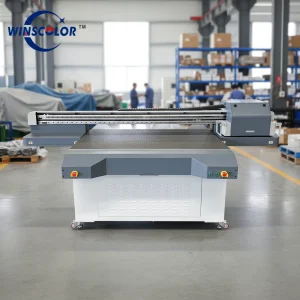
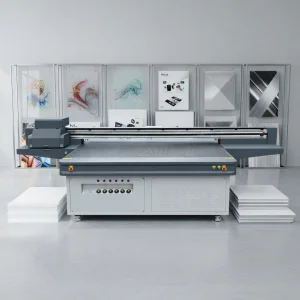

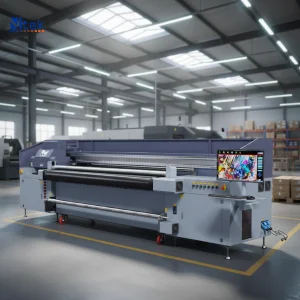
A technical deconstruction of precision mechanical feed assemblies, variable gray-scale droplet mechanics, and continuous closed-loop tension systems.
Structural rigidity is the foundation of high-speed droplet placement. Premium factories utilize carbon-structure steel milling gantries treated through 600°C thermal annealing cycles to relieve internal molecular stress. Paired with twin Japanese THK or Hiwin quiet linear guide rails and dual Panasonic AC servo motors, mechanical vibration is dampened below 0.01mm, eliminating banding across 3.2m continuous media spans.
Utilizing high-end industrial printheads such as Ricoh Gen6 (MH5320) and Kyocera KJ4A, modern roll-to-roll engines fire native 5-pl droplets with 4-level grayscale modulation up to 50 kHz. This enables pin-sharp typographic edge rendering alongside ultra-dense photographic tonal reproduction, while micro-recirculation technology inside the printhead manifold prevents premature titanium dioxide (white pigment) sedimentation.
Roll-to-roll stability over continuous 100-meter vinyl, mesh, or backlit film relies on multi-stage pneumatic air shafts coupled with magnetic powder friction clutches. Dual high-precision optical encoder feedback automatically calculates roll diameter reduction, calibrating torque in real time to avoid media skewing, thermal elongation, or cockling under cold LED cure lamps.
Conventional metal-halide lamps radiate tremendous infrared heat exceeding 80°C on the media plane, severely warping delicate thermal films, PET backlits, and heat-sensitive self-adhesive polyolefins. Leading Chinese roll-to-roll factories have standardized on 395nm water-cooled UV-LED curing arrays. These solid-state emitters maintain bed temperatures below 35°C, consume 72% less electricity, and operate with an instant ON/OFF lifecycle rating surpassing 25,000 continuous hours.
Why Tier-1 Chinese printer manufacturers deliver unprecedented performance-to-cost ratios without sacrificing industrial component reliability.
Located in Shandong Province, Jinan stands as China’s epicentre for CNC heavy machine tools, laser cutting tables, and industrial automation equipment. This regional density grants local UV printer factories immediate access to 5-axis gantry milling centers, granite inspection tables, and metal surface treatment facilities, driving structural tolerances that rival European manufacturing standards at a fraction of the capital expenditure.
Authentic Tier-1 Chinese factories do not compromise on core kinematics. Standard configurations feature Japanese Omron sensors, German IGUS low-noise drag chains, Megadyne Italian timing belts, Panasonic/Yaskawa servo drive ecosystems, and SMC Japanese pneumatic regulators. The localized assembly of verified global sub-components guarantees rock-solid reliability with universal replacement availability.
Unlike Western equipment conglomerates bound by rigid multi-year product cadences, Chinese factories excel at modular platform engineering. Whether an international distributor requires custom chassis colors, specific dual-row Kyocera carriage layouts, extended 3.3-meter pinch-roller arrays, or specialized dual-roll unwinding setups, bespoke prototypes transition to mass production in weeks rather than quarters.
| Evaluation Parameter | Tier-1 Chinese Factory (e.g., Winscolor) | Western OEM Assembly | Entry-Level Workshop Assembler |
|---|---|---|---|
| Structural Bed & Beam | Annealed steel gantry; CNC 5-axis milled (±0.02mm) | Cast aluminum or steel gantry (±0.015mm) | Cold-bent sheet metal; un-milled extrusion (>0.15mm) |
| Kinematic Drives | Panasonic/Yaskawa AC Servos + Dual THK Rails | Bosch Rexroth / Schneider Servos | Open-loop stepper motors; generic Chinese rails |
| Ink Delivery Architecture | Dual-chamber negative pressure + White circulation | Patented negative pressure vacuum regulation | Gravity feed siphon; manual purge squeeze bulbs |
| Total Cost of Acquisition | Benchmark Value ($18,000 – $45,000) | Premium Luxury ($85,000 – $220,000) | Low Initial ($9,000 – $14,000; high failure rate) |
| Spare Parts Availability | Global DHL/FedEx dispatch within 24-48 hours | Proprietary lock-in; high distributor markup | Unstandardized components; frequent obsolescence |
A rigorous economic calculation of capital depreciation, ink consumption efficiency, electrical demands, and production uptime.
Ink expense represents up to 68% of operational printing expenditure over a 36-month horizon. By implementing micro-piezo drop-on-demand firing (variable drops from 5pl to 15pl), Winscolor platforms consume merely 6.5ml to 8.2ml per square meter at 100% density. In contrast to legacy solvent systems, UV inks contain zero volatile organic solvents (VOCs), ensuring 100% solids deposition without evaporative volume loss.
Unplanned head cleans squander both ink and operator hours. Digital micro-controlled negative pressure chambers hold meniscus stability at the nozzle face within ±0.05 kPa tolerances across fluctuating ambient warehouse conditions. This precision reduces automatic cleaning cycle purges by 80%, yielding hundreds of liters of preserved ink over an enterprise production lifecycle.
Enterprise procurement directors evaluate machinery through return on investment speed. While a $150,000 legacy brand requires 24 to 36 months to achieve operational breakeven, a factory-direct industrial 3.2m UV system amortizes fully within 6 to 9 months under two-shift commercial printing operations, enabling rapid reinvestment and competitive margin bidding.
Ensuring frictionless factory integration with regional safety standards, multilingual RIP color profiles, and worldwide engineering backup.
Every industrial chassis is engineered with segregated low-voltage and high-voltage wiring channels, Schneider circuit breakers, certified emergency stop dual-loop interlocks, and shielded cables compliant with European CE machinery directives and North American UL/FCC standards.
Whether operating on European 3-phase 380V/400V 50Hz grids or North American/Japanese 208V/220V/240V 60Hz power lines, all power distribution units incorporate solid-state voltage stabilizing transformers and isolated ground line filters to resist transient voltage surges.
Color fidelity across international vinyl, coated canvas, non-woven wallpaper, and acrylic boards requires native RIP calibrations. Factory engineers provide pre-mapped ICC color profiles configured for Caldera, Onyx, PhotoPrint (FlexiPRINT), and UltraPrint engines.
Integrated Linux-based motion boards feature IoT remote diagnostic modules. Machine technicians remotely monitor waveform voltages, encoder pulses, and vacuum pressures, resolving 92% of software and workflow queries within 2 hours under global SLA agreements.
Key vector shifts in ink chemistry, artificial intelligence machine vision, and hybrid multi-substrate conversion platforms.
Next-generation carriages integrate high-resolution industrial CCD cameras that calculate media drift, edge alignment, and pre-cut contour marks on the fly. Digital micro-adjustments in carriage positioning compensate for web elongation dynamically, allowing high-speed double-sided roll-to-roll printing without human registration error.
The rigid wall separating flatbed and roll printers is dissolving. Hybrid conveyor systems utilizing heavy rubber vacuum transport belts effortlessly process 50mm thick honeycomb corrugated boards, acrylic sheets, and cast acrylic panels, and instantaneously shift to flex banner, backlit film, and synthetic textiles with zero hardware reconfiguration.
Responding to tightened European packaging directives and corporate ESG mandates, ink laboratories are deploying bio-derived photoinitiators and cross-linking oligomers derived from plant-based monomers. These newly synthesized inks enable superior flexibility up to 220% elongation for vehicle wraps without cracking or micro-fissuring.
Where industrial roll-to-roll and hybrid UV engines generate maximum commercial value and premium profit margins.
Retail flagships, luxury brand boutiques, and airport concourses demand seamless backlit silicone edge graphics (SEG). Roll-to-roll UV engines utilize multi-layer printing modes (Color + White + Color) in a single pass. When illuminated from behind, optical density remains balanced with high saturation and no white halo bleed.
Demanding vehicle fleet livery requires UV prints to withstand complex 3D compound curves, deep rivets, and intense exterior weathering. Utilizing specialized high-flexibility UV inks paired with precise roll-to-roll web tension, the printed graphics offer exceptional elongation without white stress whitening or peeling over years of road use.
Interior design studios rely on wide-format UV roll machines to produce textured wall coverings, contract murals, and embossed upholstery eco-leather. Multi-strike gloss varnish printing builds distinct tactile embossments resembling natural grain, woven canvas, or brushed concrete, commanding high per-square-meter fees.
Direct technical answers from chief engineers addressing integration, calibration, and long-term maintenance.
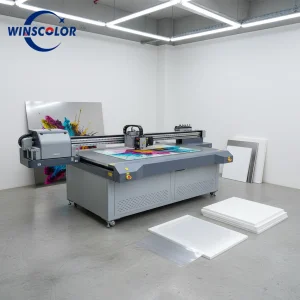
Broaden your workshop's production versatility with dedicated multi-axis, flatbed-hybrid, and heavy industrial roll printing engines.