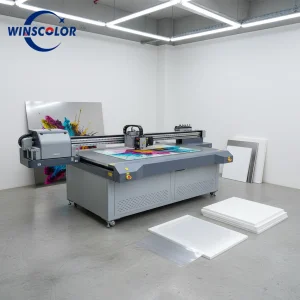
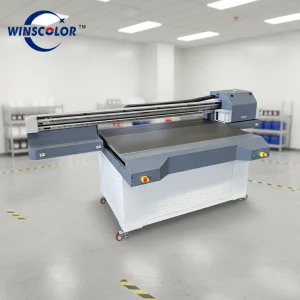
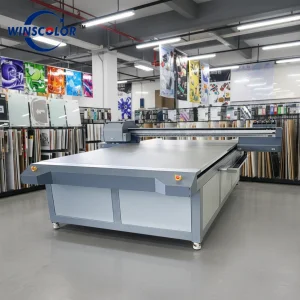
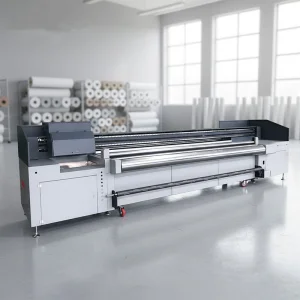
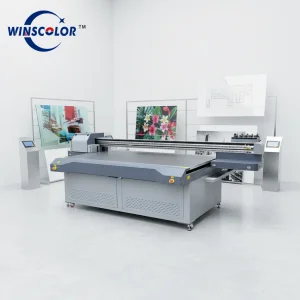
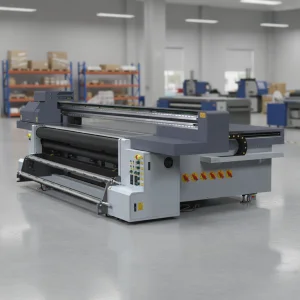
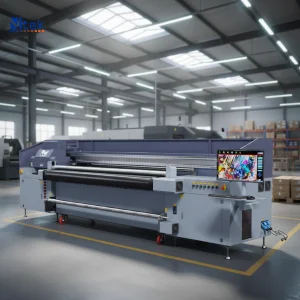
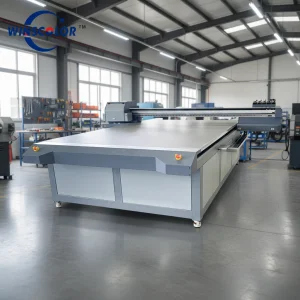
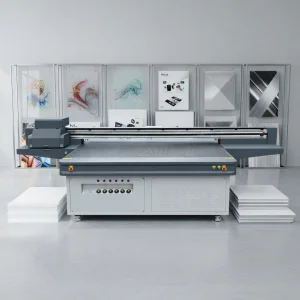
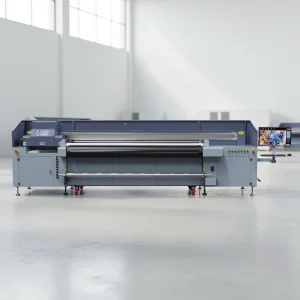
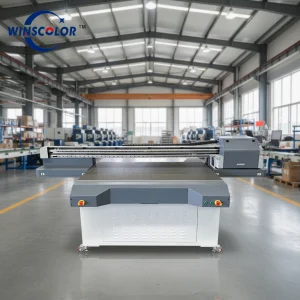
High-duty cycle UV flatbed, hybrid, and single-pass systems factory-calibrated for packaging converters, industrial décor manufacturers, and large-scale commercial signage enterprises.
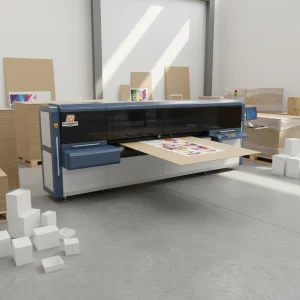
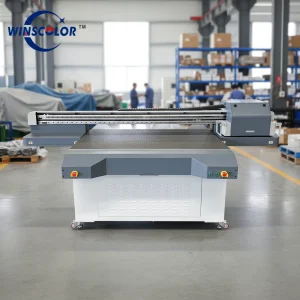


Analysis of piezoelectric printhead physics, multi-drop grayscale algorithms, cold UV-LED photopolymerization, and closed-loop magnetic levitation drive dynamics.
The transition across commercial graphics and industrial surface finishing from conventional screen printing and volatile solvent printing to digital UV-LED flatbed technology represents one of the most consequential manufacturing pivots of the 21st century. Industrial flat bed printers have evolved past simple promotional sign-making tools into multi-axis, micron-accurate manufacturing platforms integrated into continuous production lines.
Modern engineering relies on industrial Drop-on-Demand (DoD) piezoelectric printheads, such as the Ricoh Gen6 and Kyocera KJ4A series. These heads leverage piezoceramic actuators firing variable droplet volumes from 5 picoliters up to 15 picoliters at firing frequencies exceeding 50 kHz. By combining high-frequency jetting with dual independent negative pressure degassing systems, modern UV printers eliminate micro-air embolisms in high-viscosity white and clear gloss inks, ensuring continuous, zero-dropout jetting across multi-shift factory runs.
Heavyweight double-beam gantries paired with Japanese THK dual linear silent guides and linear motor drives (magnetic levitation) yield carriage positioning accuracy under ±0.01 mm, eliminating mechanical stepping artifacts across large 3.2m beds.
Configured with 395nm wavelength UV-LED water-cooled irradiation lamps, providing instant photo-initiator radical cross-linking without thermal radiation. Thin-gauge PVC, acrylic, and honeycomb core materials remain dimensionally stable without heat deformation.
Proprietary RIP controllers orchestrate simultaneous White + CMYK + Varnish layering in a single carriage pass. This unlocks high-opacity underbasing on dark substrates, double-sided day/night backlit panels, and tactile 3D haptic embossing textures up to 2mm relief.
How tier-one print service providers, industrial brands, and OEM converters evaluate capital equipment investments against operational square-meter production yields.
When enterprise procurement teams assess a flat bed printer manufacturer, initial acquisition price (CAPEX) accounts for only 28% to 35% of the total 5-year operational lifecycle cost. The predominant drivers of operational expenditures (OPEX) are ink yield per square meter, purge cycle waste, printhead longevity, electrical draw from UV curing fixtures, and unplanned downtime.
Equipment from certified manufacturers addresses these procurement pain points by utilizing isolated multi-zone vacuum suction tables that eliminate the need to manually tape down unprinted sections. The inclusion of automated anti-static ionizer bars and active head-crash sensors guarantees that expensive Ricoh Gen6 or Kyocera printhead nozzle plates do not suffer physical strikes from warped acrylic or aluminum composite sheets (Dibond).
Procurement requirements demand universal surface adaptability: rigid sheets (glass, steel, ceramics, hardwood, MDF, corrugated cardboard) and flexible materials via hybrid conveyor belts or heavy-duty roll-to-roll dual extensions.
Enterprise uptime is protected through automated ink wiping, motorized capping stations, and continuous white ink circulation that prevents titanium dioxide particle sedimentation during idle shifts.
Compatibility with international industrial RIP suites (Caldera, Onyx, ColorGATE, PhotoPrint) ensures seamless ICC color profiling, spot channel generation, and closed-loop density calibration across enterprise fleets.
How industrial manufacturing clusters in Jinan, Shandong deliver unmatched vertical integration, structural gantry stability, and global export reliability.
China has emerged as the global epicenter for industrial flatbed printer manufacturing, driven by localized precision machining clusters in Shandong province. Jinan Yingcai Digital Technology Co., Ltd (Winscolor / NTEK) exemplifies this transition, operating an independent 20,000 square meter plant equipped with 6 automated assembly lines, heavy-duty five-axis CNC gantry milling centers, and laser interferometry calibration chambers.
The manufacturing process begins with all-steel welded heavy machine beds that undergo high-temperature thermal stress relief annealing. This eliminates internal mechanical tensions within the steel framing, guaranteeing that the gantry structure does not warp or twist over a decade of continuous 24/7 industrial service. By vertically integrating frame welding, precision bed milling, electrical harness loomed assembly, and optical alignment, Chinese factories achieve rapid OEM/ODM cycle times at a price-performance ratio unmatchable by European or Japanese boutique assemblers.
Direct access to adjacent component hubs—precision linear rails, high-vacuum pumps, precision ball screws, and specialized electronic board design—ensures component lead times are measured in days rather than quarters.
Every printer undergoes continuous 72-hour burn-in testing prior to export, including full-vacuum flatness mapping, maximum-frequency nozzle firing tests, and high-speed bidirectional carriage registration verifications.
With installations across more than 100 countries and regions, machines are packaged inside vacuum-sealed, anti-corrosion barrier foil and fumigated, reinforced steel-frame crates to withstand transoceanic shipping stresses.
Comprehensive engineering guidance on direct-to-substrate printing across rigid plastics, non-porous architectural surfaces, flexible textiles, and industrial packaging.
Non-porous glass and ceramic tile require specialized silane-based chemical bonding primers. Cured under dual high-output LED lamps, prints withstand humidity, UV solar degradation, and scratch tests for exterior facades and interior splashbacks.
Plate-free, digital single-pass and wide flatbed printing on kraft and white-top liners eliminate tooling costs for short-to-medium runs. Rapid-cure inks resist flute cracking during post-print die-cutting and box folding.
Optical-grade cast acrylic printed with layered "sandwich" white inks (Color + White + Color) creates high-impact day/night illuminated signs and backlit POS installations without manual foil mounting or lamination.
Direct printing on anodized aluminum, stainless steel, and powder-coated electrical enclosures. Specialized hard inks resist mechanical abrasion, chemical exposure, and high temperatures for industrial equipment plates.
In-depth engineering answers addressing ink chemistry, printhead maintenance, curing wavelengths, and overseas after-sales logistics.
Precision-engineered UV flatbed and roll-to-roll hybrid systems built for demanding 24/7 industrial production environments.