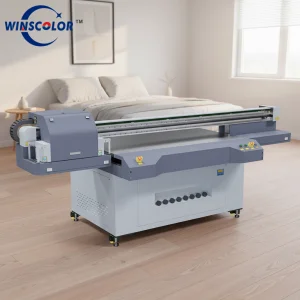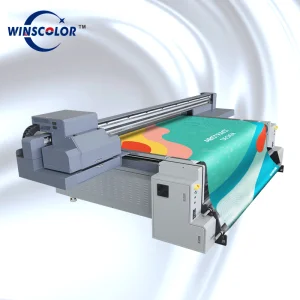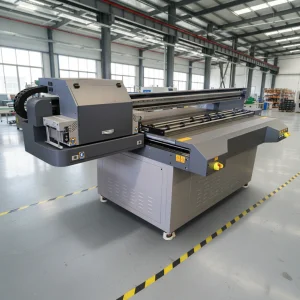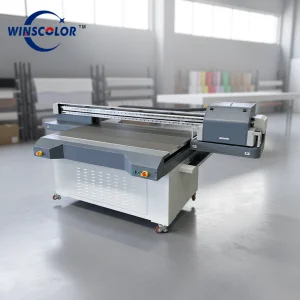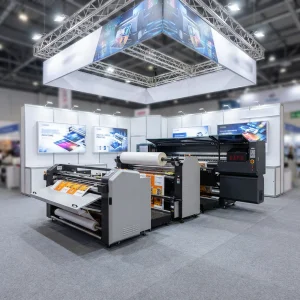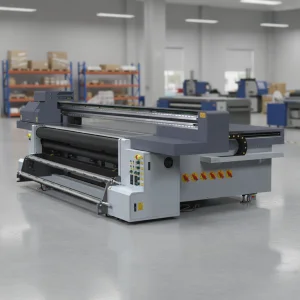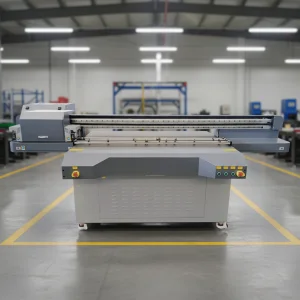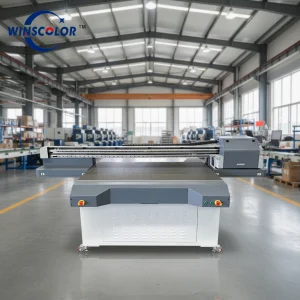
Engineered for direct-to-metal high-adhesion printing across sheet metal fabrication, industrial marking, and commercial decoration.
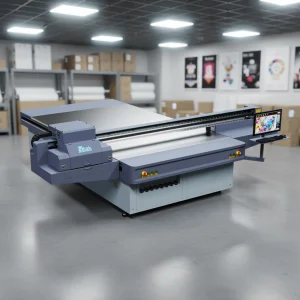
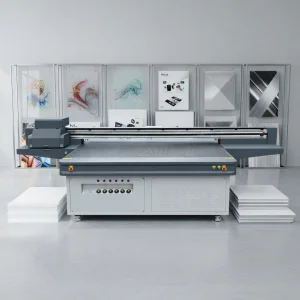
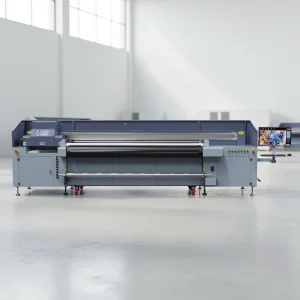
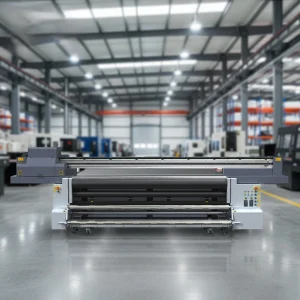
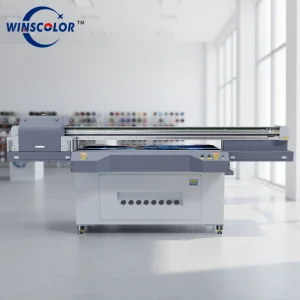
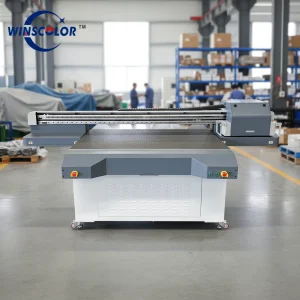
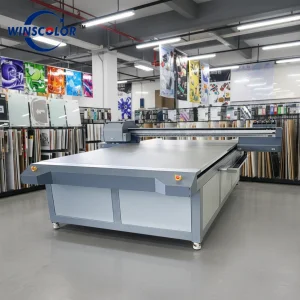
Direct-to-metal UV inkjet printing eliminates the traditional bottlenecks of screen printing, etching, and chemical photolithography, providing high-yield customisation with microscopic registration.
Stainless steel (304, 316, and brushed alloys) features an extremely low surface energy and non-porous passive oxide layer. Winscolor UV platforms integrate in-line corona/plasma treatment alongside automated nano-silane primers to elevate surface dyne levels above 48 dyn/cm, ensuring instant wettability and 5B-grade cross-hatch adhesion resistance.
Metal substrates act as natural heat sinks, dissipating conventional thermal curing. Our dual water-cooled UV-LED curing systems (395nm wavelength) supply targeted irradiance exceeding 12 W/cm². This triggers radical photoinitiators in fractions of a second, preventing droplet spreading and eliminating micro-voids without deforming thin metal plates.
Heavy gauge stainless steel demands robust mechanical stability. Our chassis feature high-tensile steel gantries with dual THK precision linear guideways and high-power zoned air turbine vacuum beds. This setup guarantees 0.02 mm carriage repeatability, completely negating deflection caused by heavy sheet metals.
Regulatory pressures, short batch cycles, and customization demands are reshaping how global manufacturing hubs approach metallic printing.
| Evaluation Parameter | Traditional Acid Etching & Chemical Masking | Silkscreen Printing on Steel | Winscolor Industrial UV Flatbed Printing |
|---|---|---|---|
| Environmental Compliance | Severe chemical waste effluent (acidic discharge) | High VOC emission from solvent inks | Zero VOC, RoHS & REACH compliant |
| Setup Time & Plate Making | Hours (film development, chemical resists) | 30–90 min (mesh burning, tension balancing) | Instant (direct digital file to print) |
| Color Capability | Monochrome or manual chemical patina | 1–4 colors, poor gradient blending | Photographic CMYK + Lc + Lm + White + 3D Varnish |
| Short Run & On-Demand Costs | High minimum setup fee per unit | High fixed screen costs per job | Zero setup overhead; variable cost per print |
| Mechanical Wear Resistance | Substrate-level depth relief | Medium, vulnerable to strong solvents | High polymer cross-linking, up to 5H pencil hardness |
From architectural installations to high-tolerance control hardware, Winscolor printers deliver reliable production runs.
Printing full-scale textures, faux wood grain, marble effects, or brand signage directly onto brushed titanium and 304 mirror-finish stainless steel panels with scratch-proof gloss clear coats.
Producing high-density QR codes, regulatory schematics, calibration lines, and hazard markers on chemical plant control boards that resist oil, ethanol, UV rays, and thermal fluctuations.
Printing customized decorative patterns on stainless steel refrigerators, high-end cooker hoods, and bathroom hardware using food-grade, odor-neutral UV inks with high wear resistance.
Leveraging multidrop printhead technology to build up white and clear varnish ink layers, creating ADA-compliant tactile Braille lettering directly on exterior metal transit signage.
Delivering turnkey machinery backed by local field support, parts warehouses, and full industrial safety certifications.
Every unit leaving our Jinan factory meets CE Machinery Directive (2006/42/EC) and Low Voltage Directive certifications. Inks supplied carry UL GREENGUARD Gold and RoHS documentation, guaranteeing safe installation across European, North American, and Asian facilities.
We partner with regional logistics hubs to stock replacement Ricoh printheads, main control boards, UV LED drivers, and negative pressure pumps, maintaining 48-hour delivery windows to minimize production downtime.
Winscolor offers end-to-end technical onboarding, covering substrate degreasing, color management profiles (ICC), RIP calibration, and automated maintenance workflows via remote diagnostic links and on-site engineering dispatches.
Explore our technical innovations designed to push the boundaries of industrial digital inkjet printing.
Our R&D laboratory is engineering next-generation hybrid monomer inks that build chemical covalent bonds with metallic oxide lattices upon UV irradiation, removing separate primer wipe-down steps and streamlining line operations.
Integrating dual top-mounted industrial CCD cameras with machine vision engines to detect irregular stainless steel stampings, punched holes, and edge bevels in real time, automatically compensating print offsets down to ±0.015 mm.
Transitioning from static vacuum tables to conveyorized pick-and-place smart lines, linking upstream metal laser cutters and press brakes directly with Winscolor hybrid UV printing stations for fully automated 24/7 dark factories.
Authoritative answers on ink adhesion, maintenance regimens, head configurations, and stainless steel production workflows.
Mirror stainless steel (8K finish) presents a non-porous surface that inhibits mechanical anchoring. We use a dual-stage approach: first, cleaning the surface with isopropyl alcohol followed by a wipe or spray of specialized silane adhesion promoter; second, printing with an industrial UV-curable ink designed for metals. The subsequent high-power LED UV cure forms strong chemical cross-links that routinely achieve a 5B rating in ISO 2409 cross-cut tape adhesion testing.
The Ricoh Gen6 (MH5320) head operates at a higher firing frequency (up to 50 kHz compared to Gen5's 30 kHz) and delivers a smaller minimum droplet size of 5 picoliters (down from 7 pl). For stainless steel nameplates and control consoles requiring ultra-sharp 2pt text, crisp micro-barcodes, and smooth gradients, Gen6 provides roughly 35% higher productivity and improved edge sharpness.
Yes. Winscolor automotive and marine grade industrial UV inks incorporate high-stability pigments and light stabilizers that resist solar degradation. When sealed with an inline clear UV gloss varnish, test panels withstand accelerated QUV weathering tests for over 1,500 hours (approximating 3–5 years of direct outdoor exposure) without noticeable yellowing or flaking.
Heavy sheet metal often exhibits bowing or laser-cutting warping. Our systems use two protective mechanisms: first, high-suction, multi-zone turbine vacuum tables that pull uneven plates flat against the bed; second, dual laser height sensors and anti-crash detection bars on both sides of the carriage that instantly halt movement if a substrate edge rises within 0.5 mm of the nozzle plate.
Explore our full line of industrial UV flatbed, hybrid, and rotary printing equipment for direct factory procurement.