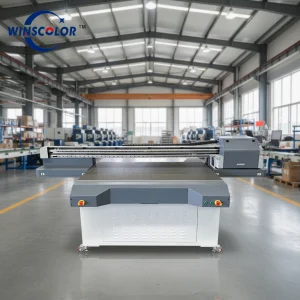
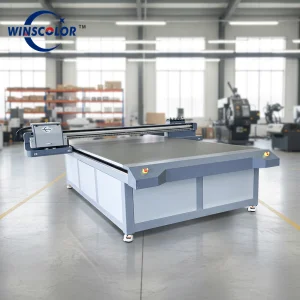
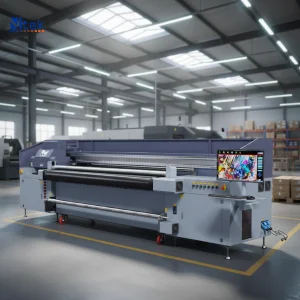
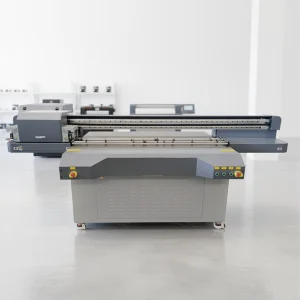
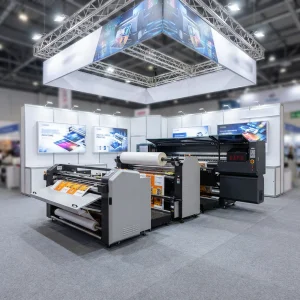
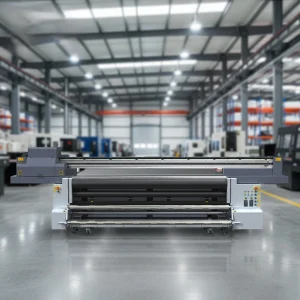
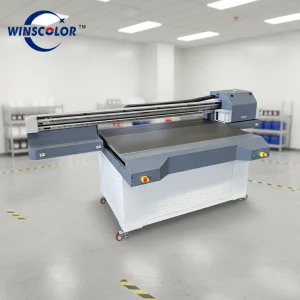
Engineered for high-duty cycles, precision registration, and cylindrical jig versatility across rigid and tapered hollowware substrates.
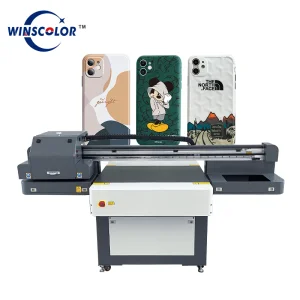
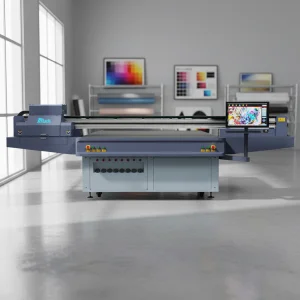
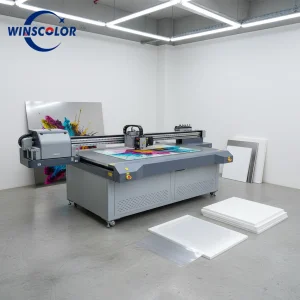
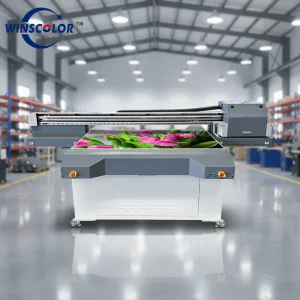
A comprehensive examination of how precision drop-on-demand piezo ejection and dynamic cylindrical synchronization have disrupted conventional screen and pad decoration.
Unlike flatbed media, cylindrical cup printing requires precise control over the drop throw distance (stand-off). Industrial printheads such as Ricoh Gen6, Toshiba CE4M, and Epson i3200-U1 utilize high-frequency acoustic piezo pulses that project micro-droplets (ranging from 3.5pl to 28pl) with minimal satellite dispersion.
The mathematical core of a modern rotary UV cup printer lies in maintaining a 1:1 linear surface velocity ratio between the rotating substrate and the carriage firing frequency. This eliminates graphic elongation and compression distortions across varied diameters.
Photopolymer inks are exposed instantaneously to tuned monochromatic UV-LED light sources (typically 395nm or 385nm). This arrests droplet spread before surface tension or gravitational runoff induces chromatic bleeds or physical pinholing.
In wholesale B2B drinkware supply, traditional screen printing demands physical screens, emulsion exposure, registration fixtures, manual ink mixing, and drying ovens for each color separation. Minimum viable runs commonly exceed 1,000 units per artwork variant. Digital UV cup printing completely dissolves these mechanical constraints: zero plates, zero setup make-ready waste, variable data capability (serialization, custom names, dynamic QR codes), and immediate multi-layer deposition (White underbase + CMYK photographic reproduction + Spot tactile varnish) executed in a single synchronized rotation.
An enterprise assessment of unit economics, manufacturing clusters, and supply chain strategies driving next-generation drinkware packaging and brand customization.
| Evaluation Parameter | Analog Rotary Screen / Pad Printing | Rotary Dye-Sublimation | Industrial Rotary Direct UV Inkjet |
|---|---|---|---|
| Pre-Press & Tooling Cost | $150 - $450 per color set (Screens/Plates) | Transfer paper + Heat press dies ($20 - $50) | $0.00 (Pure Digital RIP Asset) |
| Color Gamut & Complexity | Spot colors (1-4 typical, high setup for halftone) | CMYK (Limited spot/varnish capabilities) | CMYK + LcLm + White + 3D Gloss Varnish |
| Substrate Versatility | High (Requires specialized inks per material) | Strictly coated polymers / polyester coatings | Universal (Stainless, Glass, Ceramics, PP, PET, Wood) |
| Tactile / Embossing Capability | Limited (Heavy screen paste deposit) | None (Flat molecular dye transfer) | High (Layered white/clear varnish micro-relief) |
| Production Break-Even | Economical only at >1,500 units | Economical between 50 - 500 units | Profitable from 1 unit to 100,000+ units |
| VOC Emissions & Safety | High solvent off-gassing, washing chemicals | Thermal smoke during sublimation bake | Zero VOC, low-energy LED, mercury-free |
Modern B2B purchasers rarely buy standalone machines; they invest in integrated ecosystems. Leading wholesale manufacturers collaborate with OEM gantry producers, RIP software developers (e.g., Onyx, Caldera, SAI), and raw blank suppliers to provide turnkey printing pipelines.
In wholesale drinkware decorating, ink expenditure defines overall margin. Utilizing high-density micro-pigment UV formulas allows vibrant full-bleed decoration on 500ml tumblers at an average consumption rate of 0.12ml to 0.28ml per unit, translating to an ink cost of $0.012 to $0.028 per finished product.
Contract decoration hubs require robust APIs to link production floors with enterprise ERP and web-to-print portals. Modern wholesale cup printer systems feature automated job ingestion, barcode-driven template loading, and motorized optical substrate dimension verification.
Ensuring global industrial compliance, low-migration consumer safety, and resilient field engineering across North American, European, and Asian wholesale hubs.
Cup and drinkware applications must adhere strictly to global food-contact material guidelines. While external surfaces do not contact consumable liquids directly, migration during lip contact or stacking must be controlled.
Export-grade production machinery is certified under stringent international safety frameworks to ensure long-term mechanical reliability and operator security in industrial plants.
Wholesale manufacturing resilience demands minimal unscheduled downtime. Tier-1 UV cup printer manufacturers establish localized support structures across core economic hubs.
From insulated powder-coated stainless steel drinkware to luxury cosmetic glass containers, rotary UV systems deliver uncompromised surface adhesion and visual richness.
Widely utilized across the outdoor, corporate gifting, and lifestyle retail markets (hydro-style vacuum vessels). Direct UV printing achieves durable, scratch-resistant finishes directly over untreated powder coat or bare stainless steel.
Boutique beverage producers leverage rotary digital printing to decorate aluminum craft beer cans, glassware, and spirits bottles for regional, seasonal, or collaborative batches.
High-end perfumery bottles, lip gloss tubes, lotion dispensers, and premium aluminum aerosol cans rely on micro-precise registration and tactile haptic embossing.
With widespread municipal bans on single-use plastics, entertainment venues and sporting stadiums demand millions of customized, washable polypropylene (PP) cups.
Beyond drinkware, rotary UV mechanisms print directly onto extruded PVC piping, cylindrical oil filter housings, shock absorber bodies, and precision measuring cylinders.
Emerging developments in single-pass continuous helical motion, AI-powered computer vision registration, and sustainable eco-friendly photoinitiators.
Current multi-pass scanning systems rotate the cup multiple times under an indexing carriage. The next-generation architecture shifts toward continuous helical jetting, where the printhead carriage traverses axially in exact synchronization with continuous rotation, completing full prints in 4 to 8 seconds.
Real-time optical sensors dynamically map irregular, contoured, or slightly bent drinkware geometries. A dual-axis laser profilometer feeds topography back to the controller, adjusting the micro-piezo drop fire delay on the fly to compensate for surface runout.
To eliminate surface oxygen inhibition and achieve complete crosslinking at lower UV irradiance, future systems deploy localized nitrogen gas blankets around the curing zone. This enables lower energy consumption, zero ozone production, and compatibility with bio-based renewable monomer inks.
In-depth responses authored by application engineers addressing the critical considerations of wholesale UV cup printer acquisition.
Eliminating visible seam artifacts requires synchronization between the rotary stepper motor and the RIP software feathering algorithm. The system executes a gradient blend (feathering) across the boundary zone where the start and end of the image meet. By randomly dispersing drop locations across a 1mm to 3mm overlap window, the human eye cannot perceive a boundary step or density shift.
Yes. Conical compensation is managed directly through the machine’s specialized rotary RIP module. Because the top diameter of a tapered cup has a greater circumference and surface velocity than the base, rectangular images naturally distort into a fan or keystone shape if printed linearly. The RIP algorithm calculates the taper angle and pre-distorts the graphic file into an arc profile with compensatory pixel compression, resulting in a parallel, distortion-free output on the physical substrate.
Bare glass, ceramics, and untreated stainless steel possess high surface tension thresholds that cause UV inks to delaminate under prolonged thermal and alkaline dishwasher environments. Achieving maximum adhesion (Class 0 per ISO 2409 cross-hatch tape test) typically entails either in-line wipe primers, vacuum plasma activation, or flame pyrosil treatment. These treatments convert hydrophobic inert surfaces into high-energy receptive bonding sites, ensuring prints survive 50 to 100+ residential dishwasher cycles.
In a continuous wholesale multi-shift environment, daily maintenance involves automated wiping and head capping with a mild flush solution, taking less than 10 minutes. Weekly routines include cleaning the encoder strip, inspecting wiper blades, and verifying negative pressure calibration. Operational costs consist primarily of ink (averaging $0.015 - $0.030 per vessel depending on white/varnish coverage) and electricity for the LED-UV arrays (typically drawing 1.5kW to 3.5kW per hour, a fraction of thermal oven dryers).
Entry-level flatbed add-ons mount a motorized roller jig onto a standard flatbed table, relying on the Y-axis belt to turn the object. This is suited for craft shops but lacks speed, thermal management, and precision alignment for high tapers. Dedicated industrial rotary cup printers feature purpose-built multi-chuck indexing turrets, synchronized dual-clamp pneumatic mandrels, dedicated angled UV-LED lamps, automatic diameter sensing, and heavy-duty casting that eliminates micro-vibrations at high RPM.
Explore our complete export-certified industrial catalog engineered for packaging converters, high-volume decorators, and commercial print operations.