Pre-configured industrial flatbeds and hybrid architectures engineered in China for multi-shift sign, packaging, and decoration output.
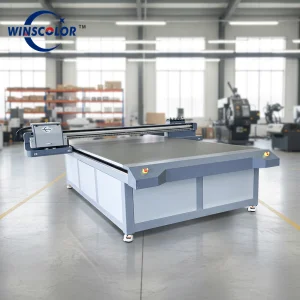
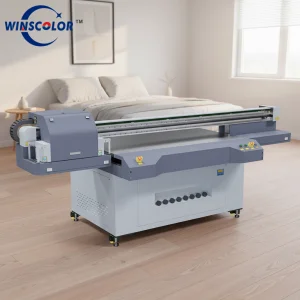
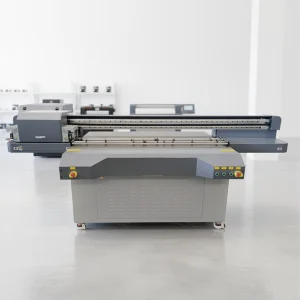

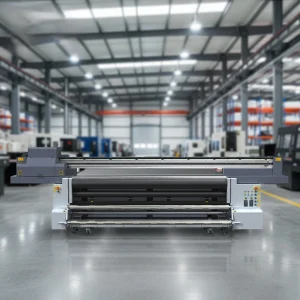
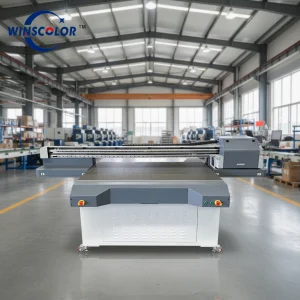
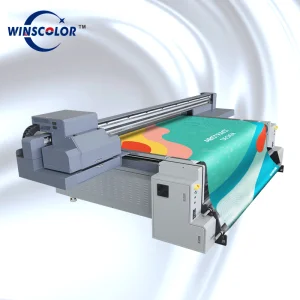
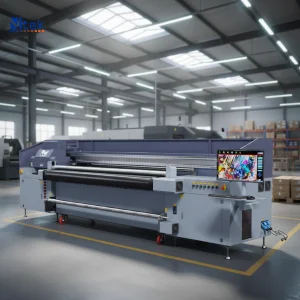
From monolithic steel frame annealing to proprietary sub-micron ink delivery systems, discover how Chinese advanced manufacturing clusters empower Tier-1 print converters worldwide.
Unlike light sheet-metal constructions prone to thermal warping, our printer beds are constructed from heavy structural tubular steel. Every chassis undergoes thermal annealing furnaces to eliminate internal crystallization stress, followed by five-sided CNC machining to maintain beam planar deflection within ±0.02 mm across full 3.2-meter widths.
Situated in Jinan's industrial heartland, our manufacturing cluster integrates optical encoders, German Igus drag chains, Italian Megadyne timing belts, and Japanese Omron optoelectronic sensors within a 50 km logistics perimeter. This localized supply elasticity shortens lead times to 7–14 days while reducing component acquisition overhead by 35% compared to Western counterparts.
We provide global brand owners, equipment distributors, and industrial integrators with comprehensive private-label OEM capabilities. From custom pantone powder coatings and localized RIP software bundling to proprietary industrial enclosure designs and automated material handling integration, our engineering teams build printers to your precise market specifications.
Strategic insights into droplet physics, photonic curing systems, and intelligent vision alignment reshaping industrial throughput.
Traditional mercury arc discharge lamps emitting excessive infrared heat are obsolete. Modern wide-format architectures use narrow-band UV-LED arrays (395nm and 365nm) with water-recirculation chillers. This permits direct imaging onto ultra-thin heat-sensitive substrates like 0.2mm PVC film, cast acrylic, and polyolefin stretch liners without thermal buckle or chromatic distortion.
The industry migration toward industrial drop-on-demand piezo printheads such as the Ricoh Gen6 (MH5320) and Kyocera KJ4A series allows high-frequency jetting up to 50 kHz. Multi-level grayscale firing (varying droplet volumes from 5pl to 15pl) delivers photographic skin tones and crisp 2pt micro-text while maintaining solid coverage density in single-pass high-speed modes.
Modern wide-format printers are transforming into smart robotic workstations. High-resolution CCD vision cameras mounted adjacent to the printhead carriage scan fiducial marks on pre-cut acrylic panels, corrugated flutes, or thermoformed sheets, dynamically calculating skew angles and X/Y offset errors within milliseconds to adjust carriage trajectory on the fly.
Delivering high-durability color deposition across dense, non-porous, and flexible substrates without surface flaking.
Printing non-porous vitreous materials requires exact chemical surface conditioning. By combining automated digital primer jetting with heated vacuum bed vaporization, our printers create covalent molecular bonds on raw float glass, tempered splashbacks, and vitrified tiles. High-opacity titanium dioxide white layers prevent back-illumination bleed-through.
Meeting the surge in short-run e-commerce boxes and point-of-sale (POS) standees, our plate-free corrugated systems eliminate traditional flexographic plate-making costs and lead times. Handle single-wall, double-wall E/B flute corrugated boards, and honeycomb panels with zero crush damage through non-contact piezoelectric jetting.
For specialized electrical and electronics manufacturers, our OEM flatbeds deposit high-precision markings onto brushed aluminum anodized panels, polycarbonate fascia overlays, instrument dials, and ABS device enclosures. Micro-droplet dot placement allows razor-sharp typography down to 0.5 mm line thicknesses.
A rigorous engineering framework for procurement directors evaluating capital expenditure against lifecycle operating margins.
Acquiring wide-format assets requires looking beyond initial machinery invoices. Factory-direct sourcing reduces capital depreciation costs by 40–55% compared to Western-branded re-badged equipment. More importantly, open-architecture ink systems reduce per-liter UV pigment expenditure from $120–$180/L down to $35–$50/L, delivering average consumable savings exceeding $35,000 annually in double-shift print shops.
Our industrial engineering philosophy guarantees a Mean Time Between Failures (MTBF) exceeding 3,500 continuous running hours. By implementing positive-pressure wiping stations, automatic ink degassing loops, and dual-rail carriage stability, we reduce nozzle deflection and physical maintenance intervals. Mean Time to Repair (MTTR) is kept under 2 hours with plug-and-play modular circuitry.
Every industrial printing machine leaving our Jinan factory floor meets European Machinery Directive 2006/42/EC, Low Voltage Directive 2014/35/EU, and Electromagnetic Compatibility (EMC) Directive 2014/30/EU standards. Machines are packaged within anti-corrosive foil vacuum envelopes, sealed inside steel-framed fumigated timber crates rated to withstand heavy maritime container transit.
Comprehensive answers formulated by our chief mechanical, chemical, and software systems engineers for commercial printing buyers.
Explore specialized large-format printing engines manufactured for heavy production volumes and high substrate versatility.
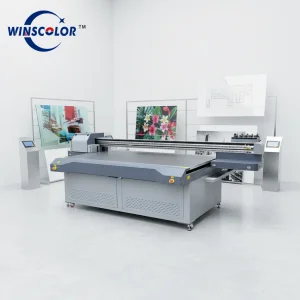
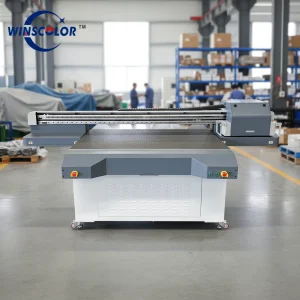
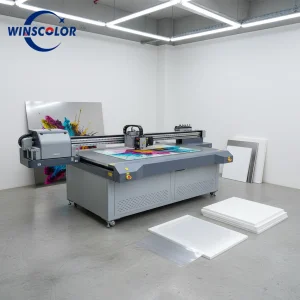
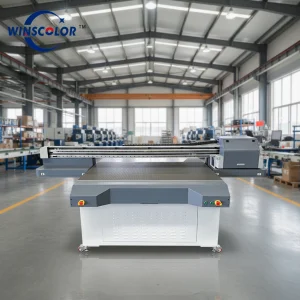
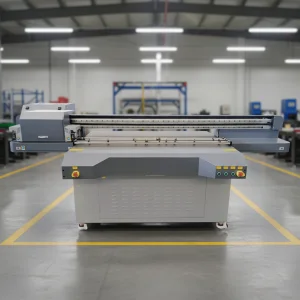
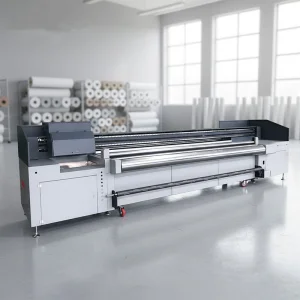
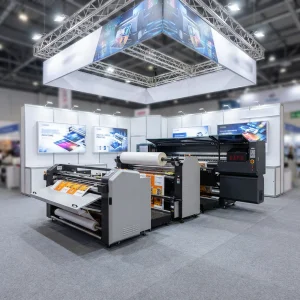
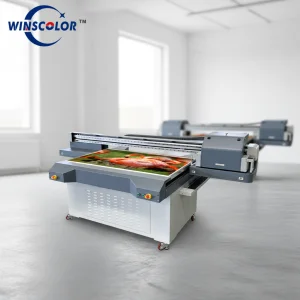
Submit your substrate profiles and target monthly output. Our senior mechanical and color management engineers will formulate custom printhead configurations, ICC profiles, and comprehensive factory-direct quotation sheets.
