Direct factory integration featuring high-resolution piezo drop-on-demand technology, dual-mode feed mechanisms, and custom OEM manufacturing.
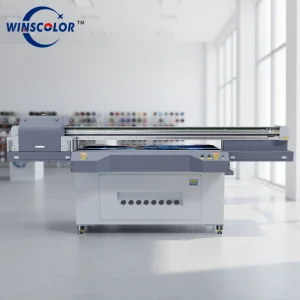
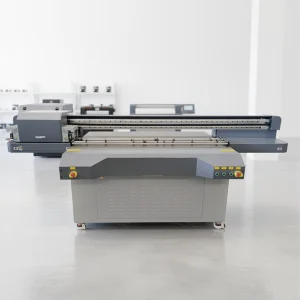
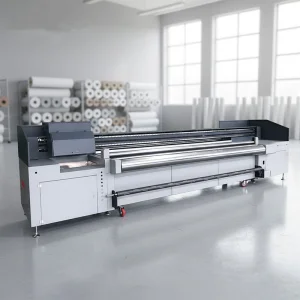
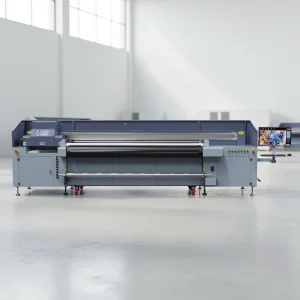
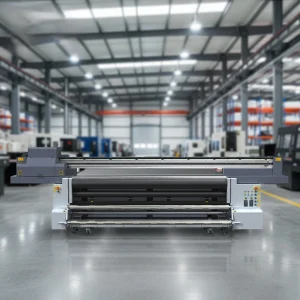

Why leading global distributors, equipment brand owners, and high-capacity sign makers partner directly with our specialized digital printing engineering plant in Jinan, China.
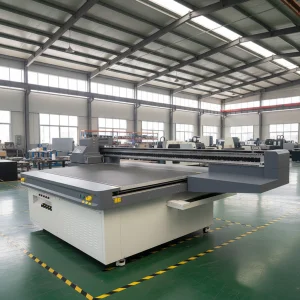
Our 20,000 m² Jinan manufacturing plant incorporates five-axis CNC gantry milling machines to anneal, temper, and machine heavy-duty tubular steel chassis. This relieves internal stresses and achieves beam flatnesses within ±0.02 mm across spans of up to 3.3 meters. Such extreme dimensional rigidity prevents mechanical deflection at production speeds exceeding 80 m²/h.
Located at the center of Shandong’s high-precision equipment cluster, our manufacturing pipeline secures tier-1 components with zero supply friction. From Japanese THK dual linear mute guideways and Panasonic AC servo motors to German Igus drag chains and Megadyne vacuum belts, our vertical assembly cuts procurement lead times by 35% compared to Western manufacturers.
We provide end-to-end white-label engineering for overseas OEMs, including specialized sheet-metal sheet styling, custom PLC interface localization, proprietary firmware integration, and private-labeled RIP color profiling. Every export batch undergoes 72 hours of uninterrupted dry runs followed by 24 hours of live printing on challenging rigid substrates like mirror acrylic and stainless steel.
An analysis of thermodynamic LED curing, grayscale piezo drop-on-demand architectures, and the convergence of flexible and rigid workflows.
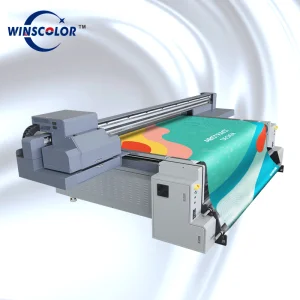
Commercial print shops historically purchased separate machines: a dedicated vacuum flatbed for corrugated board, acrylic, and ACM panels, and a roll-to-roll solvent or latex printer for flexible banners, canvas, and backlit film. Modern high-cost footprint realities and labor crunches have accelerated migration toward the industrial UV hybrid platform. By combining heavy vacuum-conveyor belts with folding extension tables and motorized tensioning rewind systems, a single hybrid footprint delivers up to 90% floor-space utilization efficiency, dropping capital equipment amortizations by nearly 40%.
Mercury vapor arc lamps are rapidly becoming obsolete due to international environmental directives (such as the Minamata Convention on Mercury) and high thermal outputs that warp heat-sensitive substrates. Winscolor UV hybrid platforms employ dual water-cooled 395nm UV-LED curing arrays. The instantaneous on/off response of LEDs cuts electrical draw by over 60%, eliminates lamp warm-up cycles, and operates with surface temperatures below 38°C, allowing distortion-free printing on ultra-thin PET backlit films, corrugated PP hollow sheets, and shrinkable PVC sleeves.
Industrial output requirements now balance raw speed with photo-realistic micro-detail. Utilizing Ricoh Gen6 and Gen5 piezo printhead technology, our hybrid printers implement variable droplet firing from 5pl to 15pl. Smaller droplets smooth human skin tones, micro-text labels, and fine gradients, while larger droplets achieve saturated solid colors and high-density white underbases at high carriage travel velocities.
| Performance Dimension | Traditional Dedicated Flatbed | Dedicated Roll-to-Roll UV | Industrial OEM UV Hybrid System |
|---|---|---|---|
| Substrate Flexibility | Rigid Boards Only (≤ 100 mm) | Flexible Rolls Only (≤ 2 mm) | Rigid Sheets + Continuous Flexible Rolls |
| Shop Floor Utilization | Requires Dedicated Table Clearance | Small Footprint, Limited Scope | Collapsible Infeed Tables Save 45% Space |
| Curing Technology | Traditional UV / Metal Halide | Standard UV-LED | Dynamic Segmented UV-LED (Cold Curing) |
| Average Setup Time | Manual Gantry Alignment (5-10 min) | Roll Threading (3-5 min) | Quick Clamp Pneumatic Roller (< 2 min) |
| Procurement Capital (ROI) | High Initial Capex | Moderate Capex | Maximized ROI (Two Machines in One Engine) |
From architectural surfaces to high-volume carton packaging, explore how our hybrid printers deliver clean ink deposition across heterogeneous materials.
Direct printing onto tempered glass shower panels, kitchen splashbacks, and architectural facades requires strict surface energy matching. Winscolor printers utilize an inline silane-based chemical primer applied digitally or manually, coupled with flexible UV inks that provide cross-hatch adhesion ratings of 5B (ASTM D3359). Ceramic tiles printed with high-gloss spot varnish resist humid interior environments without yellowing or thermal shock delamination.
E-commerce growth demands short-run personalized boxes with fast turnarounds. Plate-making for flexographic or lithographic mounting is impractical for runs under 2,000 units. Our hybrid and single-pass feeding tables accommodate single-, double-, and triple-wall corrugated flute structures up to 50 mm thick. Zero drying time enables printed cardboards to transfer straight to digital flatbed CNC cutting tables for immediate finishing.
Producing premium airport lightboxes requires high color density and light-blocking white barriers. Winscolor’s "sandwich" mode (Color + White + Color) prints two distinct graphics on opposite faces of transparent acrylic or PET film in a single carriage pass. Under daylight, the front graphic stays vivid; when back-illuminated at night, the secondary image springs to life with deep color saturation and zero register misalignments.
Industrial machinery front-plates, anodized aluminium badges, and polycarbonate membrane switches require sharp vector text and high chemical resistance. Our precision negative-pressure ink delivery prevents nozzle dropouts during complex micro-font runs down to 2-point sizes. Cured UV inks resist typical cleaning solvents, lubricants, and abrasion in field environments.
Custom furniture manufacturers print wood grain patterns, artwork, and branded textures onto pine, oak, and engineered MDF boards. Our continuous vacuum suction belt flattens warped lumber during feeding, while optional white ink layer configurations hide dark background wood grains, preserving natural wood highlights where desired.
From genuine leather luggage to PU synthetic phone sleeves, specialized flexible UV formulations prevent cracking upon bending or stitching. Multi-layer varnish deposition builds up tactile relief effects, Braille lettering, and faux crocodile textures, yielding high margins on short-run promotional products.
Key technical criteria professional equipment buyers evaluate before commissioning large-scale OEM UV printing machinery from China.
Purchasing an industrial UV hybrid printer requires evaluating the total operating cost across a 5-to-7 year lifecycle rather than just initial purchase price. The machine's structural engineering, ink fluid dynamics, and electronic components determine real-world profitability.
Explore our full line of wide-bed flatbeds, high-speed single-pass corrugated printers, and multi-axis inline converting solutions.
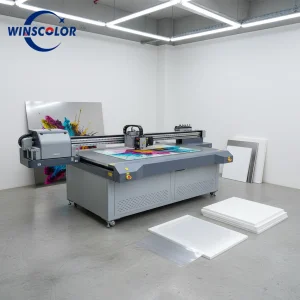
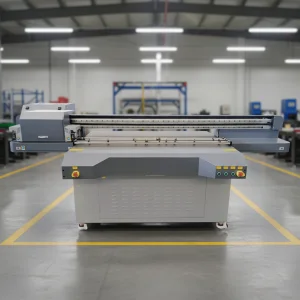
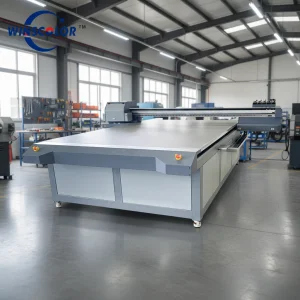
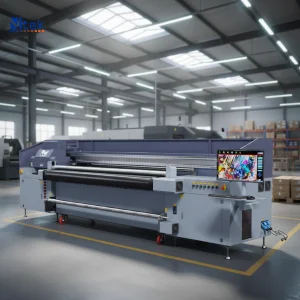
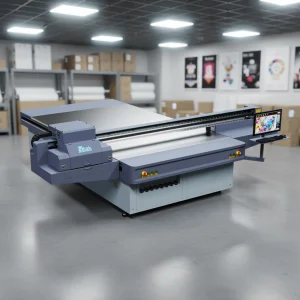
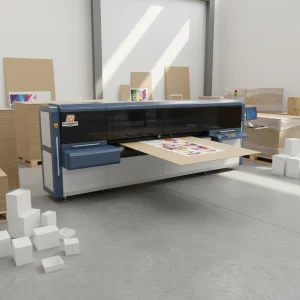
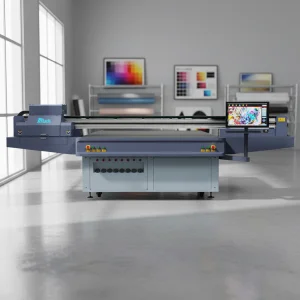
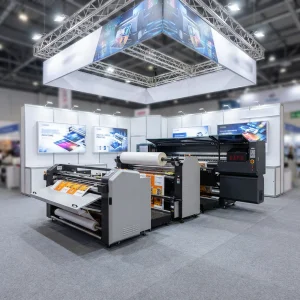
Direct answers from our chief engineers covering maintenance, printhead configurations, substrate primers, and international warranties.
A hybrid UV printer uses an automated vacuum conveyor belt coupled with detachable roll-feed mechanisms. This allows operators to switch from thick rigid materials (such as 100 mm acrylic panels, wood slabs, or corrugated cardboards) to flexible roll substrates (such as PVC banners, backlit films, canvas, and faux leather) in under five minutes. For print shops with dynamic customer orders, hybrid machines consolidate capital expenses, reduce building footprint by up to 50%, and avoid keeping multiple single-purpose machines idle.
The Ricoh Gen6 (MH5320) piezo printhead features isolated ink paths, 1,280 channels per head, and fires droplets down to 5 picoliters at an operating frequency of up to 50 kHz. Compared to consumer-derived printheads, the Gen6 offers a stainless-steel nozzle plate compatible with aggressive industrial UV inks, an integrated internal heating system to regulate ink viscosity, and an operational lifespan exceeding 100,000 m² under standard maintenance schedules.
Our hybrid vacuum transport tables feature independent multi-zone vacuum chambers driven by high-static-pressure side-channel blowers. The vacuum belt itself is reinforced with Kevlar tensile cords and perforated in high-density CNC patterns. When paired with high-torque Yaskawa or Panasonic AC servo motors and double pneumatic pinch rollers, the belt feeds materials weighing up to 100 kg with zero slip and continuous linear tracking.
While high-intensity UV-LED curing polymerizes monomers rapidly, inert non-porous surfaces like polished float glass, stainless steel, and glazed ceramics possess very low surface energies (< 30 dynes/cm). Applying a silane-based chemical coupling primer or integrating an inline corona flame pretreatment increases surface tension above 48 dynes/cm, ensuring long-term adhesion and weatherability.
Standard stock configurations (such as standard YC2513L or YC3200HR platforms) typically dispatch within 10 to 14 working days. Full OEM/ODM builds—including custom RAL powder-coating colors, private-label sheet metal casings, specialized vacuum configurations, custom firmware, and proprietary RIP software packaging—typically run on a 30 to 45 day cycle from engineering sign-off to port loading.
Winscolor operates a tiered global support infrastructure. We provide comprehensive English video manuals, board-level circuit schematics, and live cloud diagnostics via TeamViewer and video link. Core spare parts (including mainboards, printhead driver boards, pumps, and valves) are stocked at regional logistics hubs in Europe, North America, and Southeast Asia for fast courier dispatch.
Discuss your custom build requirements, get technical configuration advice, or arrange test sample prints on your specific production materials with our team in Jinan, China.
