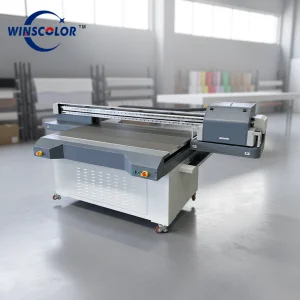
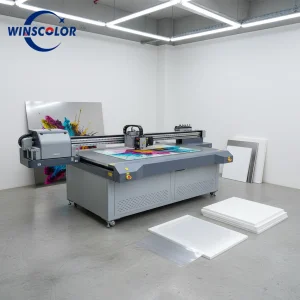
Direct factory supply equipped with industrial Ricoh Gen6 piezo printheads, dual negative pressure sub-ink management, and calibrated UV-LED curing arrays for rigid architectural glass and engineered acrylic sheets.

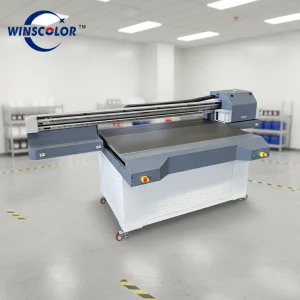

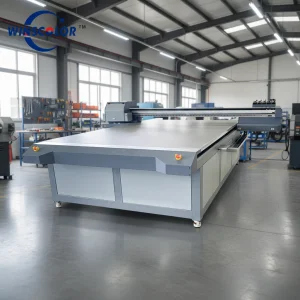
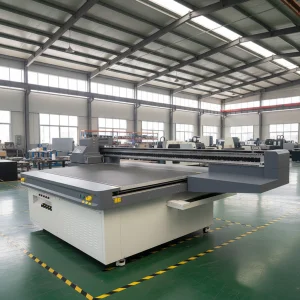
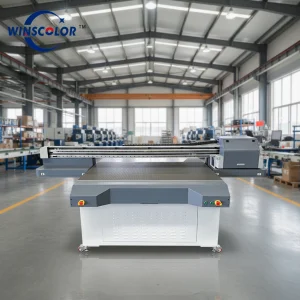
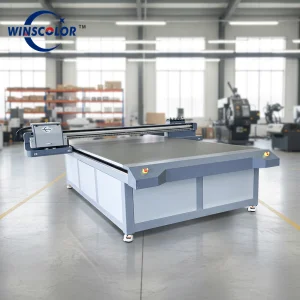

Evaluating why high-volume manufacturing lines across Europe, North America, and the Asia-Pacific region are abandoning traditional silk-screen methods and vinyl lamination in favor of high-throughput UV LED flatbed inkjet systems.
Traditional silkscreening incurs massive prepress overhead—film output, screen burning, stencil reclamation, and color-matching delays. In high-mix, variable-volume manufacturing, direct-to-substrate UV digital printing drops setup cost to absolute zero, rendering on-demand lot sizes of one just as cost-effective as runs of 5,000 units.
Silicate glass and polished acrylic present non-porous, chemically inert substrates characterized by extremely low surface energy (typically 30–38 dynes/cm). Our engineering integrates synchronized pre-print plasma ionization, micro-vaporized silane primers, and cold LED UV photoinitiators to create durable covalent bonding without thermal substrate warping.
Stringent REACH, RoHS, and EPA mandates are penalizing the solvent evaporative emissions inherent in conventional solvent-based screen inks. Winscolor UV-curable inks use 100% solid, monomeric formulation systems that polymerize instantly under 395nm wavelength LED arrays, emitting negligible volatile organic compounds.
Printing on 12mm structural tempered glass or 20mm cast acrylic presents extreme inertial and planar challenges. Explore the structural blueprints of Winscolor industrial printing beds.
Cast from high-rigidity structural steel and annealed at 600°C to eliminate residual mechanical stresses. Precision machined on a 12-meter CNC five-axis portal milling center to guarantee straightness within 0.015mm over the entire carriage track.
Configured with dual THK high-precision linear guide rails and paired with an integrated magnetic linear encoder scale (1μm resolution). Prevents harmonic vibration and micro-banding artifacts during high-speed carriage traversal.
Independent vacuum control loops for color inks and white/varnish channels ensure meniscus pressure stability at high jetting frequencies (30kHz). Prevents ink starvation during dense white floods and eliminates nozzle dripping during stand-by cycles.
Honeycomb aluminum vacuum platform divided into independently switchable airtight zones. Incorporates high-flow turbine reverse blowers that generate an air flotation cushion, allowing operators to glide 100kg glass slabs into position without edge chipping.
Expanding commercial revenue streams through engineered droplet deposition, optical-grade transparency management, and multilayer tactile texturing across varied global industries.
Printing directly on monolithic, laminated, or tempered architectural glass panels for interior feature walls, conference room privacy partitions, and exterior balustrades. Micro-controlled ceramic and hybrid UV inks resist intense solar UV radiation, thermal expansion cycles, and cleaning chemical delamination.
Ultra-clear cast acrylic (PMMA) fabrication demands immaculate optical transparency. By jetting high-density white foundations beneath vibrant CMYK pigments and finishing with selective spot gloss varnish, fabricators produce perfume glorifiers, illuminated vitrines, and edge-lit LED branding panels that command premium price points.
Household induction cooktops, refrigeration panels, and smart building thermostat control panels rely on back-printed tempered glass. Our precision optical alignment systems achieve sub-pixel registration over capacitive touch zones, with high-opacity blocking blacks that prevent backlight bleeding.
Specialty anti-glare polycarbonate and acrylic instrument clusters require tightly controlled matte and gloss finishes. Digital UV printing delivers dial calibrations, warning indicators, and dead-front icons with heat resistance up to 105°C continuous operating temperatures without color shifting.
Replacing traditional wet lab photo mounting processes. Museum-grade photographic prints are laid down directly onto the reverse side of 6mm-10mm diamond-polished cast acrylic. Ricoh Gen6 5pL variable grayscale drop execution ensures skin tones, shadow gradations, and vivid highlights show zero graininess.
Manufacturing heavy machinery labels, serial plates, and emergency directional signs on thick, scratch-resistant acrylic and chemically treated glass. Scratch resistance is reinforced through inline micro-curing, passing rigorous ASTM D3363 pencil hardness testing up to 4H rating.
Direct from the manufacturing source. How vertical integration, rigorous localized supply ecosystems, and comprehensive pre-shipment aging routines yield an unmatched total cost of ownership (TCO).
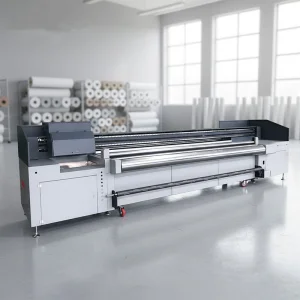
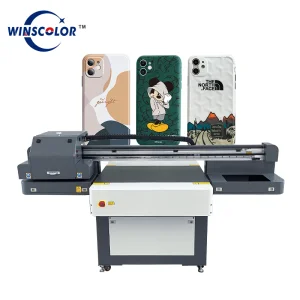
Winscolor operates six state-of-the-art assembly lines in Jinan, China, dedicated to compact flatbeds, wide-format 2513/2030 machines, hybrid roll-to-roll platforms, and ultra-wide 3.3m industrial engines. This modular manufacturing structure allows us to fulfill bespoke OEM/ODM requests within a 15-to-20-day production window.
Situated within Shandong's high-tech industrial machinery corridor, Winscolor leverages instant access to premium aerospace-grade aluminum extrusions, precision servo motors, high-frequency wiring chains, and cryogenic chillers. Component standardization guarantees guaranteed spare part availability for 10+ operational years.
Every printer leaving our manufacturing bays completes an unyielding quality control protocol: 24 hours of gantry dynamic high-acceleration burn-in, 24 hours of continuous fluidic circuit pressure testing, and 24 hours of full-coverage test printing on actual acrylic and glass slabs to certify printhead registration.
Our Jinan engineering laboratories are driving forward-looking architectural upgrades to ensure Winscolor equipment owners remain technologically insulated against market disruptions.
Integrating next-gen piezo actuators delivering multi-drop grayscale down to 2.0 pL for grainless high-optical art reproduction. Deploying inline cold atmospheric plasma torches on the carriage beam to instantly raise substrate surface energy to >52 dynes/cm immediately prior to jetting, removing the requirement for manual chemical wipes.
Carriage-mounted ultra-high-speed linear CCD visual cameras continuously inspecting printed drop formation in real-time. Embedded neural network algorithms automatically correct missing nozzles via intelligent multi-pass feathering compensation, preventing banding defects on expensive architectural tempered glass sheets.
Expanding the ink path architecture to handle functional nanoparticle conductive inks (silver and copper suspensions). Enabling direct digital printing of defogging heater grids, embedded RFID circuits, and translucent photovoltaic conductive traces directly on interior and transport glass substrates.
International industrial deployments demand strict regulatory adherence and frictionless regional after-sales support networks across Europe, the Americas, and beyond.
Every flatbed printer is built to European CE Machinery Directive (2006/42/EC), Low Voltage Directive (2014/35/EU), and EMC Directive (2014/30/EU). Electrical cabinets incorporate high-integrity Schneider electrics, dual emergency shut-off loops, and fully shielded grounding busbars compatible with UL-508A North American factory guidelines.
Every Winscolor production machine is equipped with an encrypted industrial IoT diagnostic terminal. Our Jinan central engineering team monitors negative pressure variances, carriage motor torque anomalies, and UV LED thermal sink levels in real-time to execute predictive maintenance before any downtime occurs.
Backed by over 45 international distributor partners spanning 100+ countries. We provide localized on-site installation, factory calibration, color ICC profiling for regional acrylic and glass brands, and rapid next-day dispatch of genuine printheads, boardsets, and cured inks from regional bonded warehouses.
Direct answers addressing ink adhesion thermodynamics, mechanical structural tolerances, printhead life expectancies, and operating cost analysis.
Glass and cast acrylic are chemically inert with low surface energy. We employ a three-tier adhesion protocol: first, surface wiping or carriage-based spraying of specialized silane coupling agents that chemically cross-link with inorganic SiO₂ groups on glass; second, variable-power LED UV cold pinning that eliminates thermal substrate stress; and third, customized hard-resin ink formulations providing extreme bond strength that easily surpasses ISO 2409 Class 5B cross-hatch peel testing.
Industrial Ricoh Gen6 printheads feature all-steel construction with isolated piezo actuators resistant to chemical erosion from UV monomers. They support high jetting frequencies up to 50 kHz with variable droplet control (5 to 15 pL), delivering 100% straight-line droplet trajectory over wider throw distances (up to 4–5mm). This prevents droplet deflection caused by electrostatic air turbulence commonly found above non-grounded acrylic sheets.
At 100% full-color coverage (CMYK), typical ink consumption averages between 8.5 to 10.5 ml per square meter. When applying a solid high-density white underbase at 120% coverage for reverse printing on transparent acrylic or glass, total ink volume reaches approximately 18 to 22 ml/m². Based on factory direct OEM UV ink supply costs ($35–$45/liter), production costs range from $0.65 to $0.95/m², ensuring massive margin advantages over screen printing.
Conventional mercury arc UV lamps emit severe infrared heat (IR) that easily heats thin acrylic sheets beyond their glass transition temperature (approx. 85°C–100°C), resulting in curling and nozzle crashes. Winscolor utilizes water-chilled UV-LED cold light curing arrays emitting monochromatic 395nm light with zero infrared emission. Substrate temperatures never rise by more than 3°C to 5°C above ambient levels, preserving absolute dimensional stability.
Yes. Our flatbed structural chassis is constructed with a reinforced internal web girder design and a 50mm aviation-grade milled honeycomb vacuum platform. The maximum static load rating is certified at 100 kg/m² (totaling over 400 kg evenly distributed across a 2513 bed). The reverse-flow air flotation system allows heavy glass sheets to be floated and aligned manually by a single operator without scratching the bed or glass.
The solid-state UV-LED curing units deliver a calibrated operational MTBF in excess of 30,000 to 50,000 hours, requiring no routine bulb replacements. Industrial Ricoh Gen6 printheads, when operated with Winscolor purified inks and maintained via automated wiping and capped parking stations, consistently achieve an active working lifespan of 3 to 5 years under continuous double-shift (16h/day) factory conditions.
Tactile relief is created by multi-layer micro-deposition. The RIP software slices texture height profiles into stacked greyscale layers. The machine deposits multiple successive passes of high-viscosity UV white ink or transparent gloss varnish, with UV pinning between passes, building physical reliefs up to 2.0mm high. A final flood or selective varnish layer is cured under a dedicated UV curing mode to lock in high-gloss or matte visual tactile effects.
As an established Chinese primary manufacturer, Winscolor provides comprehensive OEM/ODM engineering integration. This includes custom sheet-metal exterior styling and industrial color palettes, personalized human-machine interface (HMI) branding, custom gantry clearance heights (up to 300mm for thick objects), integration of in-line robotics, and bespoke firmware calibrated for specialized UV ink chemical configurations.
Explore our full line of industrial digital flatbed, roll-to-roll, and hybrid UV inkjet engines built to power signage, packaging, industrial marking, and architectural décor applications globally.