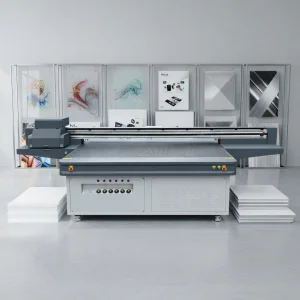
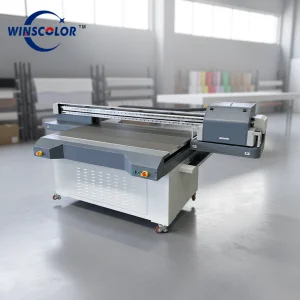
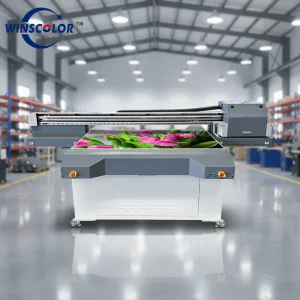
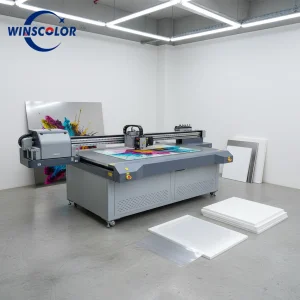
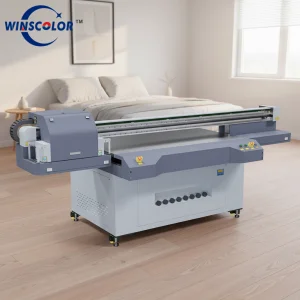
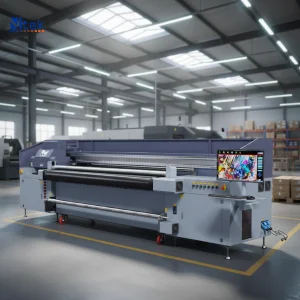
Explore our precision-engineered UV platform lineup configured for custom production factories, packaging converters, and international distributors.
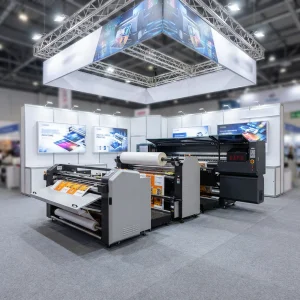
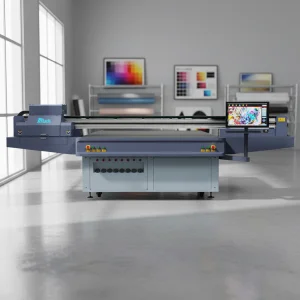
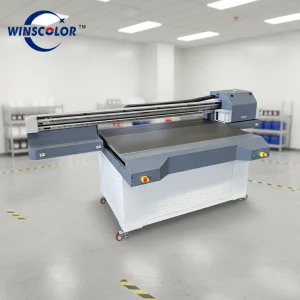
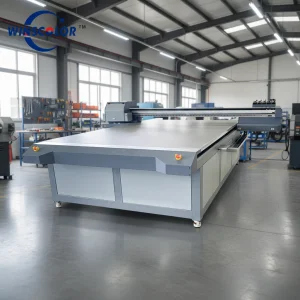
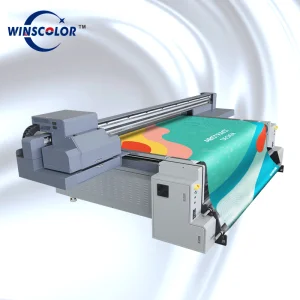

Analyzing the convergence of high-load industrial mechanics, continuous conveyor vacuum handling, and piezoelectric micro-droplet deposition systems for global industrial manufacturers.
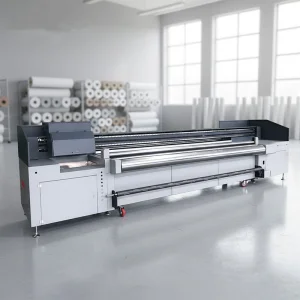
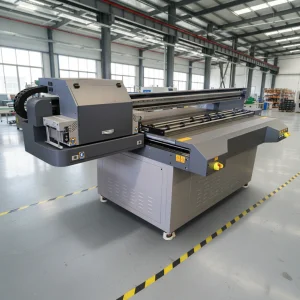
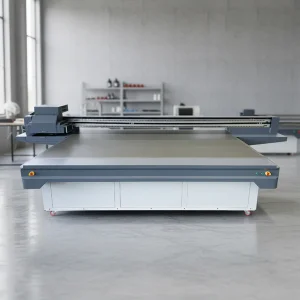
In modern industrial inkjet production, the 3.2m Hybrid UV Printer represents an architectural paradigm shift. Historically, industrial print providers faced an uncompromising trade-off: deploy dedicated flatbed printers that monopolize extensive factory floor footprints for rigid boards, or maintain high-speed roll-to-roll units that fail completely when rigid or semi-rigid substrates are introduced. The contemporary 3200mm hybrid UV platform resolves this operational dichotomy by incorporating an integrated continuous vacuum-assisted conveyor belt coupled with detachable heavy-duty extension tables.
At the center of our Jinan manufacturing facility's engineering ethos is structural mass and thermal inertia. A 3.2-meter span bridge subjected to high-acceleration carriage movements (up to 1.8 m/s) is susceptible to harmonic distortion, lateral deflection, and micro-vibration. If the gantry oscillates by merely 12 microns, the resultant bi-directional dot placement accuracy is destroyed, manifesting as acute banding across high-density solid fills. To mitigate this physics-bound hurdle, our OEM chassis are fabricated from high-tensile carbon steel box-girders, subjected to comprehensive 72-hour thermal stress-relief annealing and precision shot-peening before undergoing full five-axis CNC bridge milling in a temperature-controlled environment. This delivers true sub-micron linear guide coplanarity across the entire 3200mm span.
Equipped with independent negative pressure control chambers for white and color channels. Eliminates meniscus collapse during high-speed draft velocity shifts while maintaining hydrostatic stability.
Industrial conveyor feeding system powered by double Japanese Panasonic AC servos. Features a heavy-duty air-cushioned vacuum table divided into multi-zone switchable pneumatic chambers.
Dual-channel variable wavelength (395nm) LED curing lamps. Features closed-loop chilled liquid cooling to preserve dimensional integrity on heat-sensitive soft films and PVC flex.
Factory Engineering Note: Every OEM 3.2m chassis produced at our Jinan plant incorporates dual linear magnetic rail scales with 1μm optical encoders. This real-time positioning feedback eliminates mechanical backlash commonly experienced with traditional timing belts, ensuring razor-sharp font rendering down to 2pt text even at speeds exceeding 75 m²/hr.
Evaluating the industrial ecosystem advantages: supply-chain clustering in Jinan, direct OEM component localization, and substantial Total Cost of Ownership (TCO) optimization.
The global wide-format printing industry has experienced massive structural relocation over the past decade. Previously dominated by Western European and North American integrators who demanded exorbitant capital investments, the market has pivoted toward advanced Chinese manufacturing clusters. Located in the core machinery hub of Jinan, Shandong, our factory harnesses a vertically consolidated industrial cluster encompassing heavy structural steel casting, precision gantry CNC profiling, high-precision machining, and automated wiring loom robotics within a 50-kilometer radius.
This geographic concentration creates unmatched supply-chain elasticity and capital efficiency. When procurement managers evaluate a 3.2m hybrid UV system from Jinan Yingcai Digital Technology (Winscolor), they are not merely purchasing assembly labor; they are acquiring an industrial machine engineered with the world's most reputable Tier-1 motion and fluid components: THK or Hiwin linear guide rails from Japan and Taiwan, Megadyne belts from Italy, Igus drag chains from Germany, and Ricoh Gen6 or Kyocera KJ4A industrial printheads from Japan. By merging premium international key assemblies with China's ultra-efficient structural fabrication and proprietary board-level firmware development, we offer our OEM/ODM distributors a platform that delivers identical precision and MTBF (Mean Time Between Failures) metrics at a capital expenditure reduction of 40% to 60% compared to Western legacy equivalents.
| Evaluation Parameter | Winscolor OEM 3.2m Hybrid (China) | Legacy Western Equipment | Generic Commodity Printers |
|---|---|---|---|
| Initial Capital Outlay (CapEx) | Highly Optimized (-50%) | Substantial Premium (High markup) | Lowest (Sub-standard components) |
| Gantry Base & Structural Mass | Annealed 3200mm Heavy Cast Steel (2,200kg) | Engineered Welded Frame (1,800kg) | Lightweight Sheet Metal (<1,100kg) |
| Ink Open Architecture | Open RFID / Customized OEM Ink Chemistry | Proprietary Chipped Bags (High $/L) | Unregulated Inks (Frequent clogs) |
| Spare Parts Availability | Direct Factory Dispatched within 24 Hours | Regional Dealer Dependent (High Lead Time) | Inconsistent Component Batches |
| Customized Firmware & PLC | In-house R&D Tailored to Client Specs | Rigid Proprietary Firmware | Generic Third-party Board Sets |
From micro-embossed luxury packaging to architectural glass and exterior flex banners, examine the technical versatility enabled by the 3.2m hybrid configuration.
Evaluating environmental compliance, the decline of legacy solvent platforms, and key engineering variables for international OEM buyers.
Three powerful regulatory and commercial forces are currently driving large-format print service providers (PSPs) and industrial manufacturing plants toward 3.2m hybrid UV technology:
1. Strict Global VOC Decarbonization: Under European REACH and EPA air quality directives, solvent-based printing platforms face severe legislative restrictions, escalating disposal taxes, and mandatory thermal oxidizer installations. LED-UV curable formulations produce zero hazardous air pollutants (HAPs) and negligible VOC emissions, creating a completely safe shop-floor environment while shrinking overall operational electrical consumption by up to 65% compared to traditional mercury arc UV curing lamps.
2. Consolidation of Shop Floor Footprint: Real estate costs in major logistics hubs across Europe, North America, and Australia have increased significantly. Deploying independent 3.2m roll printers alongside separate 2.5m x 1.3m flatbed units requires substantial floor space, dual operator shifts, and redundant maintenance overheads. A single 3.2m hybrid UV platform unifies both capabilities into a 4.5m x 1.8m operating envelope, drastically reducing square-meter overhead while maximizing production flexibility.
3. Demand for High-Margin Tactile Customization: Commercial commoditization has driven standard sign margins down. However, products featuring tactile micro-embossing, spot varnish accents, and double-sided multi-layer backlit visual effects command high pricing premiums. A 3.2m hybrid equipped with dual white and clear varnish ink channels provides industrial producers with instant entry into high-margin decorative, packaging, and architectural niches.
Auditing between Ricoh Gen6 (5-15pl variable drop, 50kHz firing frequency) and Kyocera KJ4A (3.5pl native drop, 40kHz). Evaluating printhead nozzle health, native DPI, and life-cycle replacement costs per billion actuations.
Ensuring 24/7 continuous duty stability through active liquid temperature regulation inside the print carriage manifold. Verifying that ink viscosity stays within the critical 8-12 cPs tolerance envelope regardless of ambient temperature spikes.
Assessing supplier remote diagnostic telemetry, direct PLC cloud access for real-time firmware debugging, complete modular spare parts interchangeability, and certified factory-to-door technician training support.
In-depth technical answers compiled by our chief systems integration engineers for prospective OEM partners and international plant managers.
Continuous production solutions engineered for heavy industrial panels, continuous flex banner rolls, and multi-functional high-output factory deployments.