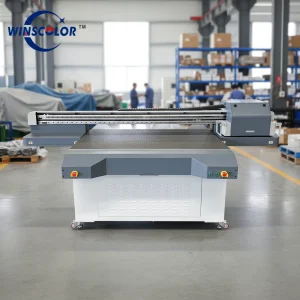
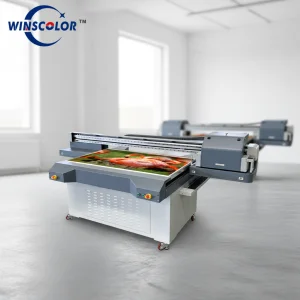
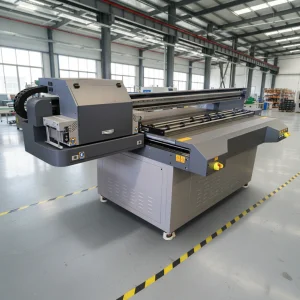
Explore high-throughput configurations calibrated for heavy-gauge rigid panels, architectural glazing, and dual-mode flexible continuous substrate processing.
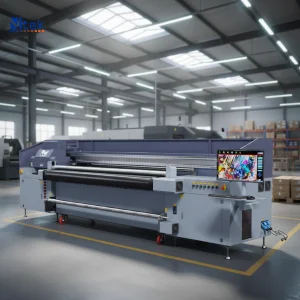
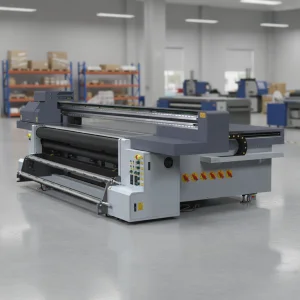

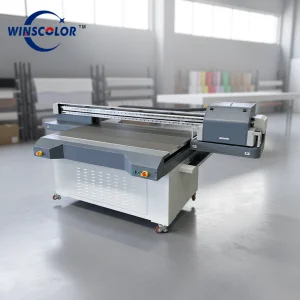
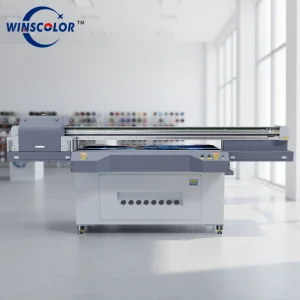
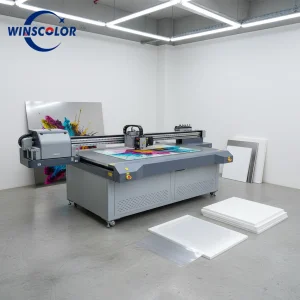
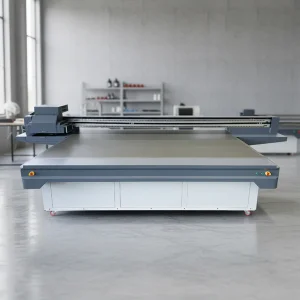
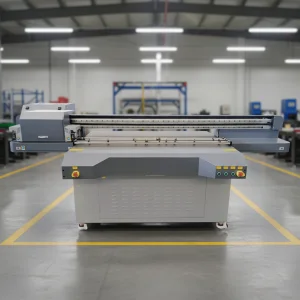
Industrial printing is executing an irreversible pivot from rotary screen and solvent evaporation towards high-density, energy-efficient photochemical ultraviolet polymerisation.
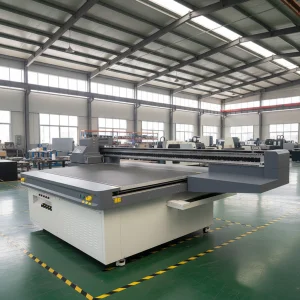
Traditional silkscreen and rotogravure production pipelines demand intensive mechanical setup: chemical emulsion deposition, photographic stencil development, color mixing, and physical registration. NTEK industrial UV flatbed architectures leverage drop-on-demand (DOD) piezo arrays directly driven by calibrated raster image processor (RIP) engines, collapsing the pre-press lifecycle from 48 hours to zero minutes.
Unlike thermal air-evaporated solvent systems that require post-print drying tunnels and VOC containment scrubbers, ultraviolet jetting triggers cationic or radical photopolymerisation upon instantaneous exposure to 395nm LED spectrums. Oligomers and photoinitiators cross-link instantly into an impermeable polymer matrix, achieving ASTM D3359 cross-hatch 5B adhesion immediately upon media discharge.
Large format UV engines eliminate substrate deformation. Thermally fragile materials such as corrugated twin-wall polypropylene, expanded closed-cell PVC sheets, unprimed acrylic cast panels, tempered architectural glass, and 3mm brushed aluminium composite materials (ACM) process without thermal bow, yielding ultra-flat registration across multi-pass runs.
Inside Jinan’s industrial machinery cluster: How vertical integration, high-precision thermal aging processes, and automated QA testing create unmatched cost-to-performance ratios.
NTEK flatbed printer frameworks are fabricated from heavy-gauge structural tubular steel beds undergoing dual natural-aging cycles and automated electric annealing furnace cycles. This eliminates residual internal stresses, preventing frame twisting over years of 24/7 continuous duty cycles. Five-axis CNC gantry milling machines machine rail datum planes in a single clamping step, holding total flatness tolerances below 0.02mm per linear meter.
Jinan Yingcai Digital Technology (Winscolor/NTEK) operates within China's densest mechatronic manufacturing ecosystem. Japanese linear rail guides, German IGUS drag chains, Italian Megadyne timing belts, and Schneider electrical controls are integrated directly on high-speed modular assembly lines, driving down component procurement cycle times and ensuring high-availability replacement spare inventories worldwide.
Every industrial engine leaves our 20,000 m² Jinan facility only after enduring 72 continuous hours of full-load simulated jetting routines, gantry bidirectional movement validation with laser interferometers, zoned vacuum table leak tests, and multi-frequency waveform oscillograph checks for piezo integrity, providing genuine zero-defect out-of-crate readiness.
A rigorous inspection of micro-piezo acoustic waveform control, constant-pressure dynamic fluidics, and precision motion kinematics underpinning NTEK industrial UV solutions.
Utilizing high-firing-frequency (up to 50 kHz) industrial Ricoh Gen6 (MH5320) printheads with variable droplet capability spanning 5pl to 15pl. Multi-drop grayscale control produces photographic color transitions while simultaneously outputting thick high-density ink layers without grainy artifacting.
Equipped with dual digital micro-negative pressure sensors operating independent loops for white and color channels. Meniscus tension at each individual nozzle orifice is stabilized within ±0.01 kPa, completely eradicating ink dripping, nozzle starving, or air induction during high-speed bidirectional scanning.
Titanium dioxide (TiO2) particles in white UV inks possess high mass densities and natural settling tendencies. NTEK’s dynamic circulation continuously drives white ink through sub-tanks, internal head manifolds, and fluid delivery lines, ensuring constant suspension and zero nozzle-clogging.
Cold UV-LED irradiation curing fixtures deliver peak energy at 395nm while maintaining an operating substrate surface temperature under 38°C. Integrated closed-circuit industrial chillers sustain diode junction longevity beyond 25,000 duty hours without UV intensity degradation.
| Architecture Parameter | YC2513L Industrial Flatbed | YC3200HR Hybrid Transport | YC1610H Precision Flatbed |
|---|---|---|---|
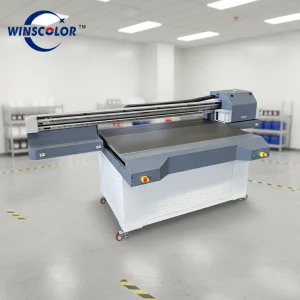
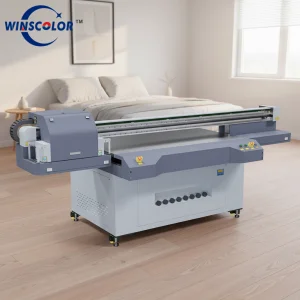
| Nominal Bed / Print Size | 2500 mm × 1300 mm (Rigid Sheet) | 3200 mm Roll Width + Continuous Tables | 1600 mm × 1000 mm Flatbed + Rotary |
| Printhead Technology | Ricoh Gen5 / Gen6 Piezoelectric DOD | Ricoh Gen6 Industrial High-Frequency | Ricoh Gen5 / Gen6 Variable Drop |
| Color Array Configurations | CMYK + Lc + Lm + White + Varnish (Dual/Triple) | 2x CMYK + Double White + Varnish | CMYK + White + Varnish (Spot/Flood) |
| Max Media Thickness / Clearance | 100 mm (Optional up to 350 mm custom) | 50 mm Rigid / 50 kg Roll Media Feed | 100 mm with Rotary Clamp Kit |
| Vacuum Table Design | Independent 4–8 Segment High-Vacuum Bed | Air-Cushion Perforated Belt Vacuum | Dual-Chamber Cast Aluminium Vacuum |
| Curing System Spec | Dual Adjustable Water-Cooled LED-UV 14W/cm² | Heavy-Duty High-Flux Dual LED Chill Arrays | Single/Dual Dynamic LED-UV 12W/cm² |
| Drive Kinematics | Dual Japanese THK Rails + Leadshine AC Servos | Linear Motor Maglev X-Axis / Servo Belt Drive | Precision Ball Screw / Linear Guide Rail |
Real-world manufacturing integration across architectural finishing, bespoke packaging prototyping, and ultra-durable electronic component labeling.
Direct printing onto tempered Float and Low-Iron glass. Formulated adhesion promoters (silane chemical primers) combined with white barrier under-printing produce scratch-resistant, humidity-proof interior partitions, backlit elevator wall claddings, and exterior building panels.
Flute-line packaging converters eliminate expensive flexographic plates. Directly deposit bold branding and micro-barcodes on coated kraftliner, white top, and honeycomb boards with zero crushing of internal flute structures.
Triple-layer Day/Night "Color-White-Color" sandwich printing on crystal cast acrylic eliminates visual desaturation when lightboxes toggle on, producing museum-grade retail point-of-sale assets.
Jetting onto anodized aluminium, stainless steel, and powder-coated electrical chassis. High cross-linking density resists industrial solvents, ISO 2409 abrasion tests, brake fluids, and prolonged salt-mist atmospheric exposure.
By repeatedly jetting high-viscosity clear UV varnish layers in synchronized multi-pass cycles, machines construct physical raised reliefs, faux leather grain, simulated wood veins, and ADA-compliant Braille signage.
Precision micro-piezo deposition onto porous and glazed ceramic slabs creates realistic marble veining and artistic decorative tile murals for luxury hospitality fit-outs and exterior commercial facades.
A transparent engineering methodology for procurement directors evaluating capital expenditures, ink yield per square meter, depreciation schedules, and operating uptime.
NTEK variable drop-on-demand printing deposits an average of 7.5ml to 10ml of ink per square meter at 100% surface CMYK coverage. At factory-direct ink pricing, total fluid consumable costs average $0.45 – $0.85/m², compared to $2.20 – $4.50/m² on proprietary closed-cartridge OEM architectures.
Ricoh Gen6 metallic printhead construction boasts a Mean Time Between Failures (MTBF) exceeding 30,000 continuous hours when operating within cleanroom temperature (20-28°C) and relative humidity (40-60%) thresholds, mitigating premature amortized printhead replacement line-item costs.
Transitioning from 12kW mercury-arc curing tubes to 1.8kW water-cooled UV-LED arrays slashes idle power draws to near-zero. On a 2-shift daily operating model (4,000 production hours/year), electrical savings routinely eclipse $3,800 USD annually per machine line.
Overseas buyers receive calibrated multi-point Factory Acceptance Testing reports: 100% nozzle jetting verification, cross-diagonal table perpendicularity validation (<0.05mm), color gamut delta E checks (<1.5 against ISO 12647), and full high-resolution live video calibration streaming.
All machinery is sealed inside moisture-barrier vacuum foil bags with desiccant charges, secured within non-fumigation heavy plywood sea-freight cases, and bolted directly onto steel shipping skids to withstand severe oceanic transits and rough port transfers.
Built-in industrial IoT gateway controllers allow NTEK tier-3 technical software engineers to access system telemetry, diagnose waveform drift, push RIP color profiles, and troubleshoot PLC sensor outputs over encrypted remote channels within hours.
From artificial intelligence edge inspection to hybrid aqueous-UV chemistry, discover the engineering developments entering industrial factory floors.
Next-gen camera arrays mounted along the print carriage capture sheet positioning markers, warped edge contours, and rotational skews on irregularly placed boards on the vacuum table. Motion trajectories are automatically recalculated on-the-fly, eliminating manual mechanical alignment jigs.
Replacing traditional timing belts and rotary lead-screws with non-contact magnetic levitation (Maglev) linear motors eliminates mechanical vibration, friction wear, and harmonic pitch ripples. Carriage scanning speeds reach up to 1.8 m/s with micro-inch bidirectional precision.
R&D is rapidly yielding non-sensitizing, plant-derived monomer resins and high-functionality bio-oligomers that deliver the same rapid cross-linking speeds and hardness ratings while complying with stringent European REACH, RoHS, and food-contact exterior packaging directives.
Explore small footprint production systems, ultra-wide mural architectures, and automated cylindrical bottle printing options.
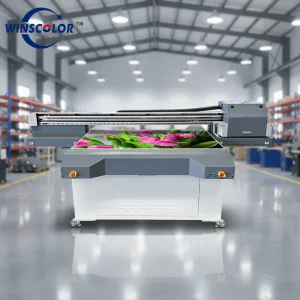
Comprehensive engineering insights compiled by our application specialists, addressing the critical technical, operational, and commercial questions raised by international distributors and print facility engineers.
