
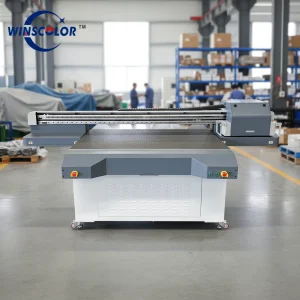
NTEK China Wholesale Digital UV Printing Machine NTEK Ceramic Glass UV Printer Manufacturer, Companies
Configure Machine
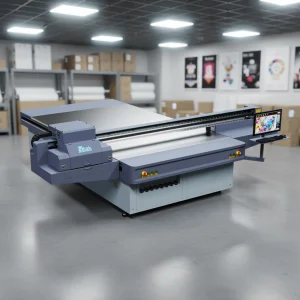
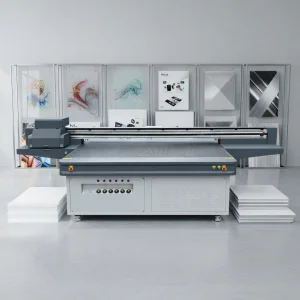
High-speed piezoelectric drop-on-demand flatbed systems tailored for architectural glass, technical acrylics, thermoformed plastics, and dimensional wood assemblies.

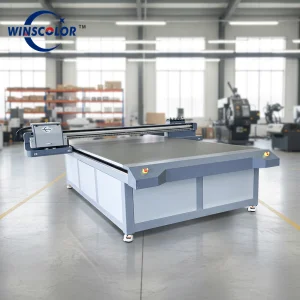
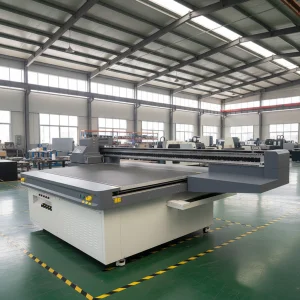
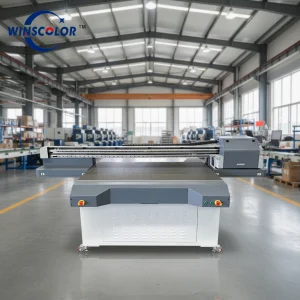
An engineering analysis of modern ultraviolet photo-polymerization curing versus legacy analog methods in multi-national supply chain deployments.
The global manufacturing ecosystem is undergoing an accelerated architectural shift away from legacy solvent-evaporative and screen printing systems toward high-resolution digital UV curable piezoelectric platforms. Driven by stringent environmental legislation (such as European REACH and RoHS directives), rapid product obsolescence, and the demand for zero-inventory customized mass production, high-capacity print service providers and industrial Tier-1 OEMs require direct-to-substrate digital apparatuses that eliminate analog plates, chemical wash baths, and protracted curing cycles.
As an authoritative export-grade engineering manufacturer, NTEK designs industrial equipment that directly resolves the thermodynamic, mechanical, and rheological challenges of UV LED ink deposition. In legacy systems, printing on non-porous and thermally sensitive media like extruded acrylic, polycarbonate, tempered float glass, and anodized aluminum frequently resulted in severe adhesion failure, heat warping, and pigment agglomeration. Contemporary NTEK industrial UV solutions employ cold-cure narrow-spectrum 395nm UV-LED matrices synchronized with variable grayscale piezoelectric printhead actuation (such as the Ricoh Gen6 and Gen5s architectures), enabling photopolymer ink droplets to solidify virtually instantaneously while maintaining substrate surface temperatures below 38°C.
Unlike standard budget systems that flood the entire platen with uncalibrated ultraviolet exposure, NTEK systems integrate software-controllable progressive pin-curing. By freezing intermediate droplet spreads within milliseconds at low milliwatt ratings before applying the final inert curing pass, color bleed and satellite misting are eradicated, delivering crisp micro-text down to 2-point legible typography on ultra-smooth non-absorbent surfaces.
Furthermore, digital UV printing has decoupled setup overhead from batch volume. In conventional screen manufacturing, physical stencil preparation, registration calibration, and screen reclamation incur between 45 to 90 minutes of unproductive setup time per job, making run lengths under 500 units financially non-viable. NTEK's high-resolution digital RIP workflow allows instant batch transitioning, automated variable data printing (VDP), barcoding, serializing, and dynamic tactile relief generation without a single physical tool modification.
| Performance Benchmark | Conventional Screen Printing | Eco-Solvent / Latex Printing | NTEK High-Res UV LED Systems |
|---|---|---|---|
| Substrate Versatility | Restricted to flat, ink-absorbent or treated sheets | Primarily coated vinyl, paper, canvas roll stock | Universal: Glass, Wood, Metal, Acrylic, Leather, Corrugated |
| Make-Ready & Setup Time | 45 – 120 minutes (Plates, screens, alignment) | 5 – 15 minutes (Profile calibration) | < 60 seconds (Instant direct-from-RIP firing) |
| Volatile Organic Compounds (VOC) | High hazardous air pollutant emission | Moderate to Low (Requires thermal ventilation) | Zero Ozone, Zero VOC (Safe ambient operation) |
| Surface Relief & Dimensional Varnish | Multiple screen passes with specialized dies | Not technologically possible | Inline multi-layer White + Color + Varnish embossed textures |
| Thermal Substrate Impact | Requires thermal drying tunnels (up to 120°C) | High radiant platen heat required (60°C – 95°C) | Cold LED Array: Substrate temp rise < 3°C above ambient |
A rigorous procurement framework designed for factory controllers, operations executives, and global sourcing specialists evaluating digital capital machinery.
Industrial flatbed UV printing requires micron-level positioning repeatability across hundreds of thousands of duty cycles. NTEK incorporates heavy-duty, stress-relieved steel gantry frames subjected to complete thermal annealing to prevent warping under continuous multi-shift production.
Titanium dioxide particles in white UV inks possess high mass density, which leads to sedimentation, head clogging, and nozzle deflection in standard gravity-fed channels. NTEK's proprietary continuous negative pressure white ink recirculation safeguards uninterrupted ink availability.
High-power mercury arc lamps consume up to 8.5 kW/hr and necessitate frequent bulb replacements (every 800-1,000 hours), representing massive energy loss. NTEK air/water-cooled UV-LED matrices consume less than 1.8 kW/hr and deliver verified lifetimes surpassing 20,000 operation hours.
Exploration of precision motion control, variable drop piezoelectric actuation, and closed-loop telemetry underlying NTEK's manufacturing platform.
At the core of NTEK's premier models (including the YC2513L and YC2030 series) is the Ricoh Gen6 (MH5320) industrial piezo printhead. Engineered with 1,280 nozzles arranged across 4 channels, each nozzle executes multi-drop gray-level firing at frequencies up to 50 kHz. This capability permits the dynamic ejection of droplets from 5 picoliters for smooth tonal gradations in highlight zones up to 15 picoliters for rapid, opaque solid fills in background areas, yielding true photorealistic fidelity without compromising linear throughput.
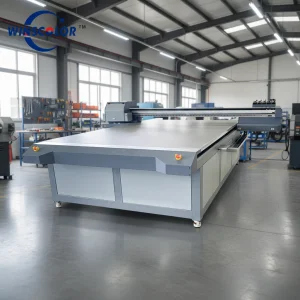
Sub-micron Carriage Suspension: The printhead carriage travels along a double-ground structural steel beam with magnetic linear encoder feedback, ensuring drop placement accuracy within ±0.015 mm across the entire 2.5m x 1.3m or 2.0m x 3.0m print expanse.
Substrate collisions represent the leading cause of premature printhead destruction in heavy-duty production environments. NTEK machines integrate multi-point dual-axis optical infrared height measurement coupled with high-sensitivity pneumatic crash sensors on both flanks of the carriage. The system autonomously maps board warpage and dynamically calibrates head-to-media clearance (maintaining optimal 1.5mm to 2.0mm jetting distance) for materials up to 100mm thick.
Anti-Static Deionizing System: Heavy plastics like acrylic and PVC accumulate immense triboelectric surface charge during handling. NTEK integrates industrial active static elimination bars that neutralize up to 25kV surface charges before ink deposition, preventing satellite droplet deflection.
Turnkey industrial recipes, chemical bonding workflows, and high-margin finishings engineered for specialized industrial segments.
Direct digital decoration of splashbacks, interior partitions, sliding doors, and architectural facade panels. Utilizing NTEK dedicated silane-based adhesion promoters (primers) applied inline or offline, the cured UV polymer exhibits 5B cross-hatch adhesion, resistance to boiling water immersion, and prolonged UV resistance for external exposure.
Industrial polycarbonate (PC), PET, and PVC dial faces, instrument clusters, and consumer appliance fascia require extreme ductility. NTEK flexible ink formulations withstand up to 250% elongation and aggressive deep-draw vacuum thermoforming without micro-cracking, crazing, or delaminating along radiused corners.
Replacing expensive photopolymer flexographic plates for customized e-commerce shippers, luxury presentation boxes, and honeycomb display stands. Instant plate-free printing handles continuous flute thicknesses from E-flute up to heavy double-wall BC-flute with vivid CMYK plus high-density white underbase printing.
Reproducing authentic oak, walnut, and exotic timber grains over cost-effective MDF, plywood, and natural planks. NTEK multi-pass tactile varnish builds natural synchronized pores and embossed grain structures, allowing boutique furniture and flooring fabricators to deliver custom architectural finishes at production scale.
Precision printing of machinery warning schematics, CE certification nameplates, high-voltage panel legends, and architectural anodized composite (Dibond). Directly yields chemical-resistant, oil-impervious, and scratch-proof legends that outlast conventional silkscreened epoxy inks in harsh environments.
By integrating NTEK's synchronized rotary jig axis, the flatbed carriage switches dynamically into a 360-degree seamless rotary printing apparatus. Engineered specifically for stainless steel vacuum flasks, glass drinkware, cosmetic tubes, and writing instruments without visible seam overlap or image distortion.
From Jinan manufacturing headquarters to facilities in over 100 countries: guaranteed mechanical reliability, international safety adherence, and multi-tier distributor support.
Operating from our modern 20,000 m² production complex with six dedicated assembly lines, NTEK (Winscolor) maintains full in-house vertical integration over CNC structural machining, wiring harness fabrication, software integration, and optical alignment. Each high-resolution UV printer undergoes an exhaustive 72-hour continuous multi-pattern burn-in stress test prior to crating, verifying that power supply harmonics, negative pressure regulation, and mechanical travel remain drift-free under maximum payload conditions.
For international buyers across North America, the European Union, South America, and the Middle East, logistical integrity and regulatory compliance are essential prerequisites. NTEK machines comply with global trade standards:
Fully compliant with European Union Machinery Directive 2006/42/EC, Low Voltage Directive 2014/35/EU, and Electromagnetic Compatibility (EMC) Directive 2014/30/EU. Shielded industrial cabling eliminates radio frequency interference with adjacent facility electronics.
Precision heavy-duty machinery exported via ocean freight faces extreme humidity and saline atmosphere. NTEK utilizes IPPC-compliant ISPM 15 heat-treated solid timber casing, vapor-corrosion-inhibiting (VCI) vacuum sealing, and silicone shock dampening mounts to guarantee intact arrival.
Backed by continuous remote diagnostic telemetry, certified engineers troubleshoot signal path errors, RIP configuration issues, and nozzle calibration via secure encrypted video and data relays. Genuine OEM replacement parts ship within 24 hours via DHL Express global freight hubs.
A preview of forthcoming R&D milestones from NTEK laboratories spanning linear drive propulsion, AI optical inspection, and bio-polymer ink science.
Migrating beyond traditional toothed belt and ballscrew mechanical carriage propulsion. Magnetic linear motor drives eliminate physical mechanical friction, allowing carriage speeds in excess of 2.2 m/s while diminishing operating noise to under 55 dB and eliminating mechanical backlash.
Integrated high-resolution linescan CCD cameras scan newly printed bands in real time. AI inference networks detect missing nozzles or misfiring trajectories on the fly and automatically recalculate raster data, filling defective nozzle paths using adjacent overlapping nozzles to ensure zero-defect output.
Collaborating with global chemical synthesizers to develop bio-renewable acrylate resins derived from plant feedstocks. These forthcoming ink matrices reduce fossil monomer dependency by 45% while maintaining rapid curing properties, high chemical resistance, and non-yellowing durability on rigid substrates.
Detailed answers directly from NTEK senior application engineers addressing substrate preparation, maintenance protocols, and international operational feasibility.
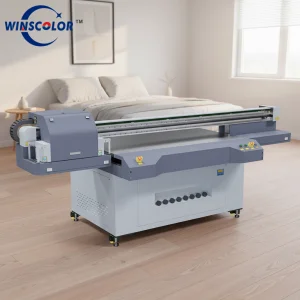
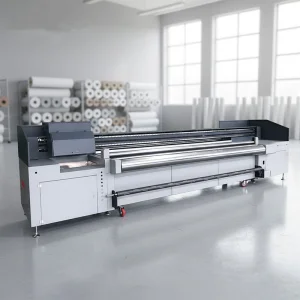
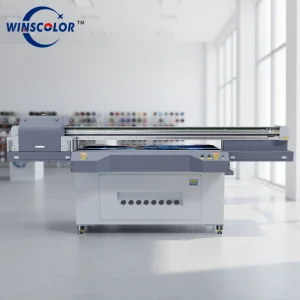
From compact desktop personalization engines to 3.3-meter industrial hybrid roll-to-roll workhorses engineered for diverse media profiles.
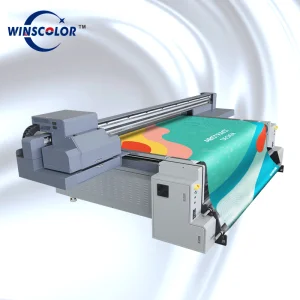
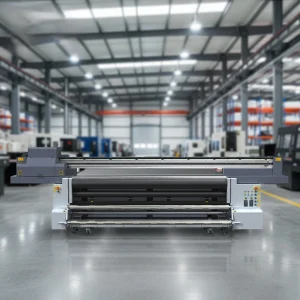

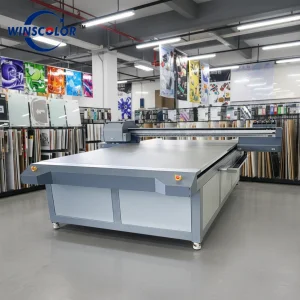
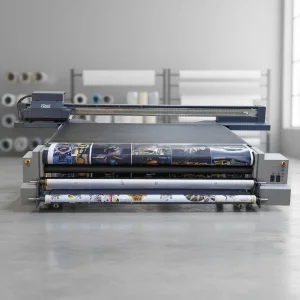
Request custom media sample testing, complete engineering specifications, or arrange a private live video factory audit directly with our Jinan development team.