Industrial UV curing platforms engineered for maximum mechanical rigidity, vacuum stability, and micro-droplet placement on non-porous glass surfaces.

Bridging the structural gap between conventional screen-printing limitations and agile digital manufacturing on inorganic, non-porous silica glass.
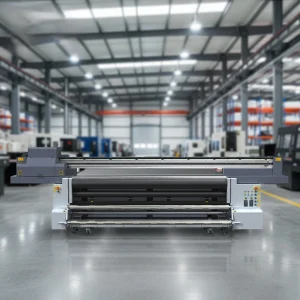
State-of-the-Art Factory Facility in Jinan
Countries Deployed with Turnkey Support
Reinforced Bed Bearing for Heavy Architectural Float Glass
Projected 2028 Digital Architectural Glass Market ($)
Traditional ceramic frit screen printing necessitates screen fabrication, photographic exposure, and chemical storage—imposing substantial upfront tooling costs. NTEK glass UV printers deploy direct-to-substrate digital piezo inkjet architectures, reducing turn-around from weeks to mere seconds for custom architectural glazing and curtain wall batches.
Glass is completely non-porous and chemically inert with low surface energy (dynes/cm). NTEK incorporates automated inline/offline atmospheric chemical priming techniques that form covalent silane couplings between the silica substrate and the cross-linked UV polymer matrix, guaranteeing 5B scratch ratings and condensation resistance.
Unlike massive drying lehrs and IR drying tunnels used in ceramic enamels, NTEK UV-LED systems emit cold 395nm wavelength radiation. This eradicates localized thermal stresses on tempered, laminated, or annealed glass slabs, preventing thermal fractures and substrate expansion during high-density multi-layer passes.
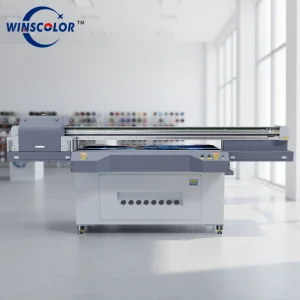
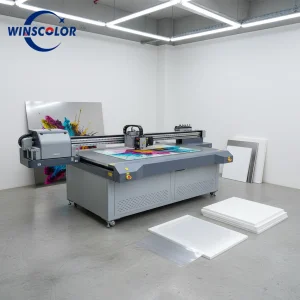
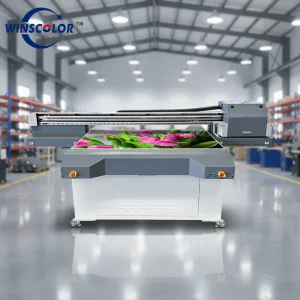
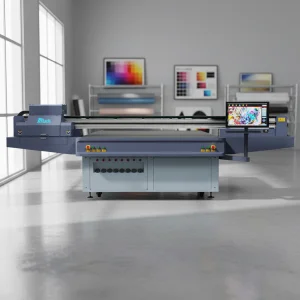
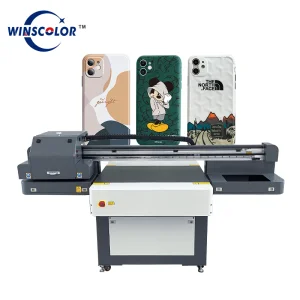
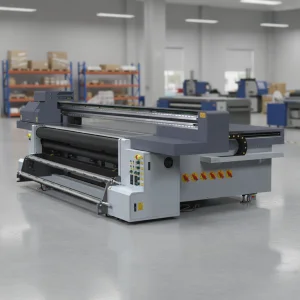
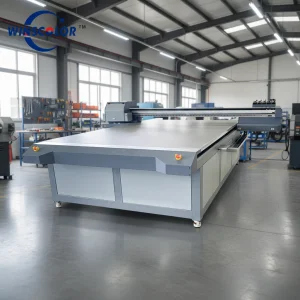
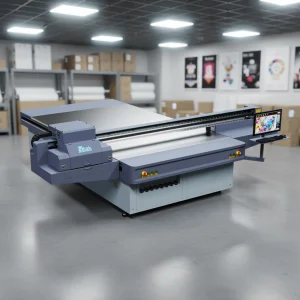
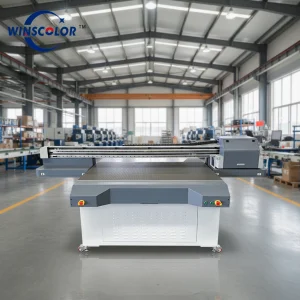
Printing directly on high-density structural glass necessitates an entirely different mechanical tolerance model than standard graphic boards. Standard sign gantries warp under heavy loads. Winscolor/NTEK leverages double-hardened steel gantry frameworks paired with specialized structural air bearings.
Step 1: Ultrasonic/Plasma Surface Degreasing: Eliminates microscopic industrial oils and dust particles.
Step 2: Dual-Action Silane Primer Vaporization: Establishes chemically bonded adhesion anchors.
Step 3: High-Intensity Dynamic Curing: Cures ink instantaneously, preventing capillary bleed across non-porous planes.
Step 4: Hydrophobic Gloss Overcoating: Provides complete protection against chemical detergents, moisture, and ultraviolet yellowing.
Deploying tailored inkjet configurations across interior design, smart building development, and consumer appliance assembly lines.
Delivering high-opacity etched-effect white ink and bespoke frosted gradients on shower enclosures, office boardroom partitions, and balustrades. Withstands sustained hot steam and bathroom sanitation agents without film separation.
Printing photographic landscape textures and marble veining directly onto the reverse side of 6mm-12mm toughened safety glass. The reverse-side print protects pigments from cooking spatters, high temperatures, and physical abrasion.
Automated batch printing for induction cooktops, touch-screen oven fronts, intelligent thermostats, and refrigerator decorative panels requiring precision light-blocking black borders and micro-metric key icon cutouts.
Every NTEK industrial production unit is built to fulfill global electrical, mechanical safety, and environmental stewardship criteria.
All Winscolor NTEK printing platforms adhere to rigorous CE machinery directives, UL-recognized electronic distribution systems, and RoHS environmental compliance, ensuring safety across North American, European, and Asia-Pacific factories.
Built-in remote diagnostic protocols allow our factory senior control engineers to examine real-time waveforms, carriage drive acceleration parameters, and ink line pressure valves remotely, slashing diagnostic latency to under 60 minutes.
Backed by over 45 international distributor alliances, regional hubs carry emergency printhead inventory, sub-tank solenoids, optical encoders, and curing arrays, reinforced by hands-on engineering calibration on customer shop floors.
Analyzing what lies ahead in advanced digital ceramic synthesis, inline robotics, and AI-driven optical print inspection.
Pioneering specialized printhead recirculation pathways capable of handling dense micro-ground ceramic glass frit inks that temper at 650°C, fusing directly into the glass matrix for unconditional 25-year facade weatherability.
Developing seamless synchronization interfaces connecting automated mechanical suction robot arms to NTEK pneumatic positioning registration pins, maximizing yield rates for unassisted 24/7 dark-factory glass processing.
Integrating closed-loop artificial intelligence camera arrays directly on the gantry to detect nozzle drop-outs, micro-dust contamination, and glass edge chipping in real-time before expensive ink passes proceed.
Comprehensive engineering insights regarding production durability, color fastness, and ROI optimization.
Yes, when paired with silane-based chemical primers and our industrial UV-LED exterior ink sets, prints provide up to 5-10 years of unlaminated outdoor stability. For lifelong facade durability (20+ years), we recommend encapsulating the UV print inside laminated double-glazing units (PVB/SGP sandwich structure).
Glass is hydrophobic and low-energy. NTEK implements a rigorous three-step protocol: complete isopropyl degreasing, pyrosil/flame or liquid silane adhesion primer wipe, followed by immediate variable-intensity UV polymer curing to establish strong mechanical bonds.
Yes. Our Ricoh Gen6 carriage configurations support dedicated independent channels for White and Gloss Varnish. This allows synchronized single-pass printing of tactile textures, simulated stained glass relief, or pure opaque white backing for crystal-clear glass panels.
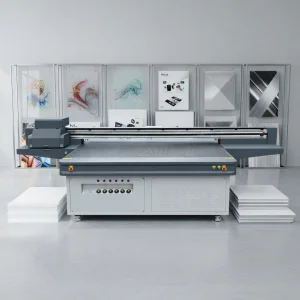
NTEK industrial flatbed frames (such as the YC2513L and YC2030 series) accommodate substrates up to 100mm (or customized 150mm) thickness. The structurally reinforced aluminum honeycomb table comfortably supports continuous static glass loads exceeding 50 kg/m².
Review the comprehensive equipment portfolio designed to accommodate multi-substrate printing lines worldwide.