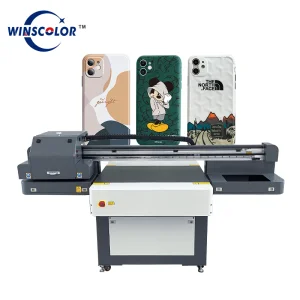
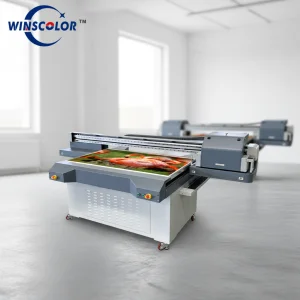
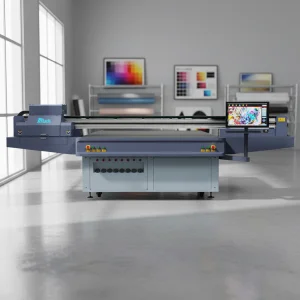
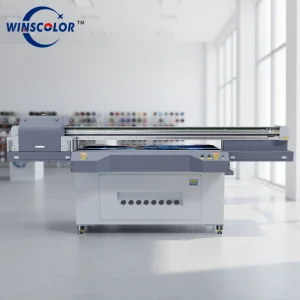
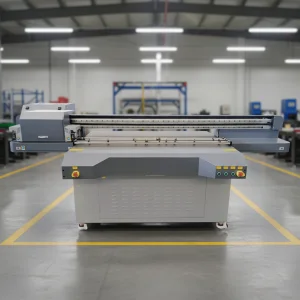
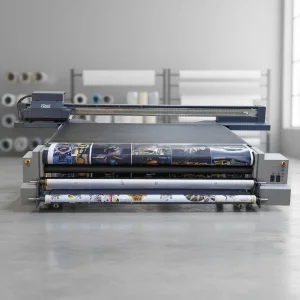
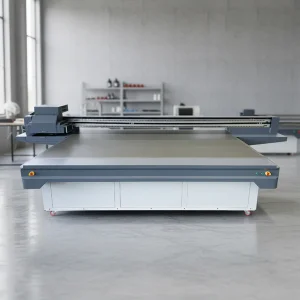
Explore production-grade flatbed, hybrid, and single-pass configurations calibrated for 24/7 continuous output.
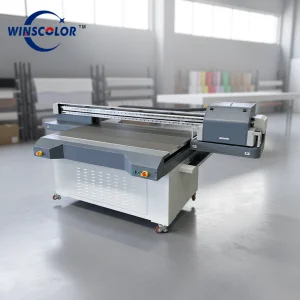
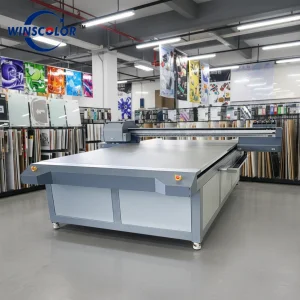
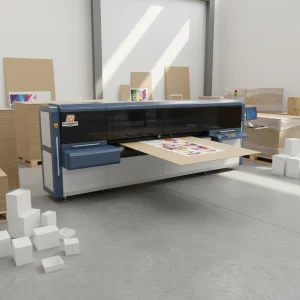
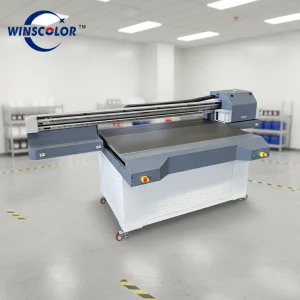
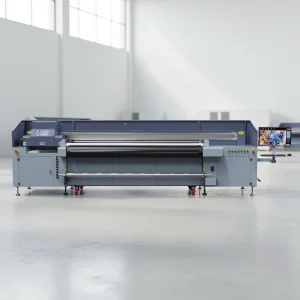

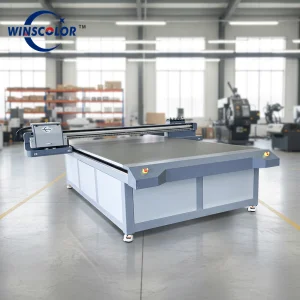
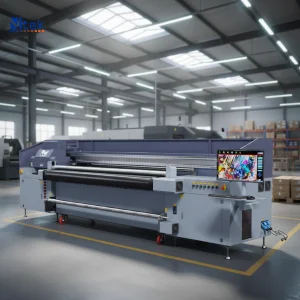
A rigorous approach to structural stability, droplet accuracy, and thermal control ensures uninterrupted long-run production.
Every flatbed chassis undergoes high-temperature annealing and stress-relief treatment before gantry rail milling. Utilizing dual THK or Hiwin linear silent guides paired with high-torque AC servo systems, our printing systems keep dynamic beam deviation under 0.02 mm over continuous multi-shift cycles, eliminating micro-banding on high-gloss substrates.
Configured with proven industrial printheads like Ricoh Gen6 and Kyocera KJ4A, our carriages support variable drop grayscale technology ranging from 5 pl to 18 pl. Variable drop sizing delivers ultra-smooth skin tones, photographic gradient transitions, and high-density monochrome solids while consuming up to 28% less ink across typical signage and packaging workflows.
Dual directional, liquid-cooled UV-LED curing arrays emit narrow-band wavelengths (385–395 nm) directly behind the printhead trajectory. Instantaneous photopolymerization suppresses ink spread without transferring damaging thermal loads to heat-sensitive materials such as thin PVC films, fluted boards, or expanded polystyrene panels.
Bridging Chinese manufacturing speed with strict European and North American electrical, mechanical, and safety standards.
Every commercial printer leaving our assembly floors includes full conformity documentation. Electrical cabinets follow strict IEC standards with Schneider low-voltage components, redundant emergency stops, shielded drag chains, and low-VOC emissions testing for indoor and cleanroom industrial applications.
Centering our engineering in Jinan's industrial heartland gives us immediate access to high-grade structural steel, precision CNC milling nodes, and world-class electronics integration. This cluster effect provides international buyers with a 30% to 45% total cost of ownership (TCO) advantage over comparable Western units without compromising component reliability.
We combine direct factory remote engineering with regional distribution hubs across Western Europe, the Americas, and Southeast Asia. Field teams carry critical consumable spares—such as secondary ink tanks, negative pressure sensors, filtration cartridges, and solenoid valves—to resolve downtime within guaranteed service level agreements.
Market realities and digital transformations dictating the next generation of flatbed printing systems.
Traditional flexo processes require plate production, lengthy wash cycles, and high minimum order quantities. Single-pass non-contact inkjet technology enables true just-in-time corrugated box printing. Real-time variable data printing (VDP), regional barcodes, and custom promotional runs now print at speeds up to 1.5 m/sec directly from vector files.
Flat prints are rapidly becoming commoditized. Advanced industrial buyers specify micro-layered white and transparent varnish capabilities to generate tactile textures, woodgrain emulations, simulated leather finishes, and ADA-compliant Braille signage. Layer-by-layer cured UV curable polymer delivers durable surface relief directly on rigid sheets.
Modern print houses require continuous line monitoring. Our newer generations of industrial flatbeds incorporate connected control interfaces that log printhead jetting temperatures, sub-tank vacuum stability, dynamic pulse widths, and square-meter ink yields. These metrics feed plant-wide ERP and MES software via standard REST APIs.
From flexible leather to non-porous float glass, our integrated primer and curing workflows ensure long-term scratch and chemical resistance.
Using specialized silane priming agents, our UV inks form chemical bonds with smooth silicate surfaces. The cured prints resist cross-hatch adhesion failure (ASTM D3359 Class 5B), making them suitable for splashbacks, backlit decorative partitions, and commercial feature walls.
Aluminum composite panels (ACP) and brushed metals require consistent ink wetting without reticulation. NTEK machines leverage multi-zone vacuum suction beds to keep sheets flat during high-speed bidirectional carriage passes, creating long-lasting outdoor architectural graphics.
Integrated rotary jigs enable our flatbeds to print seamless 360-degree graphics on tumblers, insulated flasks, glass bottles, and cosmetic containers. High-coverage opaque white underbases maintain color vibrancy on dark, transparent, or metallic surfaces.
Direct printing on corrugated kraft liner, honeycomb board, and solid bleached sulfate (SBS) eliminates mounting and lamination steps. Short-run structural mockups and point-of-purchase (POP) displays move straight from print to digital cutting tables.
Direct technical answers to the most common queries from industrial procurement teams, machine distributors, and print plant operators.
Under recommended operational conditions—using genuine filtered inks, maintaining negative pressure between -3.2 and -4.5 kPa, and running regular purge and wipe maintenance cycles—industrial Ricoh Gen6 piezo printheads regularly achieve service lifespans between 3 to 5 years in multi-shift manufacturing environments.
Our beds feature an independently controlled multi-chamber vacuum table backed by high-capacity turbine pumps. Operators can channel full suction volume to specific table sections, keeping irregular sheets, warped acrylic, or corrugated boards flat against the bed to prevent printhead strikes.
Yes. Carriages are modular and can be configured with CMYK + W + V, dual CMYK for high speed, or expanded CMYK + Lc + Lm + W + V setups. White ink runs through an active circulation circuit that prevents titanium dioxide sedimentation in the supply lines, sub-tanks, and printheads.
Each printer includes secure network diagnostics software that lets our Jinan support engineers check operational logs, driver status, and PLC parameters remotely. We also maintain overseas partner networks, stock common replacement parts for fast dispatch, and provide video setup guidance.
Installations require a dedicated 220V/380V supply (depending on the curing array and bed size) backed by a voltage stabilizer, clean dry compressed air (0.6 to 0.8 MPa) for the pneumatic pin registration system, a room temperature range of 20°C to 28°C, and relative humidity between 40% and 60%.
NTEK systems integrate smoothly with industry-standard digital front-ends, including Onyx, Caldera, SAI PhotoPrint, and ColorGate. We provide pre-built ICC color profiles, linearized media configurations, and custom spot channel definitions out of the box.
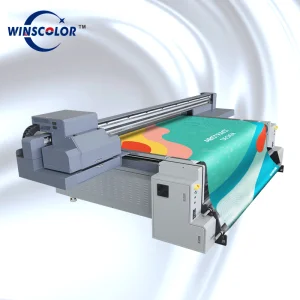
Direct manufacturer listings for roll-to-roll hybrid machines, promotional item printers, and wide-format UV flatbeds.