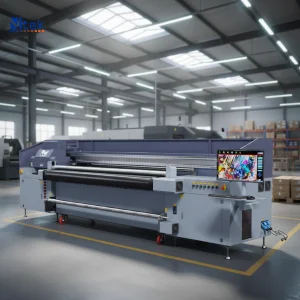
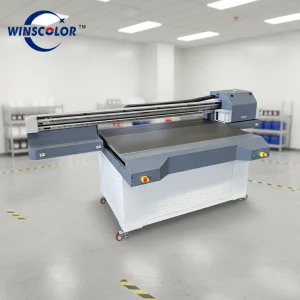
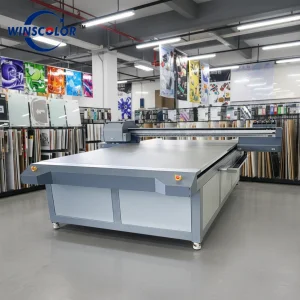
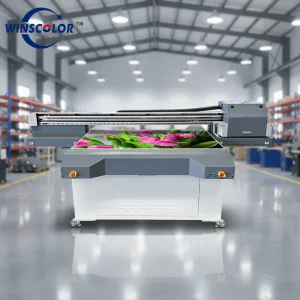
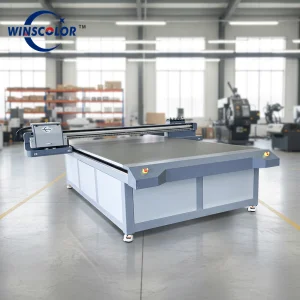
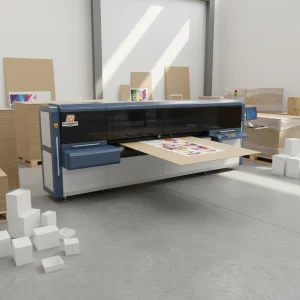
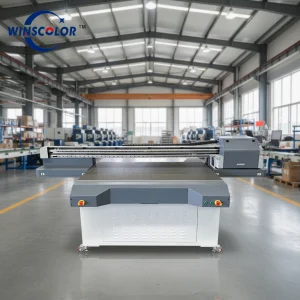
From micro-drop tabletop systems to super-wide hybrid platforms, discover factory-tested hardware designed for relentless throughput, micro-inch droplet registration, and multi-substrate adaptability.
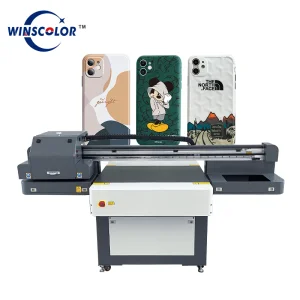
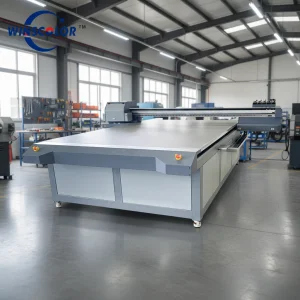
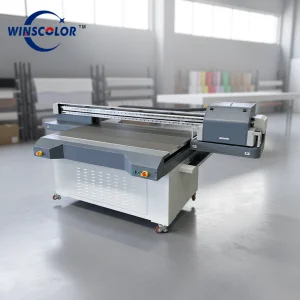
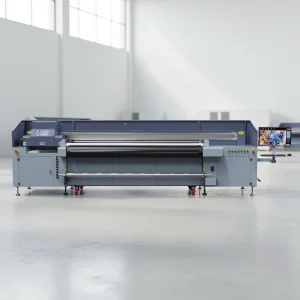
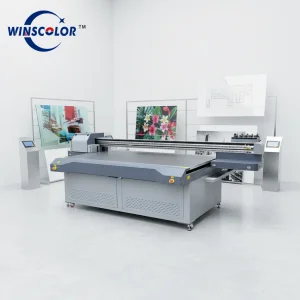
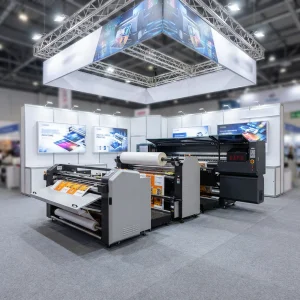
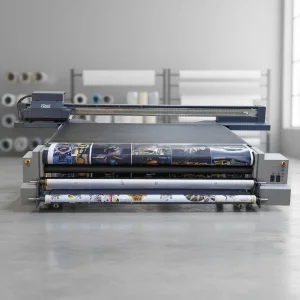
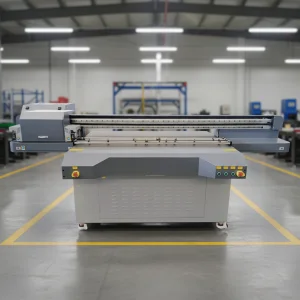
Exploring the metallurgical engineering, variable drop waveforms, and ultra-high frequency jetting performance underpinning our high-reliability Ricoh Gen5 and Gen6 flatbed printer architectures.
By implementing sub-5-picoliter variable droplet control alongside advanced binary driving circuitry, our print systems produce photographic transitions free of banding. Enhanced drive frequencies reach 50 kHz, boosting linear carriage speeds by 35% compared to legacy architectures while extending piezo lifecycle beyond 100 billion actuations per nozzle.
Structural vibration is eliminated through cold-drawn heavy steel gantries, dual THK silent linear guide rails, and integrated linear magnetic encoder scales. The closed-loop positioning system maintains ±0.01 mm mechanical travel tolerance across 3.3-meter widths, ensuring microscopic ink landing precision during high-speed multi-pass production.
Independent dual water-cooled UV-LED curing assemblies dynamically adjust output between 2 W/cm² and 16 W/cm² based on print speed and substrate sensitivity. This cold-cure capability prevents heat-induced warping on ultra-thin PET, polypropylene, and corrugated fluting, while delivering instant polymerization with minimal ozone generation.
From architectural glass facades and tactile haptic surfaces to plate-free packaging lines, our Ricoh UV flatbed and hybrid solutions eliminate legacy tooling setups to deliver short-run agility.
Equipped with automated inline silane primer misting and dual high-opacity white ink circulation, our systems achieve Grade 5 cross-hatch adhesion on tempered glass, granite, and ceramic slabs. Ideal for bespoke splashbacks, exterior cladding, and backlit interior partitions with scratch-resistant finishes.
Replacing rotary dies and flexographic plates, our systems print directly onto corrugated paperboard, kraft liner, and honeycomb sheets. Support for variable data, rapid versioning, and zero setup times empowers converters to monetize micro-runs and customized point-of-sale displays without plate wear costs.
Multi-layer ink deposition technology coordinates white, colour, and heavy gloss varnish channels in a single pass. Printers can produce ADA-compliant Braille signage, leather-grain textures, and high-gloss spot relief up to 2 mm thick, creating tactile consumer packaging and luxury retail displays.
Inside our 20,000 m² Jinan intelligent assembly facility: precision CNC bed annealing, robotic laser interferometer calibration, and multi-tier component provenance.
Heavy-duty gantry frameworks undergo high-temperature thermal annealing and mechanical vibration aging to eliminate internal structural stresses, preventing frame twisting or distortion across decades of operation.
Every axis is mapped using Renishaw dual-frequency laser interferometers to evaluate micro-step pitch error, yaw, and perpendicularity, securing absolute spatial registration across the bed.
Before ocean shipping, every unit runs 72 hours of uninterrupted white ink recirculation, full-frequency carriage sweeps, and test patterns to verify fluidics, thermals, and driver boards under extreme duty cycles.
For procurement directors, plant managers, and enterprise buyers: a structured framework to evaluate flatbed investments across capital costs, running overhead, and production uptime.
Optimized ICC profiles and small drop jetting (starting at 5pl) deliver up to 30% ink savings compared to older 12-14pl heads. Our high-density pigments provide superior colour saturation at thinner ink film layers, lowering ink costs to approximately $0.60–$0.85 per square metre at typical 4-pass commercial coverage.
Built with industrial-grade components—including German IGUS drag chains, Japanese Omron optical limit sensors, and Panasonic brushless AC servo motors—our systems achieve an average MTBF exceeding 6,000 continuous operating hours under multi-shift conditions.
Factory compatibility with industry-standard workflow solutions like Onyx, Caldera, and PhotoPrint simplifies prepress integration. Automated features—including pin registration, active anti-static bars, media thickness sensors, and zone vacuum controls—cut changeover times between substrates to under 90 seconds.
Our export operations are backed by complete international certifications, documented safety compliance, and multi-channel technical support across key overseas hubs.
Every printer is constructed according to European Machinery Directive 2006/42/EC and low-voltage electrical standards. Critical components carry UL/cUL recognition, while our UV curing formulations comply with RoHS, REACH-SVHC, and Greenguard Gold criteria for indoor installations.
Integrated VPN network diagnostics allow factory engineers to assess hardware issues, review board health, tune servo timing, and calibrate drop profiles remotely. Real-time telemetry accelerates troubleshooting without waiting for on-site dispatches.
We maintain regional spare-parts hubs stocked with printheads, motherboards, UV ballast lamps, and fluidics hardware. Critical parts ship via DHL/FedEx priority lanes within 24 hours of notification, helping international operators maintain consistent production schedules.
Clear answers to common questions about printhead lifetimes, primer application, multi-pass productivity, and facility power preparation.
Explore our full line of wide-format and specialized flatbed configurations, engineered for precision, throughput, and long-term production reliability.