Engineered for high-duty continuous cycles across rigid, roll, and custom substrate applications.
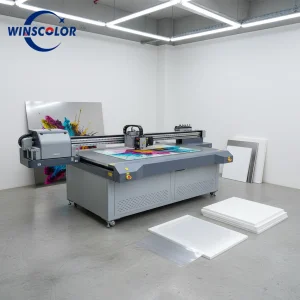

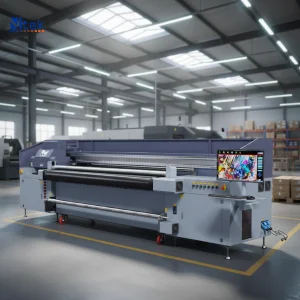
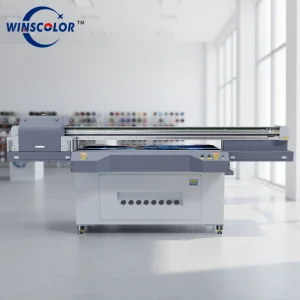
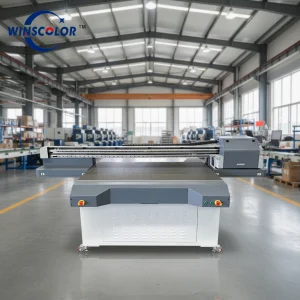
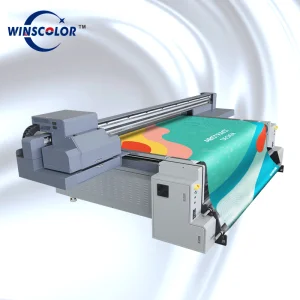
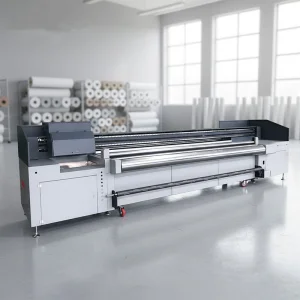
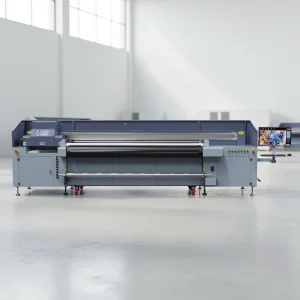
Analyzing global production metrics, substrate transitions, and total cost of ownership (TCO) benchmarks.
Traditional silk-screen and flexographic printing carry severe economic penalties for variable print volumes under 2,000 units. High platemaking expenditures, chemical emulsion handling, and mechanical alignment scrap significantly increase unit costs. Modern UV digital flatbed and hybrid platforms eliminate plates entirely, enabling zero-overhead short runs and immediate job turnarounds with no make-ready waste.
Transitioning from mercury vapor discharge lamps to directional gallium-nitride (GaN) UV-LED diode arrays radically alters mechanical substrate interaction. Generating narrow-spectrum radiant power typically at 395nm, cold-cure systems deliver complete photo-polymerization without infrared thermal transfer, opening compatibility with heat-sensitive polyolefins and ultra-thin foams.
Industrial large-format printer investments depend directly on stable operating parameters. High-grade Chinese direct manufacturing integrates high-frequency piezo drop-on-demand actuators with localized CNC machine beds to maximize output per investment dollar, reducing initial capital outlays by 35% to 50% compared to legacy European assemblers while matching industrial run rates.
Inside our Jinan production ecosystem: rigorous mechanical engineering, thermal frame stabilization, and integrated electronics manufacturing.
Structural stability under continuous high-speed carriage acceleration requires robust mechanical fundamentals. Our chassis frames undergo thorough thermal annealing and high-temperature stress-relief baking to release welding tension, followed by finish-milling on large gantry five-axis CNC centers. This eliminates baseline micro-torsion across the travel envelope.
Operational reliability is secured through proven component architecture. Sub-systems are paired with premium industrial motion hardware: Panasonic/Yaskawa AC servo packages, German IGUS low-friction cable carrier drag chains, Italian Megadyne timing belts, and Omron multi-stage optical interrupter arrays.
Prior to export packaging, every flatbed and roll unit undergoes rigorous qualification protocols. This includes a non-stop 48-hour carriage pass endurance run, laser interferometer rail straightness inspections, vacuum leak tests, and multi-layer high-density color matching checks across the entire bed surface.
Purpose-built configurations for challenging substrates, architectural glass, dynamic packaging, and high-spec industrial marking.
Direct printing on float glass, mirrors, backsplashes, and porcelain requires reliable chemical ink bonding. Integrated inline silane priming modules spray or wipe molecular coupling formulations immediately before ink application, forming strong cross-linked polymer chains that withstand moisture, cleaning chemicals, and scratch abrasion.
Production Standard: Meets ASTM cross-hatch adhesion class 5B criteria.
Short-run secondary transit packaging and POS retail displays benefit from digital speed. Eliminating flexographic stereo preparation times enables box-to-order operations. Multi-zone high-flow vacuum beds hold warped cardboard and recycled corrugated flutes firmly flat, preventing head strikes across long production runs.
Capacity Benchmark: Fast single-pass and multi-pass corrugated printing without fluting crushing.
By precisely stacking photocurable clear varnish and high-opacity white ink micro-droplets, machines construct controlled relief layers up to 2.0mm high. This produces compliant ADA accessibility signage with domed Braille dots and creates tactile faux-embossed textures across art reproductions, timber boards, and cosmetic containers.
Visual Dynamics: Spot gloss, matte velvet, and variable depth dimensional layers.
Precision calibration ensures exact registration across control switch fascias, instrument clusters, and stainless steel or aluminum nameplates. Advanced UV ink matrices remain ductile after curing, preventing micro-fractures during subsequent die-cutting, corner punching, and shallow-draw mechanical stamping.
Target Spec: High UV-opacity black and white masking layers resistant to solvent exposure.
With versatile hybrid drive belts or dedicated heavy-duty uncoilers, roll-to-roll workflows easily handle banners, cast self-adhesive vinyls, non-stretch woven textiles, and backlits up to 3.2 meters wide. Advanced tension-controlled rollers prevent skewing across lengths up to 100 meters.
Mechanical Advantage: Heavy 50kg roll handling with servo-driven feeding accuracy.
With pneumatic synchronized 360-degree rotary jigs, flatbed models convert smoothly into precision circular printing stations. This setup prints seamless graphics around drinkware, metal cans, glass cosmetic bottles, and promotional cylinders with automatic tapering compensation.
Rotary System: True 360° drop placement without overlap seam artifacts.
Upgrades in variable drop micro-piezo designs, edge computing intelligence, and sustainable chemistry.
Transitioning to ultra-high-density piezo MEMS printhead clusters allows up to 1200 native DPI resolution with high drop fire frequencies (up to 50 kHz). Thin-film piezo layers deliver precise sub-drop volume metering down to 2.5 pL, rendering fine text down to 2pt without raster fringing.
Integrated high-speed line scan CCD cameras scan ongoing print swaths in real time. Proprietary calibration engines identify clogged nozzles instantly, adjusting droplet firing on adjacent operational channels to prevent visible banding, and prompt automatic ultrasonic cleaning routines during idle cycles.
Addressing tighter global environmental rules, research focuses on bio-derived chemical monomers, eliminating volatile organic compounds (VOCs) and hazardous air pollutants (HAPs). Formulated inks meet Greenguard Gold and RoHS directives for safe indoor wall coverings and school interiors.
Industrial IoT sensors monitor vacuum blower pressure, linear motor thermal profiles, peristaltic pump operating cycles, and UV-LED radiant output. Data feeds securely to predictive support systems, flagging necessary preventative maintenance before hardware stoppages occur.
Comprehensive regulatory certification, export logistics, and international field service coordination.
All machinery platforms conform to European CE Machinery Directive 2006/42/EC and Low Voltage Directive 2014/35/EU, with electrical designs adapted to UL 508A configurations for North American operations. Robust EMI/EMC shielding prevents electronic noise interference with adjacent production hardware.
Export equipment receives comprehensive multi-stage moisture barrier wrapping, anti-corrosion barrier spray coats on machined steel guides, carriage transport lock pinning, and heavy ISPM-15 compliant timber outer crating. Packaging is engineered for transoceanic transit shocks, rough intermodal switching, and humid warehouse storage.
A dual-tier service support structure combines remote diagnostic teams with local factory-certified field technicians for physical commissioning and site training. Critical spare parts—mainboards, head boards, optical decoders, ink pumps—are stocked across regional distribution hubs for prompt shipment, minimizing unscheduled line downtime.
Explore heavy-duty UV flatbed, hybrid, packaging, and rotary printer models.
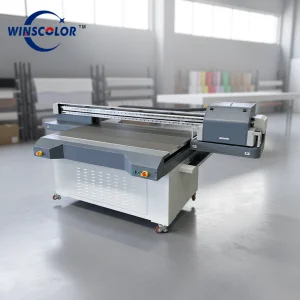
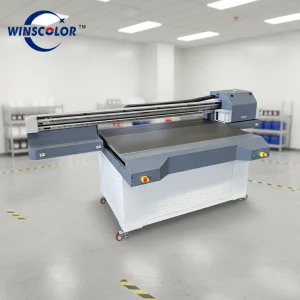
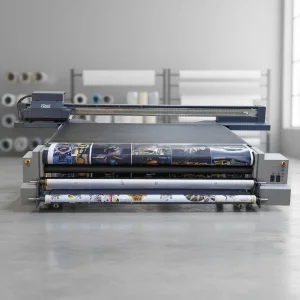
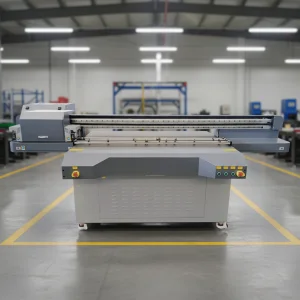
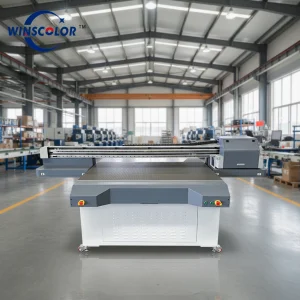
Detailed engineering explanations covering ink chemistry, drop-on-demand mechanics, and operational maintenance.
Ricoh Gen6 piezo printheads utilize stainless steel and silicon micro-machined architecture rated for continuous industrial runs. Operating at higher firing frequencies (up to 50kHz) with variable greyscale drop firing down to 5pL, they achieve superior droplet velocity, pinpoint dot placement, and increased ink open time. This design delivers higher throughput and longer operational lifespans compared to consumer-derived printheads.
Inorganic non-porous surfaces like polished glass, stainless steel, and raw aluminum lack mechanical absorption pores. To guarantee long-term durability, we apply a clear chemical bonding primer (manual or via dedicated inline piezojet channels). The silane formulation chemically cross-links the inorganic surface with the UV photoinitiator polymers during curing, achieving ASTM 5B cross-hatch scratch resistance.
Dual negative pressure systems balance ink meniscus tension at the nozzle face to prevent ink weeping or starvation during high-speed moves. Daily care involves automated wiping and capping with dedicated solvent solutions. Weekly protocols require checking digital vacuum gauges, inspecting peristaltic air valves, and flushing secondary sub-tanks to maintain consistent micro-fluidic pressure.
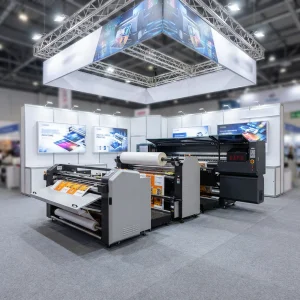
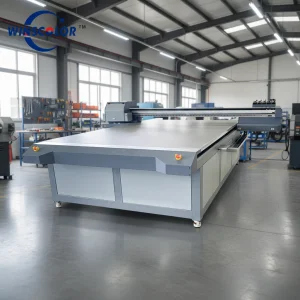
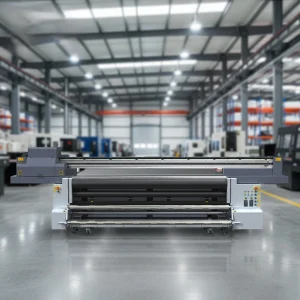
A true flatbed employs an immovable cast-iron frame with a multi-zone vacuum table designed for heavy, rigid materials (wood, glass, sheet plastics) up to 100mm thick. Hybrid printers use an automated conveyor belt drive with extendable support tables, moving both rigid sheets and rolls efficiently. True roll-to-roll systems use dedicated torque tensioning rollers strictly for flexible media like banner, vinyl, and canvas rolls.
Industrial UV machines require clean, stable operating environments. Ambient temperatures should remain between 20°C and 28°C (68°F to 82°F) with non-condensing relative humidity between 40% and 60% to avoid static buildup and printhead drop deflection. Dedicated independent ground wiring (<4Ω resistance), an isolated voltage stabilizer/online UPS, and a stable industrial compressed air supply (0.6–0.8 MPa) are essential.
Specialized RIP software generates distinct layered raster files. The printer runs multiple passes, first jetting and curing concentrated white ink to build physical 3D base topography (from 0.1mm up to 2.0mm). A registered CMYK layer deposits full color, followed by an overprint of clear gloss varnish cured by secondary LED passes for high-gloss, matte, or textured finishes.
