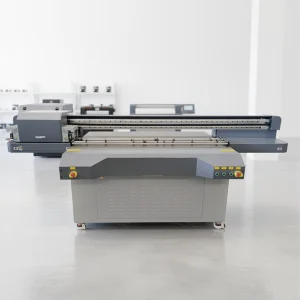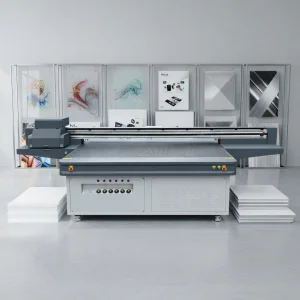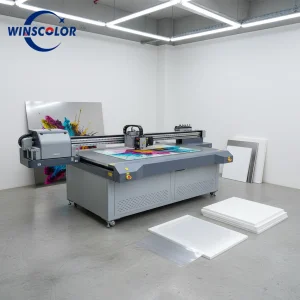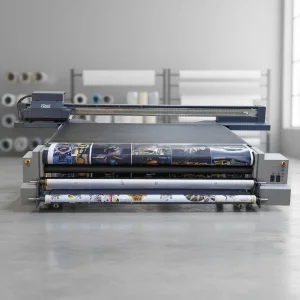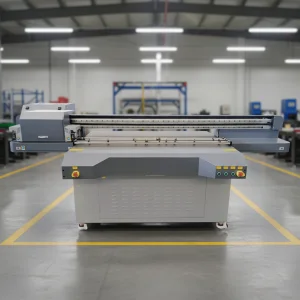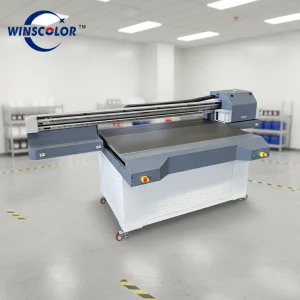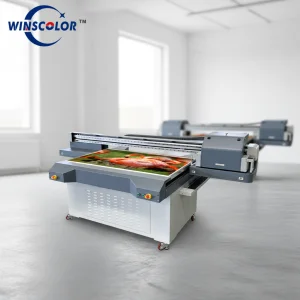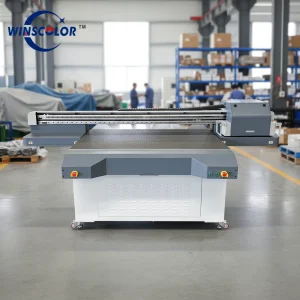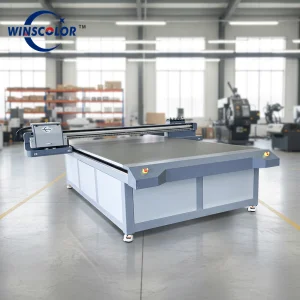
Direct manufacturer solutions engineered with industrial piezoelectric printheads, advanced LED-UV curing matrices, and micron-accurate vacuum flatbeds for non-stop industrial output.
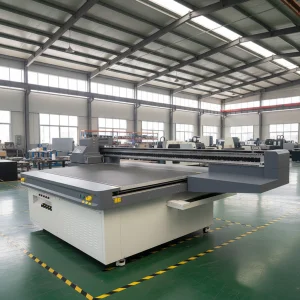
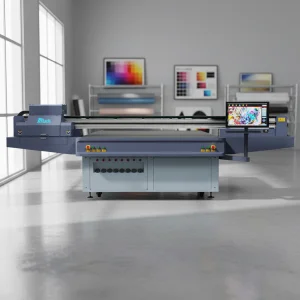
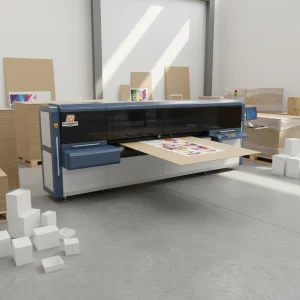
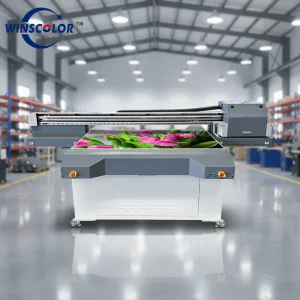

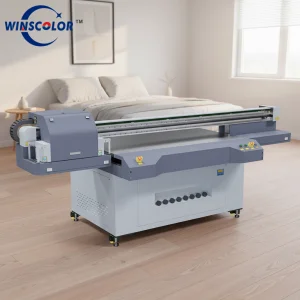
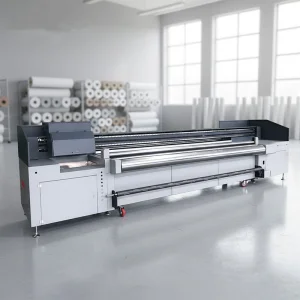
The global wide-format UV printing industry is experiencing an irreversible tectonic shift away from legacy solvent, eco-solvent, and analog screen-printing workflows toward photopolymerizable LED-UV curing systems.
Traditional printing relied on volatile organic compounds (VOCs) that evaporated into the atmosphere, leaving thin dried pigments while demanding extensive drying channels and costly exhaust ventilation. Modern LED-UV curing systems use high-intensity narrow-wavelength ultraviolet light (typically 385nm to 395nm) to initiate an instantaneous free-radical photo-polymerization reaction. Monomers cross-link into a solid, resilient polymer matrix in milliseconds, allowing instant handling, zero VOC emissions, and dramatically reduced electrical consumption.
Analog screen printing suffers from severe economic constraints on runs below 2,000 units due to positive film imaging, mesh tensioning, emulsion coating, exposure, and color-separation setup times. UV flatbed and hybrid digital systems eliminate tooling and make-ready costs entirely. With modern variable drop-on-demand (DoD) piezo printheads firing microscopic droplets down to 2.5 picoliters, operators achieve photographic gradients, raised tactile micro-embossing, and variable data serialization straight from digital RIP files in seconds.
Enterprise procurement demand has moved decisively beyond single-purpose machines. Factory managers require multi-substrate agility: printing acrylic, brushed aluminum composite, structural glass, tempered wood, and foam PVC during standard shifts, then toggling to flexible rolls (canvas, banner, PVC film) or cylindrical items (insulated tumblers, wine bottles) with rotary attachments. Equipment that balances bed stability, multi-zone vacuum clamping, and carriage clearance is the clear global market favorite.
A high-performance UV printer is not merely an assembly of electronic circuits and ink tubes; it is a heavy-duty, high-precision mechatronic platform engineered for micron-level droplet landing accuracy across millions of cycles.
The core of modern UV flatbed performance is the industrial printhead. The Ricoh Gen6 (MH5320) platform represents the benchmark for heavy-duty volume: operating with 1,280 nozzles arranged across 4 rows, firing variable drop sizes from 5 pl to 15 pl, and boasting a maximum jetting frequency of up to 50 kHz. This yields extraordinary edge sharpness and rapid solid-color fills. For ultra-fine art, high-precision dials, or steep 3D curved surfaces, the Ricoh Gen5i offers high-throw capability, jetting fine 3.0 pl drops across distances up to 12mm without airborne misting or deflection.
Micro-stepping belt systems are susceptible to thermal elongation and wear-induced backlash over time, creating bidirectional registration errors and visual banding. Premium machines utilize dual Japanese THK or Hiwin silent linear guides paired with magnetic linear encoder scales providing 1-micron resolution feedback. Carriage movement is driven by dual Panasonic or Yaskawa AC digital servo systems, guaranteeing smooth traverse speeds up to 1.8 m/s without mechanical resonance or carriage deflection.
White ink utilizes titanium dioxide (TiO2) pigments, which are significantly heavier than organic dyes and prone to rapid sedimentation, nozzle starvation, or premature clogging. High-end Winscolor/NTEK systems employ dedicated dual negative-pressure systems: independent pneumatic regulation for white/varnish channels versus CMYK channels, alongside closed-loop continuous white ink recirculation from the sub-tank through the printhead manifold. This architecture keeps pigment suspension uniform 24/7, even during extended standby.
| Printhead Model | Native Droplet Size | Firing Frequency | Drop-on-Demand Type | Optimal Application Scenarios |
|---|---|---|---|---|
| Ricoh Gen6 (MH5320) | 5 – 15 pL (Multi-drop grayscale) | Up to 50 kHz | Industrial Stainless Steel Piezo | Continuous 24/7 production, rigid signage, Dibond, acrylic, wood |
| Ricoh Gen5i (TH5241) | 3.0 – 12 pL | Up to 40 kHz | High-throw distance (up to 12mm) | Deep-relief items, toys, uneven leather, high-profile footwear, golf balls |
| Kyocera KJ4A Series | 3.5 – 14 pL | Up to 64 kHz (High Speed) | Piezoelectric Ceramic Array | High-speed single-pass corrugated packaging, ultra-wide hybrid machines |
| Epson i3200-U1 HD | 3.2 – 12 pL (PrecisionCore) | Up to 43.2 kHz | Thin Film Piezo (MEMS) | Cost-effective commercial desktop flatbeds, custom phone cases, stationery |
Why Tier-1 industrial buyers worldwide source their digital printing platforms from Jinan Yingcai Digital Technology (Winscolor / NTEK) rather than regional assemblers.
Situated in the industrial heart of Shandong, the Winscolor campus operates six dedicated assembly lines capable of batch production and rapid OEM/ODM customization. Machine frames undergo full thermal stress-relieving annealing in large-scale tempering furnaces to prevent structural distortion over decades of operational life. Following annealing, heavy bed gantries are milled on ultra-precise 5-axis CNC machining centers, ensuring gantry parallelism within 0.02 mm across a 3.3-meter span.
China's comprehensive electronics, precision casting, and optics supply chain cluster enables Winscolor to integrate tier-one global components—including Japanese Ricoh printheads, German Igus energy drag chains, Italian Megadyne timing belts, and Schneider electric safety relays—with significant economy of scale. This structural BOM (Bill of Materials) cost advantage is transferred directly to global distributors and production facilities, slashing capital expenditure hurdles by 40% to 60% compared to Western-assembled equivalents.
Zero machinery departs the Jinan manufacturing facility without exhaustive multi-stage verification. Every flatbed is inspected across thousands of grid points with Renishaw laser interferometers to certify bed flatness and sub-micron linear positioning repeatability. Following mechanical assembly, machines endure a continuous 72-hour burn-in stress test, printing rigorous drop-positioning charts, dense CMYK+W+V solid passes, and dynamic speed shifts to identify any electronic, ink-delivery, or optical anomalies before export packaging.
Industrial UV inkjet printing succeeds or fails at the interface between the cured ink droplet and the chemical characteristics of the substrate surface.
Inorganic non-porous surfaces like polished architectural glass, glazed ceramic tiles, and porcelain slabs have low surface energy, which can cause cured ink film to delaminate when exposed to humidity or abrasive friction. Winscolor incorporates specialized silane-based adhesion promoters (primers), applied either via dedicated wipe/spray protocols or automated inline printhead channels. This forms strong covalent chemical bonds across the glass-ink interface, achieving Class 5B cross-hatch adhesion and superior moisture resistance.
For point-of-sale displays and visual merchandising, color density and backlit illumination require multi-layer registration. Winscolor UV flatbeds provide native Color + White + Color or White + Color + Varnish single-pass printing. By laying a micro-registered white diffusing barrier between two full-color graphics on transparent acrylic, lightboxes maintain vibrant color fidelity whether backlit at night or viewed under natural daytime illumination without lamination.
E-commerce fulfillment demands customized, on-demand corrugated boxes without expensive flexographic rotary die or plate manufacturing. The Winscolor High-Speed Digital Single-Pass printing line feeds pre-cut corrugated boards, kraft paper, and honeycomb cartons beneath stationary wide-array inkjet printhead bars at speeds exceeding 1.2 m/s. This delivers sharp brand graphics, scannable QR codes, and custom shipping designs economically—even on short-run orders of a few dozen boxes.
Beyond two-dimensional images, UV inks can be stacked in multiple passes to create structural, three-dimensional textures. Winscolor UV engines can stack clear UV varnish to produce ADA-compliant Braille signage, leather-grain textures, water droplet simulations, and spot-gloss finishes. Controlled UV-LED curing can pin droplets instantly for a matte finish or delay exposure slightly to allow self-leveling for an ultra-high-gloss mirror shine.
Traditional flatbeds cannot print curved items without distortion. Winscolor rotary tooling synchronizes high-torque steppers to rotate tumblers, glass perfume bottles, aluminum water flasks, and tapered candles seamlessly beneath the carriage array. Advanced firmware handles conical taper compensation in real time, preventing visual distortion across non-uniform diameters.
In electronic manufacturing, UV inks provide high chemical resistance against oils, solvents, and mechanical abrasion. Direct-to-panel UV printing eliminates screen-printed overlays for polycarbonate control switches, instrument clusters, household appliance fascias, and anodized aluminum equipment nameplates with sub-millimeter registration accuracy.
Purchasing an industrial digital printer requires calculating the total operating cost per square meter over a 5-year lifecycle rather than simply comparing initial machine price tags.
A standard industrial UV printhead running high-density CMYK at 720×1200 DPI consumes approximately 8 ml to 12 ml of ink per square meter at 100% full coverage. Variable drop grayscale printing reduces ink volume by up to 28% without sacrificing perceptual optical density. Industrial buyers should calculate ink cost per liter, purge waste volumes during daily maintenance, and the open-source ink system flexibility offered by manufacturers like Winscolor versus locked-chip proprietary ink cartridges that inflate operating expenses.
Legacy metal halide UV lamps consume 4.5 kW to 8 kW of electricity per hour, generate high thermal radiation that can warp heat-sensitive PVC, thin film, or styrene, and require warm-up and cool-down cycles. Winscolor water-cooled LED-UV curing systems consume less than 1.2 kW, fire instantly on demand, generate negligible substrate heat, and have an operating lifespan exceeding 25,000 hours—slashing shop electricity bills and eliminating frequent bulb replacement cycles.
Unplanned downtime can quickly erase production margins. Industrial buyers should review the Mean Time Between Failures (MTBF) of the motion carriage and printheads. Winscolor pairs high-durability Ricoh Gen6 stainless-steel chambers with modular ink delivery paths, board-level component isolation, and universal spares, keeping replacement parts accessible and maintenance simple compared to closed-architecture European systems.
The UV printing landscape is rapidly advancing. Over the next five years, key technological developments will redefine output speed, automation, and environmental sustainability.
Next-generation digital UV printers are integrating high-resolution vision systems directly onto the print carriage. Built-in spectrophotometers and AI camera modules measure color density swatches in real time, automatically compensating for environmental humidity or batch-to-batch ink viscosity changes without manual recalibration. Vision modules detect nozzle dropouts during high-speed runs, automatically re-mapping adjacent operational nozzles to maintain flawless output without stopping the job.
Global regulatory frameworks such as REACH, RoHS, and EU food-contact standards are driving ink formulation advancements. The next wave of photopolymer chemistry focuses on low-migration, bio-renewable photoinitiators that eliminate hazardous residual monomers entirely. This expands UV inkjet printing safely into primary cosmetics packaging, pharmaceutical folding boxes, and sensitive interior children's furnishings without chemical odor.
Industrial UV flatbeds are transitioning into fully autonomous manufacturing workcells. By combining heavy vacuum gantries with automated sheet feeding stations, robotic suction arms, optical substrate edge alignment, and automatic post-cure unloading conveyors, print facilities can run complete second and third shifts without manual operator intervention.
Detailed engineering and procurement answers compiled by Winscolor application engineers and technical specialists.
Explore our full range of 1610 mid-format, 2513 wide-format, and super-wide roll-to-roll hybrid systems built for high throughput and continuous commercial return on investment.