
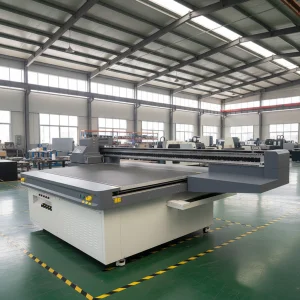
Explore heavy-duty, high-throughput digital UV printing platforms purpose-built for rigid polyvinyl chloride (PVC) sheets, acrylics, composite panels, and flexible visual media.

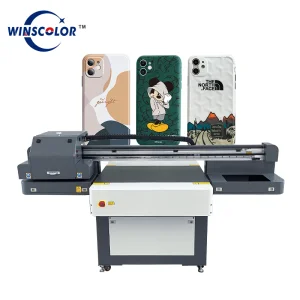
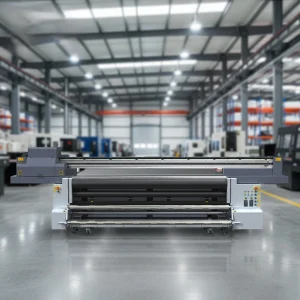


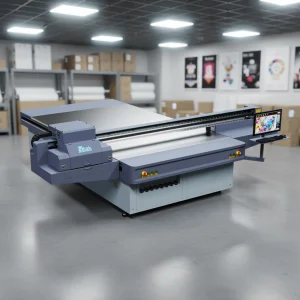

Direct printing on rigid polyvinyl chloride foam sheets demands strict mechanical rigidity, precise thermal management, and advanced electrostatic mitigation.
Heavy-duty dual THK linear guide rails eliminate harmonic distortion during high-velocity carriage acceleration across 2500 mm beds.
Industrial Ricoh Gen6 piezo printheads deliver precise multi-drop grey levels down to 5 pL droplet size for ultra-smooth gradients.
Narrowband 395nm UV-LED cold curing prevents thermal deflection, edge curling, and plasticizer migration in lightweight Celuka foam sheets.
All-steel unified gantry, stress-relieved via high-temperature annealing and five-axis CNC surface profiling for decades of 24/7 cycles.
Polyvinyl Chloride (PVC) boards—encompassing rigid expanded foam PVC (often marketed as Forex, Sintra, or Celuka), co-extruded hollow core panels, and dense rigid PVC sheets—represent the cornerstone of modern retail displays, architectural hoardings, and point-of-sale graphics. However, high-speed UV digital printing on PVC introduces distinct chemical and mechanical hurdles. Because expanded PVC is composed of micro-cellular closed cells stabilized by organic metal soaps (such as Ca-Zn complexes) and internal lubricants, its surface energy typically hovers between 36 to 40 dynes/cm. Standard water-based or mild solvent inks fail to wet the surface evenly, leading to reticulation, pinholing, and brittle flaking under post-print CNC routing or V-groove scoring.
As an established famous PVC board UV printer manufacturer, Winscolor (Jinan Yingcai Digital Technology Co., Ltd) integrates dual anti-static deionizing bars alongside customized photo-curable acrylate ink formulations. These UV curable formulations balance monofunctional monomers (which foster controlled micro-penetration and chemical anchorage into the vinyl polymer chains) with cross-linking polyfunctional oligomers that deliver exceptional scratch and impact resistance. Coupled with our high-torque, multi-zone vacuum suction tables, our systems prevent the thermal warpage common with obsolete mercury halide vapor curing lamps, guaranteeing edge-to-edge registration within sub-millimeter tolerances.
A rigorous examination of micro-fluidics, magnetic levitation linear drives, multi-pass interlacing algorithms, and closed-loop spectrophotometry.
Moving away from traditional timing belts, next-generation Winscolor systems deploy magnetic levitation linear servo drives paired with 0.1 μm Renishaw optical metal encoders.
Dynamic acoustic wave pulsing allows precise droplet velocity tuning across varied ambient factory viscosities (8 to 14 mPa·s), completely suppressing micro-satellite spray.
Continuous negative pressure degassing manifolds ensure ink delivery lines remain free of micro-bubbles during high-speed, 24/7 continuous pass runs on heavy Celuka panels.
From visual merchandising graphics to heavy-gauge architectural wall cladding: matching chemical primers, ink droplet deposition, and curing parameters.
| Substrate Material | Core Application | Primary Technical Barrier | Winscolor Engineering Solution | Throughput Tier |
|---|---|---|---|---|
| Expanded Free-Foam PVC (1–5 mm) | Retail POP/POS signage, hanging indoor placards, exhibition stands | Static charge buildup attracting airborne mist; board bowing under radiant lamp heat | Dual corona/plasma deionizing bars + cold-cure 395nm UV-LED array (<38°C) | Up to 65 m²/h |
| Rigid Celuka PVC Board (8–25 mm) | Outdoor architectural facades, high-end millwork, marine furniture panels | Glossy non-porous skin resisting pigment anchoring; post-cut edge chipping | High-adhesion flexible UV oligomer ink series + automatic primer jet channel | 42–55 m²/h |
| Rigid PVC Co-Extruded Foam | Industrial transit cases, chemical cabinetry, sound barriers | Heavy panel deadweight causing carriage deflection; vacuum leakage across wide formats | Sectional 8-chamber high-vacuum platen with multi-stage turbine air pumps | 35–48 m²/h |
| Composite Dibond / PVC Sandwich | Permanent estate hoardings, directional wayfinding, architectural cladding | Differential thermal expansion rates between aluminum skin and core PVC foam | Layered White+CMYK+Varnish single-pass configuration with variable-dot control | 30–45 m²/h |
For industrial print shops, the fundamental determinant of outdoor weatherability and mechanical adhesion is the critical surface tension relationship between the liquid UV ink droplet and the PVC substrate. Expanded PVC boards, when freshly extruded, typically exhibit a surface tension of 38 dynes/cm. However, over time and storage in varying humidity, this value can degrade to 32–34 dynes/cm as migratory plasticizers bloom to the surface.
Winscolor industrial printers utilize specialized low-surface-tension inks (28–31 dynes/cm at jetting temperature of 45°C). By ensuring that the liquid ink surface tension remains consistently lower than the PVC board’s surface energy, our systems achieve instantaneous wetting without excessive droplet bleeding. Furthermore, our auxiliary UV inline varnish systems deliver 3D raised tactile embossing, Braille compliance (ADA standard), and high-gloss spot accents that cure completely within milliseconds, preventing oxygen inhibition and preserving sharp mechanical borders.
Inside Winscolor’s 20,000 m² production facility in Jinan, China: vertical integration, standardized assembly, and heavy industrial quality control.
Every printer chassis undergoes 72-hour thermal stress relief annealing, followed by single-clamping milling on large five-axis gantry CNCs to maintain ±0.015 mm flatbed true-planarity.
Located in the heart of Shandong’s heavy industrial cluster, Winscolor sources Japanese THK rails, German IGUS drag chains, and Italian Megadyne belts with complete tier-1 batch traceability.
Before international crate sealing, every production unit executes a continuous 168-hour continuous pass cycle, verifying board heating, ink path vacuum stability, and servo motor thermal limits.
With 6 dedicated robotic and manual assembly lines, we provide specialized chassis branding, custom industrial firmware configurations, and bespoke bed dimensions for global distributors.
A transparent economic evaluation of industrial UV flatbed acquisition, operating expenditures, consumables, and return on investment horizons.
| Cost Driver Component | Legacy Western Equipment | Winscolor Industrial Architecture | Direct Operational Benefit |
|---|---|---|---|
| Initial Capital Expenditure (CapEx) | $140,000 – $280,000 USD | $35,000 – $65,000 USD (Direct Factory Price) | 60–75% reduction in asset payback duration (< 8 months) |
| Ink Consumption / Square Meter | 10 – 12 ml/m² (Proprietary RFID Locked) | 6 – 8 ml/m² (Open Architecture Bulk Feed) | Direct ink consumables cost reduced by ~42% annually |
| Printhead Lifecycle & Replacement | $3,500 – $6,000 per head (Encrypted) | Ricoh Gen6 Genuine OEM ($1,400 – $1,900) | Drastically reduced risk of catastrophic carriage replacement costs |
| Energy Consumption (kWh) | 12 – 18 kW (Mercury Arc System) | 3.5 – 5.5 kW (High-Flux LED Water-Cooled) | Up to $4,800 saved yearly in facility power consumption |
For print service providers converting 2,000 to 5,000 square meters of rigid expanded PVC board per month, profitability hinges not simply on peak carriage velocity, but on net yield—factoring in purge waste, media rework, and daily maintenance overhead. Winscolor printers utilize an automatic negative-pressure sub-tank array that reduces daily purging ink loss to under 15 ml per channel.
Assuming an average commercial sell price of $18.00/m² for printed 3mm foam PVC, a substrate raw cost of $4.50/m², and a Winscolor ink consumption cost of $0.65/m² (calculated at 7 ml/m² across CMYK+W), gross margins consistently exceed 68%. This allows full hardware amortization within 180 production shifts under standard single-shift operating schedules.
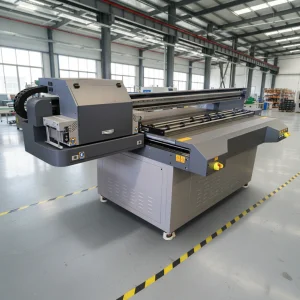
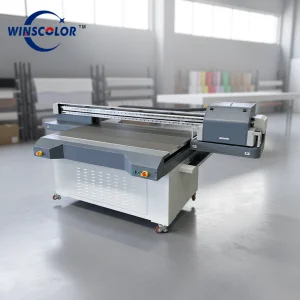
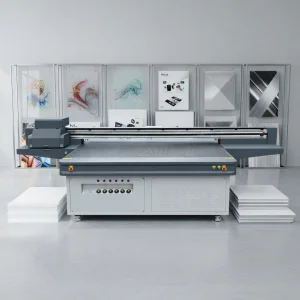
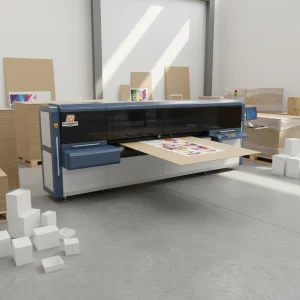
Discover high-speed automatic carton presses, multi-pass hybrid roll-to-roll platforms, and rotary-equipped digital flatbeds from our Jinan manufacturing plant.

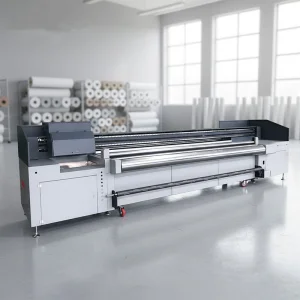
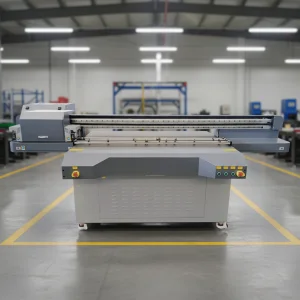

Comprehensive certifications for North American, European Union, and international industrial environments, backed by multi-lingual remote engineering.
As an exporter serving print shops in over 100 countries, Winscolor machinery is manufactured to comply strictly with the European Machinery Directive 2006/42/EC, Low Voltage Directive (LVD) 2014/35/EU, and Electromagnetic Compatibility (EMC) 2014/30/EU. All components conform to RoHS 3 (EU 2015/863) directives, ensuring that printed PVC foam boards, inks, and electronic control harnesses remain free of hazardous heavy metals and regulated plasticizers.
For industrial plants across the United States and Canada, our power distribution enclosures are engineered in compliance with NFPA 79 Electrical Standards for Industrial Machinery and feature dual-channel Category 4 Emergency Stop architectures with safety interlock curtains.
Real-time machine diagnostics allow Jinan senior field engineers to assist local technicians via secure VPN tunnels, viewing live head waveforms and vacuum pressures.
Direct supply arrangements in regional logistics hubs (Rotterdam, Dubai, São Paulo, Chicago) guarantee printhead and motherboard delivery within 48 to 72 hours.
Comprehensive video certification and factory-based hands-on courses enable distributor engineers to handle mechanical leveling and RIP color profiling independently.
Authoritative technical responses compiled by Winscolor application engineers regarding ink adherence, anti-static measures, curing wavelengths, and hardware setup.