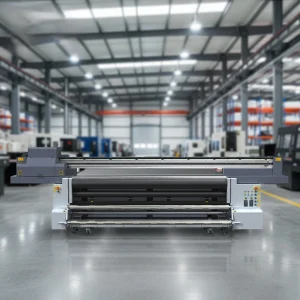
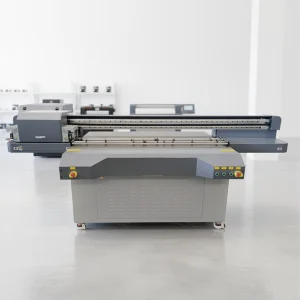
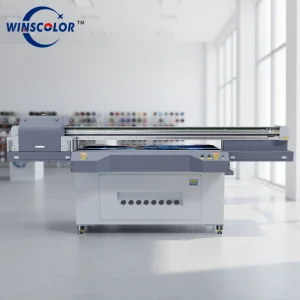
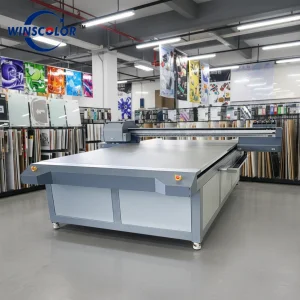
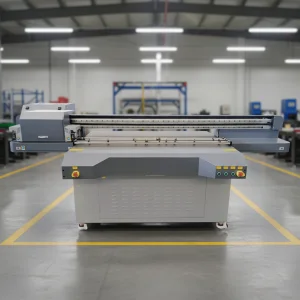
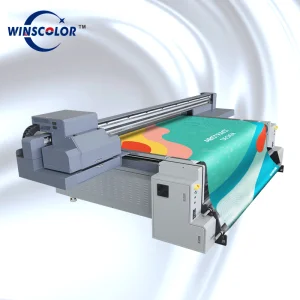
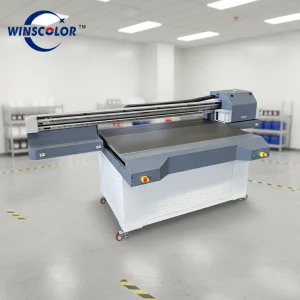
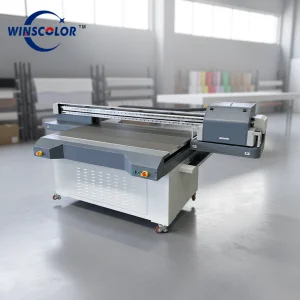
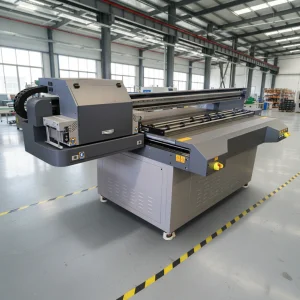
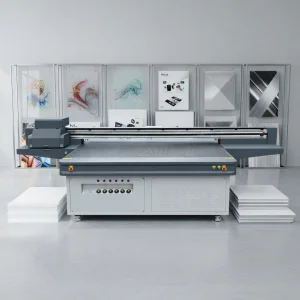
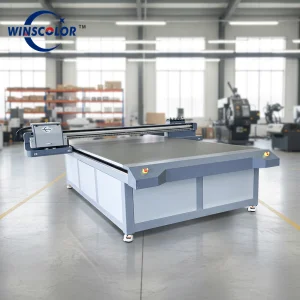
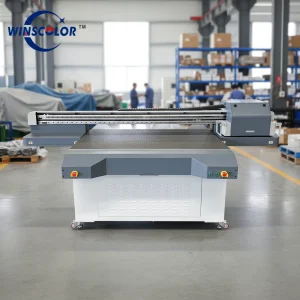
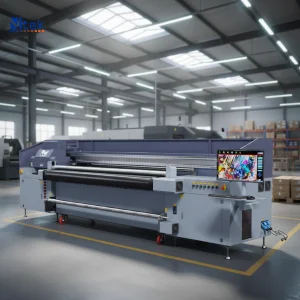
Industrial UV curing digital printers engineered with multi-drop piezoelectric printheads, precision vacuum bed partitioning, and robust structural gantries.
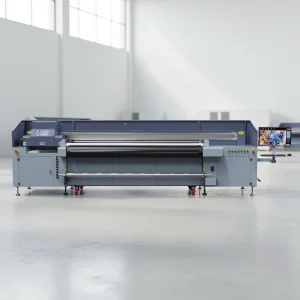

Understanding mechanical rigidity, optical linear encoders, variable grayscale droplet control, and specialized ink chemistries in modern B2B manufacturing.
The global digital imaging landscape has transitioned from traditional solvent, eco-solvent, and analog screen presses toward high-efficiency flat bed UV printing machines. Modern industrial UV printing relies on photopolymerization, in which high-intensity ultraviolet light-emitting diodes (UV-LEDs) instantly solidify specially formulated UV-curable inks onto diverse substrates. Unlike conventional thermal drying systems that depend on evaporation and emit substantial volatile organic compounds (VOCs), UV-LED technology cures the ink film instantaneously through cross-linking polymer chains. This yields immediate adhesion, exceptional chemical resistance, high surface hardness, and sharp dot placement without dot gain or substrate bleeding.
For global procurement directors and machinery importers, specifying an industrial-grade wholesale UV flatbed printer requires auditing mechanical chassis dynamics. High-precision printing across large bed dimensions (such as 2500 × 1300 mm, 2000 × 3000 mm, and 3300 × 2100 mm) necessitates an all-steel, stress-relieved gantry frame milled on heavy CNC five-sided milling machines. Any structural deformation under thermal fluctuation or vibration leads to registration misalignment across multi-pass operations. The integration of dual Japanese THK or Hiwin silent linear guideways, Panasonic or Yaskawa AC servo drive systems, and Renishaw metal optical raster encoders ensures carriage travel repeatability down to micro-millimeter tolerances, avoiding horizontal banding artifacts across long production cycles.
Furthermore, piezoelectric printhead engineering serves as the operational heart of the system. Systems deployed with industrial Ricoh Gen6 (MH5320/MH5340) or Konica Minolta heads achieve native firing frequencies reaching up to 50 kHz with minimum droplet sizes of 5 picoliters. Configured with multi-level variable droplet grayscale technology (VSDT), these machines deliver hyper-realistic skin tones, smooth micro-gradients, and pin-sharp typography down to 2-point sizing. Integrated multi-zone independent vacuum tables with reverse air-cushion floatation simplify the loading, registration, and safe unloading of heavy sheets like 100 kg annealed glass slabs and thick architectural composite sheets.
Why Jinan and Chinese precision engineering hubs deliver unmatched price-performance ratios and total quality lifecycle management for worldwide equipment distributors.
By leveraging dense industrial clusters across Shandong and the Pearl River Delta, raw steel machining, precision CNC milling, sheet metal powder coating, and specialized PCB surface mount assemblies are completed within localized manufacturing perimeters, slashing assembly lead times and supply chain friction.
Every industrial wholesale printing unit undergoes a minimum of 72 hours of uninterrupted dry cycling followed by a 48-hour continuous ink jetting and curing endurance test. Laser interferometers verify table flatness, X/Y axis parallelism, and perpendicularity prior to moisture-barrier vacuum packaging.
Direct sourcing from original equipment manufacturers eliminates multi-tiered markups. Distributors receive tailor-made chassis branding, customized RIP color profiles (Onyx, Caldera, Photoprint), tailored ink configurations (CMYK, Lc, Lm, White, Varnish, Primer), and turnkey spare kits at factory cost.
Systematic comparison of technical criteria evaluating capital equipment lifecycle costs, uptime availability, and operational return on investment.
| Evaluation Parameter | Entry-Level Commercial Units | Mid-Tier Production Systems | Industrial High-Volume Systems (Winscolor/NTEK) |
|---|---|---|---|
| Chassis Construction | Bolted sheet metal, lightweight gantry | Milled steel profile, standard dampening | Heavy-duty annealed tubular steel, CNC 5-sided milled gantry |
| Printhead Technology | Desktop/Modified (Epson i3200/XP600) | Entry Industrial (Toshiba CE4 / Ricoh GH) | Industrial Piezo (Ricoh Gen6 MH5320 / Konica Minolta 1024i) |
| Curing Architecture | Low-power air-cooled UV-LED (5–8 W/cm²) | Standard UV-LED lamps (8–12 W/cm²) | Dual water-chilled UV-LED curing (16–22 W/cm²) with zone controls |
| Vacuum Bed Engineering | Single-chamber, uniform draw | 2–4 manual toggle zones | 6–8 independent high-torque turbine vacuum zones with reverse blow |
| Continuous Shift Rating | 4–6 hours intermittent duty | Single-shift 8-hour operation | 24/7 continuous duty cycle under industrial ambient variations |
| Safety & Anti-Collision | Basic mechanical micro-switches | Carriage physical bump sensors | Infrared optical proximity guards + anti-crash crash pins on X-axis |
Mitigating cross-border operational risk through rigorous international certification standards, remote telemetry diagnostics, and localized maintenance frameworks.
All exported printing systems feature dual-channel emergency stop safety relays, low-voltage 24V DC control loops, CE Machinery Directive compliance (2006/42/EC), and UL-listed electrical distribution enclosures. Low-VOC inks conform strictly to REACH and RoHS standards.
Integrated cloud diagnostic modules enable factory engineers to troubleshoot system parameters remotely. Technicians evaluate sub-tank negative pressure balances, printhead board temperatures, voltage wave curves, and encoder pulse integrity in real time.
To eliminate overseas downtime, wholesale supply agreements incorporate modular replacement kits. High-wear items including ink pumps, sub-tank solenoid valves, UV-LED power ballasts, and negative pressure filters are stocked across European, North American, and Middle Eastern distribution hubs.
From architectural structural cladding to micro-detailed industrial control panels, explore specialized production engineering setups.
Direct printing on tempered curtain walls, splashbacks, and porcelain tiles utilizing customized silane molecular primers. Employs multi-layer high-opacity white ink backup under variable gloss spot varnish finishes.
Zero-plate digital short runs on E/B-flute corrugated cardboard, honeycomb boards, and wooden luxury packaging crates. Eliminates flexographic plate costs while executing personalized, versioned print runs.
High-resolution reproduction of schematics, warning decals, membrane switches, and anodized aluminum control panels. Delivers ultra-high solvent resistance against MEK, alcohol, and extreme ultraviolet degradation.
Specialized thermoforming UV inks allow deep-draw vacuum forming up to 20 cm stretch depth on cast acrylic, polycarbonate, and PETG sheets without film micro-cracking or ink delamination.
Evaluating the paradigm shifts transforming digital wide-format hardware: from inline automated robotics to tactile 2.5D haptic textural modeling.
Flatbed printers are evolving from standalone manual workstations into integrated smart factory cells. The incorporation of robotic arm gantry loaders, automatic pin alignment sensors, and inline palletizing conveyors ensures continuous lights-out production without manual sheet manipulation.
Advanced RIP software slicing algorithms allow multiple layers of high-density clear UV varnish and white ink to build physical reliefs. This facilitates true ADA-compliant Braille signage, high-end fine art reproductions with realistic oil-canvas impasto, and tactile woodgrain textures.
Next-generation water-cooled LED modules feature narrow ultraviolet wavelength emission (395nm ± 5nm), concentrating energy precisely on photoinitiator absorption profiles. This lowers electrical consumption by over 60% compared to traditional mercury arc lamps while maintaining negligible heat transfer on ultra-thin, heat-sensitive films.
In-depth responses from senior digital print engineers covering machine mechanics, ink stability, and maintenance routines.
Explore rotary-equipped, large-format hybrid, and high-speed multi-head printing models built to enterprise procurement standards.