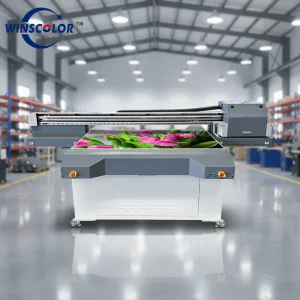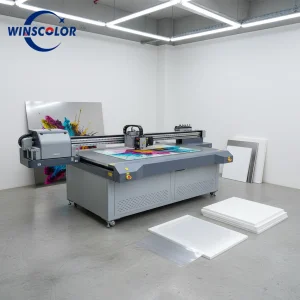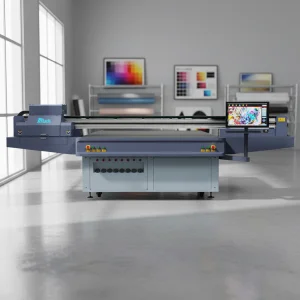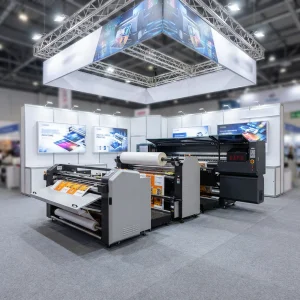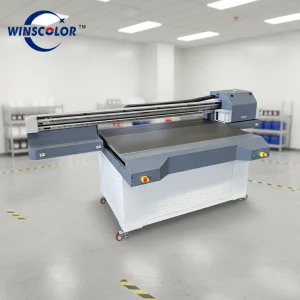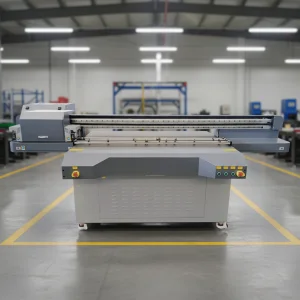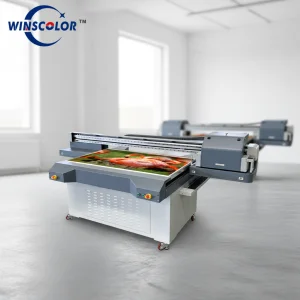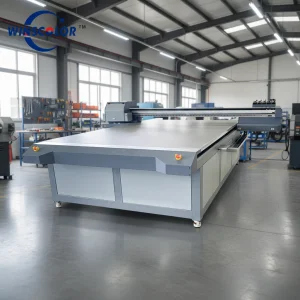
Explore our core UV printing equipment engineered for MDF architecture, custom cabinetry panels, fine art reproduction, and ultra-durable signage manufacturing.
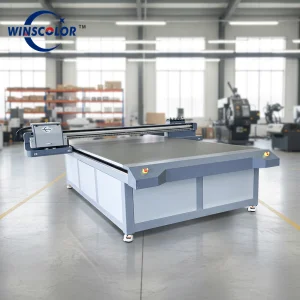
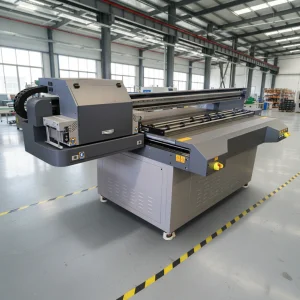
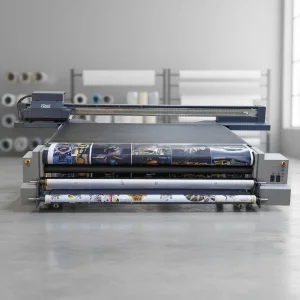
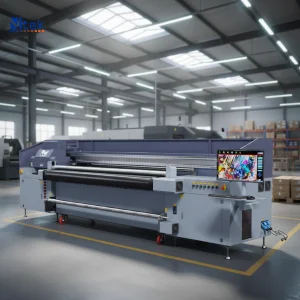

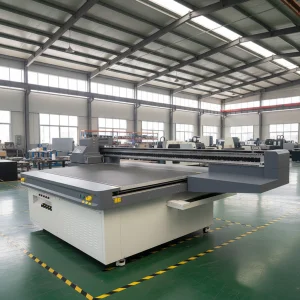
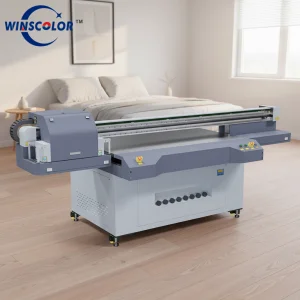
A comprehensive examination of how UV curing technology and precision drop-on-demand piezo systems are redefining medium-density fibreboard processing globally.
Executive Strategic Summary: The transformation of modern interior décor, bespoke contract furniture, and sustainable modular construction relies directly on high-speed flatbed direct printing. Replacing traditional vinyl lamination and melamine paper pressing with industrial-grade digital MDF printing reduces VOC emissions, eliminates physical plate inventory, and cuts customized prototyping turnarounds from 30 days to mere hours.
Global demand for value-added engineered wood products is projected to surge beyond 6.8% CAGR through 2030. Commercial buyers require agile flatbed solutions capable of continuous multi-shift production without mechanical downtime.
Strict ESG mandates throughout the EU and North America are eliminating solvent-borne inks. NTEK UV-LED photopolymer systems emit zero volatile organic compounds, preserving internal factory air quality while meeting REACH standards.
Modern architectural buyers expect physical realism. Through proprietary layered drop-on-demand varnish depositions, NTEK platforms output micro-embossed wood grains, hyper-realistic marble strata, and tactile artistic reliefs directly onto porous wood boards.
MDF substrates present physical challenges: microscopic surface pores, localized thickness variations, and hygroscopic dust particles. Our engineering framework systematically tackles each constraint.
MDF expands and contracts under changing ambient humidity. NTEK machines integrate a continuous multi-zone internal honeycomb vacuum table driven by high-torque air turbine systems. This maintains strict flatness tolerances within ±0.03mm across the total 2500 × 1300 mm or 2000 × 3000 mm printing surface, preventing printhead strikes during high-speed passes.
Furthermore, our integrated electrostatic ionization bars neutralize particulate attraction prior to jetting, eliminating print artifacts created by residual wood fibers.
Utilizing high-frequency industrial Ricoh Gen6 / Gen5 printheads, NTEK delivers variable drop sizing ranging from 5pl to 12pl. This ensures fine text, vector micro-lettering, and smooth high-key facial transitions maintain clarity, while larger droplets fill porous grain pockets for saturated, continuous tone reproduction without pinholing.
The integrated sub-tank heated circulation loops keep white ink constantly agitated, guaranteeing zero sedimentation during offline idle periods.
| Performance Dimension | Legacy Melamine / Screen Print | Standard Commercial Flatbeds | NTEK Industrial MDF Solution |
|---|---|---|---|
| Pre-Production Setup | 14–30 Days (Plates / Cylinders) | 10 Minutes (Digital file preparation) | Instant Dynamic RIP Integration |
| Direct-to-MDF Adhesion | Requires secondary adhesive resins | Moderate (Prone to edge chipping) | Industrial Hard-Ink Polymerized Grip |
| Tactile Surface 3D Depth | Fixed mechanical roll embossing | None (Flat 2D layer only) | Synchronized Varnish Relief (up to 1.5mm) |
| Short-Run Economical Lot | > 5,000 m² to justify setup | 1–50 m² | 1 to Unlimited m² Continuous Linear Flow |
Purchasing managers, plant supervisors, and international commercial importers evaluate UV printers through strict total cost of ownership (TCO) matrices.
Global operations prioritize long-life piezo printheads and accessible bulk ink delivery systems. NTEK's automated negative-pressure cleaning stations cut ink purge losses during daily maintenance cycles by over 32% compared to standard desktop systems.
High-volume wood product processors run continuous shifts. High-tensile steel crossbeams, imported THK double-silent guide rails, and high-response Panasonic AC servo motors guarantee mechanical positioning accuracy over years of high-volume usage.
Integrators frequently request customized chassis coatings, specialized RIP driver packaging, integrated loading conveyors, and customized drop clearances to print directly onto pre-fabricated furniture doors exceeding 100mm in thickness.
Our Jinan R&D engineering division continues to refine motion mechanics, UV spectrum profiles, and real-time process monitoring.
Integrating high-speed line scan cameras directly onto the carriage gantry to profile board surface warpage in real time. Automatic micro-stepping Z-axis actuators adjust printhead clearance instantaneously, ensuring drop placement accuracy even on non-planar MDF sheets.
Combining 365nm and 395nm UV spectrum arrays to balance immediate surface curing with deep substrate cross-linking. This provides scratch-resistant top coats without sacrificing adhesion along the deep fibers of untreated wood matrices.
Partnering with global chemical formulators to engineer ultra-low viscosity, water-dispersible UV curable inks. These formulations will expand architectural approvals for cleanroom environments, medical facilities, and infant furniture manufacturing.
Purchasing capital manufacturing equipment internationally demands robust mechanical assurances, international safety verifications, and rapid logistical responsiveness.
Every NTEK industrial machine shipped overseas complies with international electrical guidelines and low-voltage machinery directives. From Siemens electrical contactors to CE-certified emergency deceleration loops, our equipment guarantees workplace safety compliance.
We provide comprehensive bilingual technical manuals, video setup guides, and secure remote VPN firmware diagnostics. Our certified field application engineers assist distributors in localized installation, color management calibration, and operator training worldwide.
Critical operational components—including high-voltage boards, secondary ink tanks, peristaltic pumps, solenoid valves, and precision encoder strips—are stocked for immediate air courier dispatch, minimizing unplanned factory stoppages.
Actionable answers addressing production speeds, adhesion mechanics, cost management, and media prep.
For standard raw MDF, pre-wiping the board to remove surface dust is essential. Because raw MDF is porous, applying a light digital UV primer or utilizing our high-density white ink underbase ensures the ink does not absorb unevenly into the fibers. For melamine-coated or pre-sealed MDF, direct UV printing with NTEK hard industrial inks delivers strong cross-hatch adhesion without requiring separate liquid primers.
Our RIP software breaks down artwork into color and depth maps. The NTEK printer deposits multiple layers of UV-curable white or transparent varnish ink on targeted coordinates to build physical ridges. Once the structural texture is formed, the CMYK color layer is applied, followed by a final matte or gloss varnish coat. This reproduces the authentic tactile feel of natural timber, leather, or carved stone.
Depending on printhead configuration (e.g., 2 to 8 Ricoh Gen6 heads), speeds typically range from 18 to 45 square meters per hour in high-quality production mode (720×1200 dpi). Average ink consumption ranges between 8ml and 12ml per square meter for full 100% CMYK coverage, making unit printing costs predictable and cost-effective for mass production.
Unlike legacy metal-halide mercury lamps that emit high infrared heat, our solid-state UV-LED curing units output monochromatic UV light with minimal thermal radiation. Substrate surface temperatures remain close to ambient levels, preventing thin composite boards or veneered MDF panels from warping or bowing during extended print passes.
NTEK exports globally under FOB, CIF, DDU, and DDP terms. Every printer undergoes a continuous 48-hour burn-in and print testing cycle prior to release. Machines are vacuum-sealed in anti-corrosive foil, moisture-proof barrier wraps, and packed in reinforced, fumigated solid wooden crates engineered for secure multi-modal ocean and rail transit.
Explore our specialized hybrid platforms, all-in-one digital roll laminators, and high-efficiency rigid board solutions supporting worldwide industrial automation.