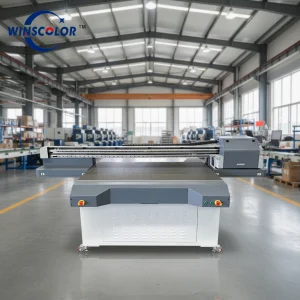
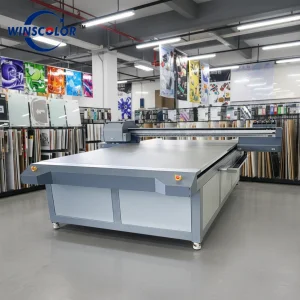
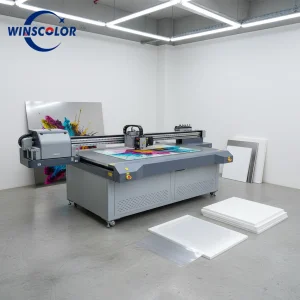
Explore our tier-one industrial production series engineered for commercial signboards, rigid architectural sheets, specialty packaging, and ultra-wide substrates.

A rigorous engineering evaluation of mechanical stability, drop-on-demand piezo micro-fluidics, and photonics curing dynamics for commercial print service providers.
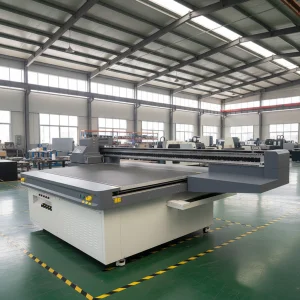
In modern industrial manufacturing and wide-format graphic arts, the term High-Quality UV Printer Large Format represents far more than an assembly of standard electronic parts. It signifies a master-level orchestration of heavy mechanical stability, sub-micron precision motion control, advanced micro-piezo fluidics, and photochemical polymer crosslinking. As print buyers demand higher optical resolution alongside aggressive per-square-meter cost efficiency, printing equipment must endure non-stop multi-shift operating cycles while holding registration down to the hundredth of a millimeter.
Equipped with state-of-the-art greyscale piezoelectric printheads, our UV systems fire droplet volumes ranging from a delicate 5 picoliters up to 15 picoliters. This dynamic variable drop capability achieves silky photographic gradients without visible grain, alongside rich, opaque solid fills at speeds exceeding 60 m²/h.
Structural rigidity is the backbone of micro-accuracy. Every chassis undergoes thermal stress relief and precision dual-milling on industrial CNC centers. Dual Japanese THK linear mute guide rails eliminate carriage vibration, keeping droplet placement deviation under ±0.015 mm across entire 3.2-meter spans.
Integrating high-irradiance water-cooled LED-UV curing clusters running at 395nm wavelength ensures near-instantaneous ink polymerization. Heat-sensitive media like ultra-thin PVC, PET films, and fluted plastics can be decorated without thermal warping or yellowing, reducing electricity draw by 65% versus metal-halide lamps.
Why leading global graphics houses and industrial OEM distributors source their large-format machinery directly from our Jinan manufacturing epicenter.
Situated in Shandong's heavy industrial hub, Winscolor leverages world-class local machining, laser cutting, metal tempering, and electronic component supply chains. This concentrated manufacturing ecosystem reduces parts transit lead times by 80%, translating directly into shorter assembly turnarounds and competitive capital acquisition costs.
While the heavy mechanical body and intelligent software architecture are engineered in-house, critical mechanical components are sourced from globally recognized leaders: THK Linear Guides (Japan), Panasonic AC Servo Motors (Japan), German Igus Cable Chains, and Italian Megadyne Timing Belts for uncompromised operational lifespan.
Whether you require extended table lengths up to 5 meters, multi-row staggered printhead alignments for ultra-speed production, dual-rotary attachments for cylindrical containers, or specialized vacuum partitioning for porous corrugated sheets, our 100+ R&D engineers deliver customized mechatronic solutions to your operational brief.
A direct comparison of industrial flatbed investments, ink yields, preventive downtime mitigation, and net square-meter operational metrics.
Corporate procurement officers and commercial print executives evaluate wide-format equipment not on initial invoice cost alone, but through the holistic lens of Total Cost of Ownership (TCO) over a standard 5-year asset lifecycle. When running high-throughput production lines, operational costs are predominantly dictated by ink consumption, nozzle replacement frequency, electrical overhead, and unscheduled maintenance downtime.
| Evaluation Parameter | Winscolor Industrial UV Platform | Legacy Solvent / Traditional Screen | Imported Western High-Cost Brands |
|---|---|---|---|
| Initial Capital Outlay (CapEx) | Balanced ($18k – $55k depending on heads/size) | Low to Moderate ($15k – $35k) | Prohibitive ($120k – $350k) |
| Fluid Deposition Cost (per m²) | $0.45 – $0.85 (High pigment load, 6–9 ml/m²) | $0.70 – $1.40 (Volatile solvent carrier evaporation) | $1.20 – $2.50 (Proprietary locked-chip ink sets) |
| Pre-Press & Setup Downtime | Instant digital RIP; zero plate preparation | 30–90 min screen making & chemical washup | Instant digital RIP; complex proprietary profiles |
| Substrate Versatility | Rigid boards, acrylic, glass, wood, metals, rolls | Paper, vinyl banners, limited porous media | Rigid & roll media with vendor certification |
| Curing Electricity Consumption | 0.8 kW – 1.8 kW (Instant-on LED-UV arrays) | 4.5 kW – 8.0 kW (Thermal drying tunnels) | 2.5 kW – 5.0 kW (High-output hybrid systems) |
| Break-Even Operational Horizon | 4 to 7 Months under regular 8-hr shifts | 12 to 18 Months (Limited margin on basic signs) | 24 to 36 Months (Heavy amortization burden) |
Emerging developments transforming throughput velocity, surface embellishment aesthetics, and environmental compliance standards.
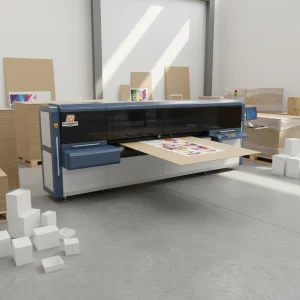
Traditional multi-pass scanning gantries are giving way to continuous-feed single-pass print bars for high-speed corrugated cardboard and carton manufacturing. Output speeds reach 1.2 meters per second, closing the gap between digital agility and flexographic print run volume.
Multi-layered UV varnish and white ink jetting allow micro-relief texturing up to 5mm thick. From architectural wood textures and oil painting reproductions to certified ADA-compliant tactile Braille sign boards, digital embellishment turns low-margin boards into premium products.
Integrated optical laser micrometers map the Z-axis topology of warped boards before printing. Real-time physical anti-collision sensors stop carriage travel in milliseconds if an obstruction is met, protecting sensitive Ricoh Gen6 printheads from catastrophic contact damage.
Stricter global chemical regulations drive rapid adoption of bio-derived reactive monomers. Contemporary UV-curable inks omit heavy aromatics and hazardous air pollutants (HAPs), meeting indoor environmental quality standards for educational and healthcare spaces.
Tailored adhesion chemistries, specialized primers, and curing recipes for both flexible media and challenging non-porous rigid sheets.
Printing directly on float glass, mirrors, backsplashes, and porcelain tiles using pyrosil chemical flame primers. Resists peeling, water ingress, and direct UV radiation exposure in humid washrooms or sunlit exterior curtain walls.
Approved printing configurations for micro-prismatic retroreflective sheeting (3M / Avery Dennison). Formulated inks withstand severe weather, road salts, thermal cycling (-40°C to +80°C), and abrasion without protective clear laminate film.
The core standard of high-impact visual merchandising. High-opacity opaque white under-printing produces vibrant color pops on black, brushed metallic, and neon-tinted acrylic boards without color bleed or cross-contamination.
Plate-free direct printing on fluted cardboard (E, B, and C flute) and honeycomb packaging. Eliminates prepress delays and expensive tooling, letting packaging converters print 10 to 5,000 custom shipping boxes economically.
Micro-droplet jetting directly onto textured polycarbonate (Lexan) and polyester films for industrial control consoles, home appliance touch panels, and electronic instruments. Formulated inks bend and flex during embossing without spiderweb cracks.
Natural timber veneers, engineered MDF boards, artist canvas rolls, and genuine leather upholstery. Variable drop jetting preserves organic grain textures while spot white layers ensure realistic flesh tones and vibrant colors.
Comprehensive engineering certifications, international electrical safety adherence, and multi-tier localized field service agreements.
Every printer ships with full conformity to the European CE Machinery Directive 2006/42/EC, Low Voltage Directive (LVD), and EMC shielding. Electrical panels use UL94 V-0 flame-retardant wiring harnesses, and all inks comply with RoHS 3 (EU 2015/863) and REACH SVHC safety regulations.
To eliminate prolonged shipping waits, Winscolor works with regional logistics and distribution hubs across Europe, North America, Southeast Asia, and the Middle East. High-wear items including UV-LED lamps, negative pressure pumps, ink solenoid valves, and filters are stocked locally for fast courier dispatch.
Optional integrated IoT gateways allow our technical support engineers to review system log files, diagnose pressure fluctuations, audit voltage wave curves, and tune color RIP profiles in real time. For complex hardware repairs, factory-certified regional technicians are deployed on-site.
Technical answers compiled by our application engineers addressing hardware duty cycles, ink behavior, printhead protection, and maintenance schedules.
Under recommended operational conditions—consistent 21°C–25°C ambient temperatures, 40%–60% relative humidity, clean ink filtration, and systematic daily automated capping/flushing—Ricoh Gen6 piezo printheads maintain high nozzle consistency across an expected service life of 3 to 5 years in active industrial environments.
Dense titanium dioxide particles settle rapidly if allowed to sit static. Our machines use a Dual Active White Ink Circulation System that continuously cycles white ink through main reservoirs, sub-tanks, internal damper filters, and head manifolds 24/7, preventing sedimentation and nozzle clogging.
Yes. We offer dedicated hybrid configurations (like our YC2500HR and YC3200HR series) with vacuum-conveyor belts and synchronized front/rear extension tables. These run flexible rolls (vinyl, canvas, mesh) as well as heavy rigid panels (glass, MDF, composite boards up to 50mm thick) on one machine footprint.
Our digital dual negative pressure system decouples white ink from color channels. Micro-stepping vacuum regulation keeps the meniscus at each nozzle face stable during acceleration and deceleration gantry reversals, preventing ink weeping or starved drop firing at high speeds.
Non-polar, non-porous surfaces like polished glass, bare aluminum, and stainless steel require specialized surface energy adjustment. We recommend applying our silane-based chemical adhesion primers or integrated flame/plasma treatment modules, achieving class-5B cross-hatch adhesion test ratings.
Our UV printers interface natively with leading professional RIP platforms including Onyx Postershop, Caldera GrandRIP+, and SAi FlexiPRINT. We supply custom ICC profiles with linearized ink limits, spot channel mapping (White, Varnish, Primer), and G7 grayscale calibration targets.
Broaden your workshop's manufacturing capabilities with our high-versatility commercial models engineered for rigid substrates, cylindrical wares, and wide-format hybrid rolls.
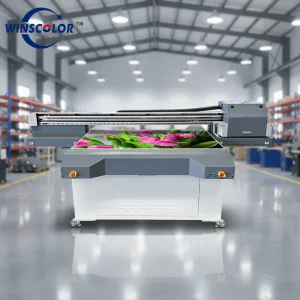
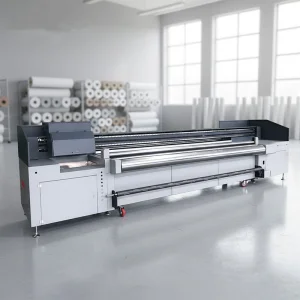
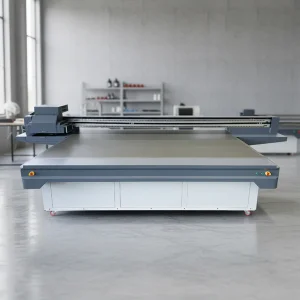
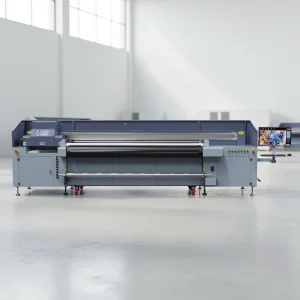

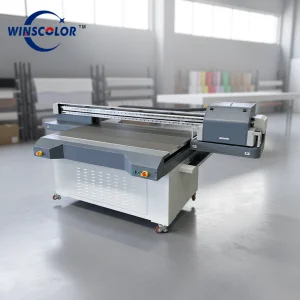
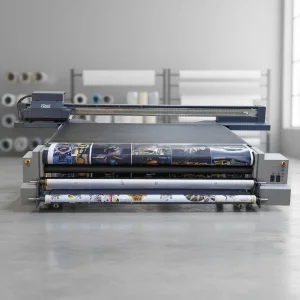
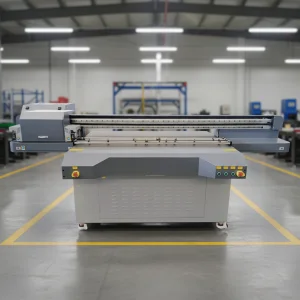
Cross-reference physical footprint, carriage speeds, printhead channel configurations, and media handling before commissioning factory production.
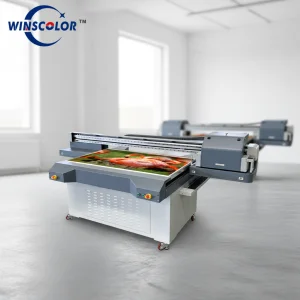
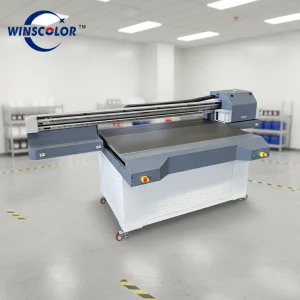
Engineered for specialty merchandise, promotional gifts, consumer electronics prototypes, and tactile ADA signage. The 1600 × 1000 mm vacuum platform allows rapid changeovers between small jigs and cylindrical rotary attachments without consuming broad workshop square footage.
The global graphic industry standard for 8 × 4 foot (2440 × 1220 mm) rigid substrates. Accommodates standard PVC foam, acrylic, composite panels, and timber boards with zero trimming required. Configurable with up to 8 Ricoh Gen6 printheads in dual CMYK + White + Varnish layouts.
Combines heavy-gauge flatbed rigidity with roll-fed versatility. Features heavy air-shaft feeding mechanisms alongside front-and-back extension rollers, outputting continuous flexible banners, self-adhesive vinyl rolls, wallcoverings, and rigid panels up to 3200mm seamless print widths.
Submit your core target substrates, estimated monthly square-meter throughput, and finishing specifications. Our Jinan engineering team will calculate optimal printhead layouts, estimate realistic per-meter ink costs, and send high-resolution video recordings of sample runs on your substrates.
