Engineering-Grade Digital Direct-to-Metal Flatbed Systems | Surface-Energy Pre-Treatment, Nanoscale Droplet Placement, and Cross-Linked Industrial Curing
Engineered for high-throughput fabrication on bare, anodized, brushed, and coated metallic substrates with micro-droplet precision.
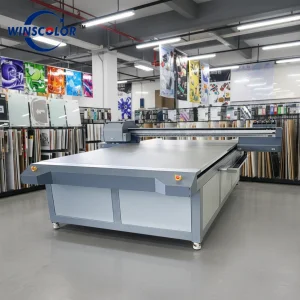
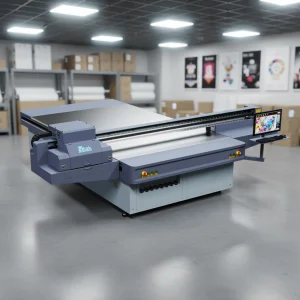
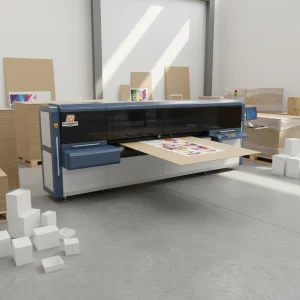
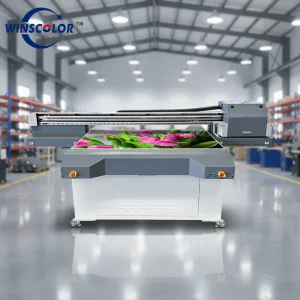
A strategic breakdown of cross-linking polymer chemistry, thermodynamic equilibrium, and the end of legacy analog screen preparation.
Bare metals including extruded aluminum, stainless steel, and brass possess distinct surface tensions and non-porous characteristics. Industrial metal UV printers utilize tailored organosilane primers and corona surface pretreatments to elevate dyne levels above 48 dynes/cm, preventing ink reticulation and ensuring covalent bonding.
Traditional screen printing requires photochemical prepress, stencil washing solvents, drying ovens, and large physical storage areas. Digital UV inkjet systems bypass stencil fabrication completely, converting short-run and mid-run industrial nameplate runs from loss-leaders into high-margin on-demand cycles with zero setup overhead.
With volatile organic compound (VOC) directives tightening across North America and the EU (REACH, RoHS), photocurable inks deliver 100% solids formulation with zero hazardous air pollutants (HAPs). LED curing eliminates harmful ozone discharge, reducing cleanroom ventilation ducting load.
What Tier-1 engineering firms, industrial signage distributors, and electronics contract manufacturers evaluate before hardware acquisition.
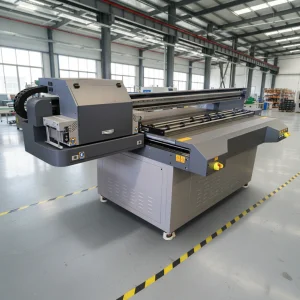
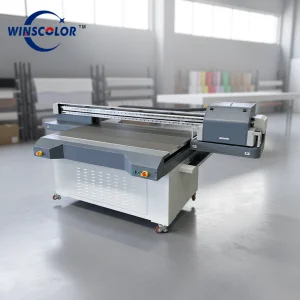
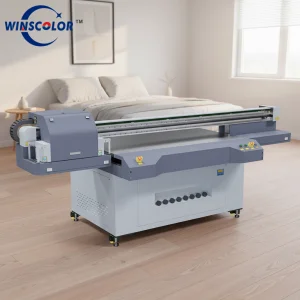
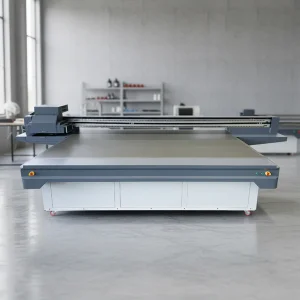
Heavier metal sheets transmit resonance during carriage deceleration. Sourcing specifications demand high-tensile ground steel gantries with dual THK or Hiwin linear rails, Japanese Panasonic/Yaskawa AC servo drives, and dual ball screws to mitigate carriage yaw and ensure droplet placement within ±0.01 mm tolerances.
Warpage and burrs on cold-rolled steel or sheared sheet aluminum cause nozzle plate collisions. Procurement requires localized multi-zone honeycomb vacuum tables equipped with air-reversal blowers for easy loading/unloading of dense metal plates weighing upwards of 100 kg/m².
Titanium dioxide pigments inside high-opacity white ink tend to settle quickly. Industrial buyers require integrated negative pressure ink supply systems paired with continuous per-nozzle white ink recirculation to maintain viscosity, purge microbubbles, and ensure uninterrupted print operation across multiple shifts.
Deployment frameworks built to address harsh aerospace salt sprays, automotive thermal fluctuations, and architecture durability thresholds.
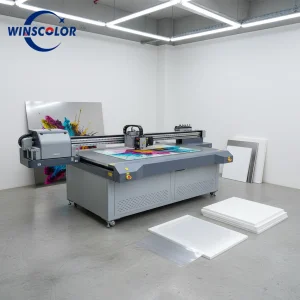
Brushed stainless and aluminum faceplates require micro-scale tactile legibility, high scratch resistance, and chemical defense against cutting fluids. Winscolor UV engines deposit multi-layer matte primers, high-density spot-white backings, and resilient varnish overlays capable of surviving severe abrasion cycles.
Aluminum Composite Panels (ACP) and insulated exterior siding demand extreme UV weathering protection. Integrating proprietary automotive-grade photoinitiators prevents sun-induced yellowing and fading, guaranteeing colorfastness across 5 to 10-year outdoor exposure intervals without edge delamination.
Short-run luxury confectionery tins, promotional packaging, and metal cylinders call for zero-distortion deformation printing. Flexible ink chemistries allow direct printing onto flat tinplates before light mechanical bending and stamping, preventing ink film flaking along tight bend radii.
Ensuring frictionless installation, continuous uptime, and compliance with statutory manufacturing codes worldwide.
Every industrial chassis is compliant with European 2006/42/EC standards, including optical safety curtains, emergency stop loops, and EMC shielding.
Factory-trained service teams handle mechanical bed leveling, waveform matching, droplet flight angle verification, and custom ICC profiling on client metal stock.
Decentralized spare parts centers maintain stock of industrial Ricoh Gen6/Gen5i printheads, sub-tank circuit boards, encoders, and UV modules for next-day dispatch.
Integrated real-time IoT diagnostic interfaces transmit carriage acceleration, ink temperature, and UV output levels directly to support engineers for proactive servicing.
Exploring upcoming print innovations: functional conductive traces, nanocoating primers, and smart printhead motion control.
Transitioning from chemical wiping primers to print-carriage-mounted atmospheric plasma jets. This eliminates manual wiping prep, continuously activates high-density bare alloys, and raises surface energy dynamically ahead of ink ejection.
Combining structural colorants with nano-silver and copper-particle inkjet inks. This enables the direct deposition of functional circuit paths, grounding points, and RF identification antennas onto structural sheet metal parts in a unified pass.
Closed-loop laser surface triangulation systems scan sheet metal before print start, automatically modeling warpage contours. Dynamic Z-axis height adjustment prevents printhead strikes while maintaining consistent 1.0 mm droplet throw distance.
Tunable UV arrays emitting dual 365 nm and 395 nm bands. The shorter wavelength ensures surface cross-linking and scratch resistance, while the longer wavelength penetrates deep into heavy ink deposits for complete cure adhesion.
In-depth technical answers addressing ink chemistry, curing parameters, adhesion benchmarks, and prepress workflows.
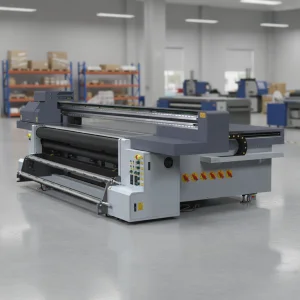
Explore wide-format, high-yield digital UV solutions for large-scale architectural and multi-substrate applications.