Direct factory configurations certified for rigorous multi-shift architectural ceramics, wallboard embellishment, and rigid industrial substrate processing.
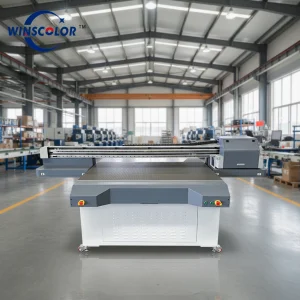
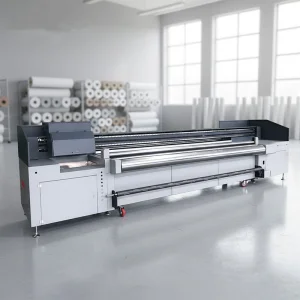
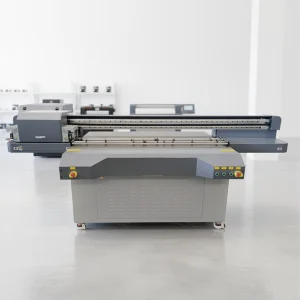

Addressing the complex micro-rheology, mechanical tolerances, and thermodynamic challenges of digital printing on sintered and raw ceramic surfaces.
The contemporary architectural and ceramic decoration sectors have completely moved past the limitations of analogue rotary cylinder printing and screen methods. Today, selecting a ceramic inkjet printer manufacturer requires deep engineering scrutiny of drop-on-demand (DoD) piezo systems, multi-axis gantry stabilization, and sub-micron positioning. Modern ceramic printing demands unyielding hardware resilience: printers must cope with the high abrasive friction of mineral suspensions, volatile thermal gradients, and pervasive particulate dust characteristic of ceramic processing facilities.
Winscolor (Jinan Yingcai Digital Technology Co., Ltd) combines advanced motion control software with industrial Ricoh Gen6 and customized piezo printheads, delivering variable grayscale drop sizes ranging from 5 to 15 picoliters. By incorporating industrial negative-pressure circulation systems and internal printhead heating, our printing units eliminate micro-air bubble formation and particulate settlement in pigmented ceramic UV and inorganic glaze inks. This ensures continuous, uninterrupted ink delivery during 24/7 industrial production runs.
Equipped with high-frequency grey-scale Ricoh Gen6 printheads capable of firing multi-drop wave combinations. This delivers exceptional gradient transitions, photographic realism, and tactile ink laydown on rigid porcelain tiles, sintered slabs, and vitrified materials without satellite drop contamination.
All-steel gantry frames subjected to high-temperature annealing relieve structural stress and prevent chassis micro-distortion over decades of operation. Dual precision THK linear mute guides and dual lead screws drive synchronous motion with registration accuracy within ±0.02 mm.
Features dynamically modulated UV-LED and conventional UV curing systems that cross-link inks instantly on cold substrates, preventing ink bleed and optimizing adhesion matrices on smooth, pre-glazed, or polished surfaces without thermal deformation of underlying structures.
How Jinan Yingcai Digital Technology integrates domestic supply-chain velocity with strict global industrial engineering benchmarks.
As a seasoned, factory-direct ceramic inkjet printer manufacturer based in Jinan, China, Winscolor leverages the world’s most comprehensive manufacturing supply ecosystem. By combining high-precision CNC machining centers, domestic electronic drive component fabrication, and streamlined laser cutting infrastructure, we significantly reduce manufacturing lead times while delivering total cost-of-ownership savings of 35% to 50% compared to Western European machinery builders.
However, cost efficiency is never achieved at the expense of industrial precision. Every printer undergoing assembly in our 20,000 m² Jinan plant undergoes rigorous quality control protocols. This includes 72 hours of uninterrupted dry-run gantry travel, dynamic laser interferometer calibration for spatial registration, and rigorous high-density solid-block ceramic printing checks before sea packaging and dispatch.
Comprehensive turnkey print system deployment across interior construction, bespoke sanitaryware, and architectural cladding.
Deploying specialized UV-curable primers and pigmented outdoor inks designed to withstand extended weathering, UV radiation, and acid rain exposure. Ideal for heavy porcelain facades, ventilated wall panels, and structural stone panels requiring consistent pattern matching across multiple contiguous slabs.
Providing high-definition relief and 3D textured varnish deposition directly onto polished or matte floor tiles, splashbacks, and feature walls. Our multi-layer micro-layering system replicates natural marble veining, wood grain textures, and artistic impasto effects without physical stamping moulds.
Custom rotary and specialized flatbed configurations engineered to accommodate dimensional variations on ceramic basins, sanitary fixtures, and specialty tableware. Provides fine edge definition, micro-text clarity, and industrial scratch resistance required for demanding commercial utility.
Evaluating total life-cycle costs, sustainability compliance, and technical criteria for international procurement teams.
Global architectural regulations demand zero-VOC output. Our advanced cold-curing LED UV technology reduces overall shop-floor electricity consumption by up to 60% compared to legacy mercury arc lamps while eliminating harmful ozone emissions.
Enterprise factories integrate machinery via standardized industrial Ethernet and PLC protocols. Real-time logging of head firing cycles, temperature profiles, and ink viscosity enables automated preventative maintenance before print defects occur.
Procurement directors verify Delta-E color variation consistency across long production runs. Our systems incorporate ICC-certified raster image processors (RIP) and closed-loop density calibration, ensuring batch-to-batch visual fidelity.
Evaluating initial purchase price against consumables, daily nozzle maintenance overhead, and spare part availability. Winscolor standardizes open component sourcing, freeing international operators from vendor-locked consumable pricing models.
Detailed engineering and logistical explanations addressing direct questions raised by global plant operators and procurement officers.
Vitreous and fully sintered ceramic surfaces have exceptionally low surface energy, which can impede standard mechanical wetting. We resolve this through automated inline atmospheric plasma surface activation or dedicated chemical nano-primers applied via digital printheads or micro-spray systems. This lowers surface contact angles and creates covalent chemical bonds with the cured UV ink layer, yielding Class 0 cross-hatch tape adhesion (ISO 2409 standard).
Firing-glaze digital printing relies on inorganic metallic pigment slurries printed onto greenware tiles before entering a continuous roller kiln firing cycle at 800°C–1200°C. In contrast, UV flatbed printing is executed on cold, finished, cut, or sintered tiles. UV printing offers a broader color gamut, enables tactile 3D spot varnishing, eliminates costly kiln re-firing cycles, and is best suited for small to medium runs, custom architectural panels, and on-demand renovation orders.
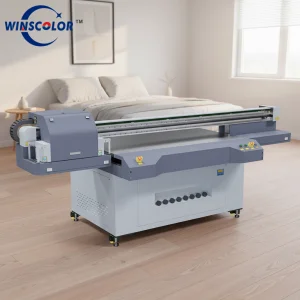
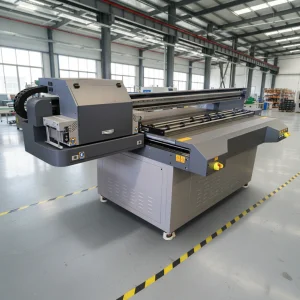
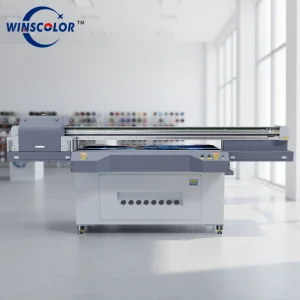
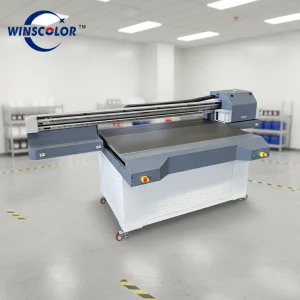
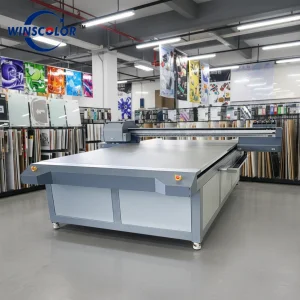
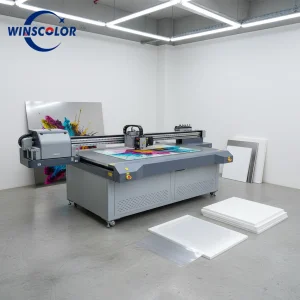
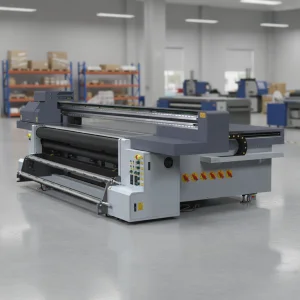
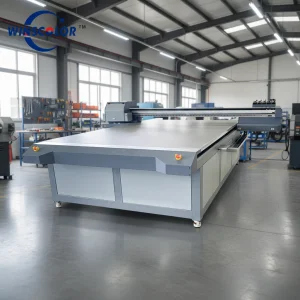
Our flatbed models (such as the YC2513 and YC2030 series) incorporate reinforced gantry columns and heavy-duty steel beam foundations paired with multiple pneumatic alignment pins. High-power vacuum zoning beds with heavy-load ball-bearing transfer units allow operators to slide solid ceramic and sintered slabs weighing up to 100 kg/m² into position without impacting mechanical alignment or deflecting the printing plane.
Winscolor provides full overseas technical lifecycle management. We offer remote live video commissioning, real-time telemetry diagnostics via direct network control, continuous English-language engineering support, and rapid express dispatch of genuine replacement parts (sub-tanks, boards, UV lamps, filters). On-site engineering setup and operator training programs are also available globally for distributor hubs and high-volume industrial end-users.
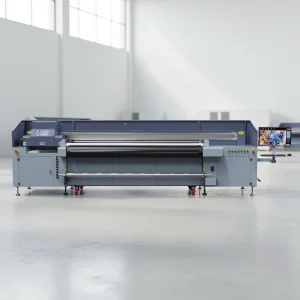
Explore additional high-accuracy machinery configurations engineered for varied substrate widths, production volumes, and tactile finishing requirements.