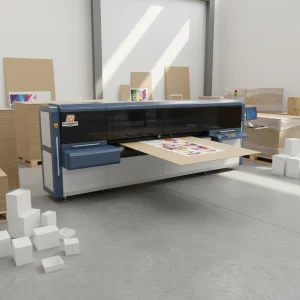
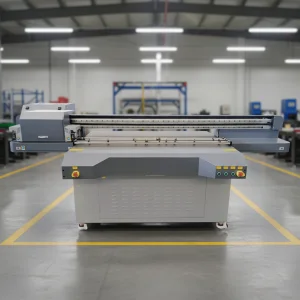
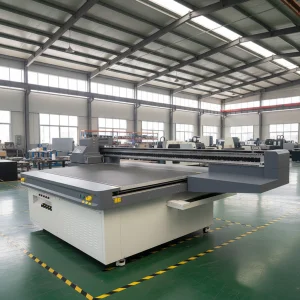
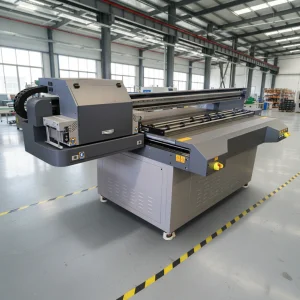
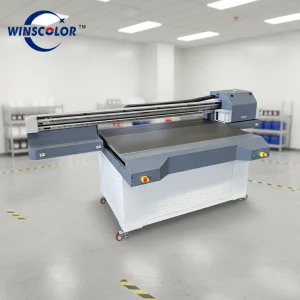
Direct from our specialized industrial assembly lines: High-speed continuous roll-fed systems, flatbed UV LED setups, and precision single-pass corrugated packaging converters.
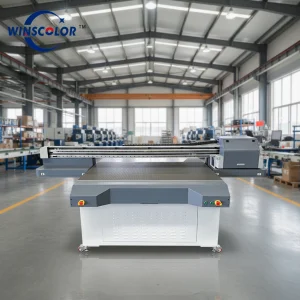

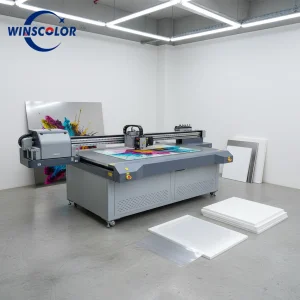
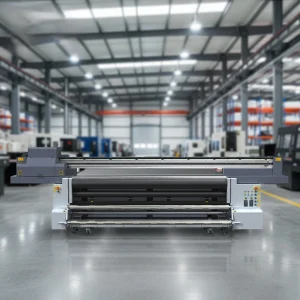



Understanding substrate traction dynamics, high-frequency piezo actuation, and cross-linking UV-LED photo-polymerization across continuous roll-to-roll and rigid-sheet transport platforms.
Industrial roller printers must overcome substrate elastic distortion during continuous high-speed movement. Our dynamic closed-loop servo system regulates web tension within ±1.5 N across flexible flex banner, vinyl, backlit textiles, and synthetic leather, eliminating media buckling, stepping micro-banding, and lateral drift.
Equipped with enterprise Ricoh Gen6 and industrial-grade printheads, our systems deliver variable drop sizes from 5pl to 15pl. Actuated at 50 kHz firing frequencies, the meniscus control module guarantees razor-sharp vector micro-text down to 2pt, smooth photographic flesh gradients, and dense solid color saturation in a single pass.
Employing dual water-cooled UV-LED semiconductor curing arrays operating at a narrow 395nm wavelength peak, monomers and photoinitiators undergo instantaneous cross-linking without thermal radiation buildup. Heat-sensitive thermoplastic films like thin PVC and PET stay dimensionally true without warping.
Engineering Insight: True hybrid roller architecture bridges the historical divide between flatbed precision and rotary productivity. By combining high-grip abrasive rubber rollers with vacuum-assisted air-float conveying tables, print facilities gain the operational versatility to run rigid aluminium composite panel boards by day and continuous soft film roll media through unassisted overnight production shifts.
How tier-one printing operations, multinational franchise converters, and high-volume packaging manufacturers evaluate Total Cost of Ownership (TCO) when selecting digital roller printing systems.
Enterprise buyers examine ink consumption metrics rigorously. Traditional solvent or weak aqueous systems evaporate up to 60% of liquid carrier volume during drying. Our 100% solid-content UV curable inks utilize high-density pigment milling, achieving full opacity at only 6.5 to 8.2 ml/m² under standard 4-pass CMYK conditions. Calculated over an annual volume of 150,000 square meters, this ink formulation delivers a 28% reduction in consumables expense compared to standard roll-fed equipment.
Factory managers in North America and Western Europe operate 24/7 schedules where unexpected carriage pauses directly erode margins. Procurement requirements demand dual industrial linear THK guide rails, magnetic linear motor carriage traction options, independent negative pressure ink degassing circuits, and motorized head wiping mechanisms. These prevent micro-air bubbles and pigment settling from starving nozzles during prolonged production runs.
| System Architecture | Primary Substrate Focus | Tension Control Mechanism | Maximum Caliper | Typical Daily Duty Capacity | Target ROI Horizon |
|---|---|---|---|---|---|
| Hybrid Roller System (YC3200HR) | Flexible Rolls + Rigid Sheets (Dual Use) | Multi-axis Rubber Drive with Vacuum Bed | Up to 50 mm | 1,200 – 1,800 m² | 6 - 9 Months |
| Dedicated Roll-to-Roll (YC3321R) | Soft PVC, Mesh, Backlit Fabrics, Canvas | Pneumatic Air Shaft with Magnetic Brake | Up to 3.0 mm (Web) | 1,500 – 2,400 m² | 5 - 8 Months |
| Flatbed with Roller Kit (YC2513R) | Rigid Boards Primary, Auxiliary Roll Kit | Front/Rear Motorized Synchronization | Up to 100 mm | 800 – 1,300 m² | 7 - 11 Months |
| Single-Pass Roller Feeder | Corrugated Kraft, Folding Boxes, Honeycomb | High-Speed Suction Conveyor Belt | Up to 25 mm | 4,000 – 8,000 m² | 4 - 7 Months |
How our 20,000 m² modern manufacturing complex in Jinan, China integrates localized precision component sourcing with vertically integrated mechanical fabrication to empower worldwide importers.
Machine stability begins at the steel frame. Our factory features proprietary 12-meter gantry five-sided CNC machining centers. All primary welded crossbeams undergo high-temperature thermal stress relief annealing before milling. This eliminates internal molecular stress, ensuring gantry deflection does not exceed 0.015 mm across a full 3.3-meter traversal bridge over ten years of continuous vibration.
Situated within the world-renowned Shandong industrial machinery corridor, we benefit from complete upstream raw material ecosystems. Within a 30-kilometer logistics radius, we source aerospace-grade cast aluminum brackets, custom extruded honeycomb vacuum tables, high-purity brass fluid fittings, and precision drive electronics. This geographic integration cuts prototype cycle times to under 14 days and lowers overall BOM costs by 35% compared to European or North American machinery builders.
Every unit leaving our Jinan factory undergoes a relentless 72-hour non-stop dry-cycle motion burn-in, followed by a 24-hour continuous ink jetting benchmark on challenging substrates. Laser interferometer inspections calibrate Y-axis and X-axis straightness down to single-micron tolerances, ensuring zero field commissioning surprises when shipping across international sea freight lanes.
International distribution requires rigorous electrical, mechanical, and chemical certifications, paired with responsive after-sales technical field support.
Full compliance with 2006/42/EC Machine Safety Directives and EN 60204-1 safety of electrical equipment in industrial machinery, complete with physical emergency disconnect interlocks.
Our proprietary LED-curable ink chemistries are fully documented under EU REACH regulations and certified free from toxic heavy metals, phthalates, and persistent aromatic compounds.
Configured with genuine Schneider, Omron, and MeanWell electrical architectures matching 220V/380V three-phase configurations suited directly for North American NFPA 79 installations.
Integrated cloud diagnostic modems allow Jinan senior field engineers to inspect CAN-bus telemetry, firmware register health, and ink board waveforms remotely within minutes of an alert.
From micro-embossed luxury interior decorative finishes to heavy-gauge corrugated packaging converters, examine the localized manufacturing domains transformed by modern roller UV platforms.
Roller printers run seamless non-woven wall coverings, fiberglass cloth, and textured PVC foils at widths up to 3.2 meters. By laying down multi-layer structural white ink base coats beneath vibrant process colors and finishing with tactile gloss varnishes, producers fabricate high-margin 3D simulated stone, brushed metal, and tactile damask patterns for hotel chains and luxury residences without rotogravure cylinders.
Illuminated transit shelter signage and lightboxes require intense pigment density to prevent washed-out visuals when backlit. Our synchronized "Color + White + Color" three-layer daylight/night print workflow executes in a single pass across soft polyester fabrics and self-adhesive cast vinyl. The resulting polymer bond flexes alongside vehicle curves without micro-fracturing or perimeter peeling.
Single-pass digital roller platforms eliminate flexographic plates and expensive tooling setups. E-commerce packaging plants, boutique beverage labels, and retail counter display producers can intake 100 to 5,000 piece corrugated kraft board box runs profitably, printing custom SKU barcoding, photo-realistic branded graphics, and functional gloss coats directly onto raw fluted cardboard with zero make-ready waste.
Emerging innovations redefining throughput, automated colorimetry, and ecological sustainability in modern digital industrial printing machinery.
Next-generation roller printers integrate high-speed line-scan cameras positioned behind the carriage. Embedded neural vision engines scan printed substrates at full production velocity, instantly detecting deflected or clogged nozzles and automatically commanding adjacent nozzles to adjust droplet volume in real time. This automated compensation preserves clean output without stopping runs.
To align with global corporate decarbonization initiatives and stringent indoor emissions mandates, ink research is moving toward water-based UV curable chemistries. These formulations combine the negligible VOC profile of water-based inks with the instant curing and substrate versatility of UV cross-linking, resulting in ultra-thin ink film profiles and lower cost-per-square-meter overhead.
Multi-pass gantry setups are transitioning into stationary printhead arrays with high-precision roller conveyances. By organizing banks of 8 to 24 industrial printheads over continuous feed lines, production speeds leap from 100 m²/h up to 45 linear meters per minute, allowing digital equipment to compete directly with traditional rotary screen and offset presses.
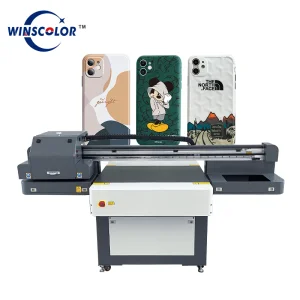
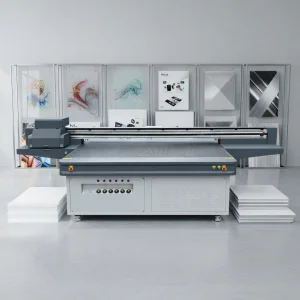
Expand your industrial output: Small-format desktop personalization systems, 2.5m heavy-duty flatbeds with G6 heads, complete lamination cutting all-in-one stations, and high-relief varnish machines.


Detailed technical answers to the most critical mechanical, operational, and financial considerations submitted by international distributors, technical directors, and purchasing managers.
