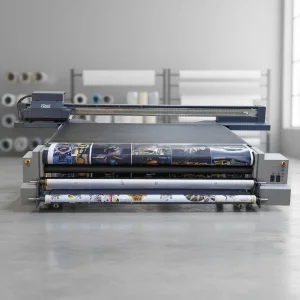
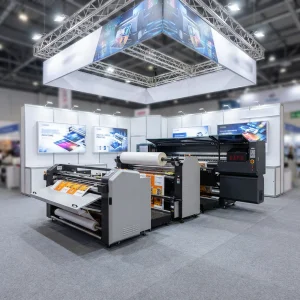
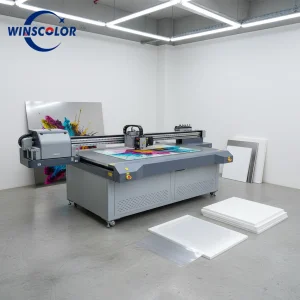
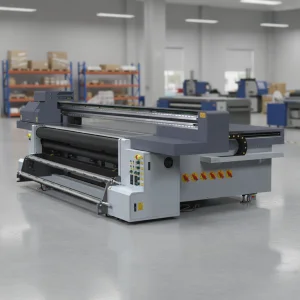
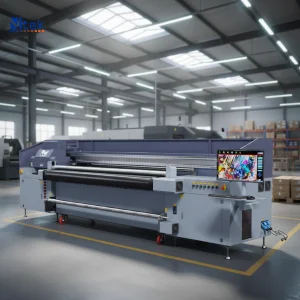
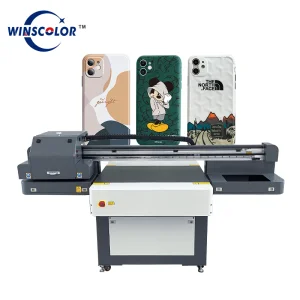
Direct factory production models tested and calibrated for high-precision industrial output across Incheon, Ansan, and Gyeonggi manufacturing zones.
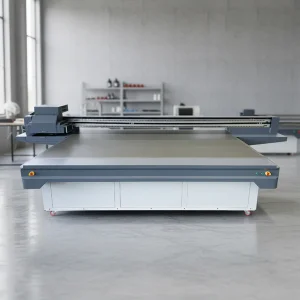
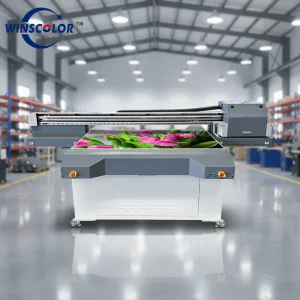
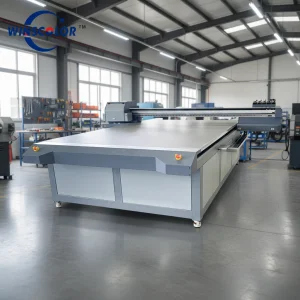
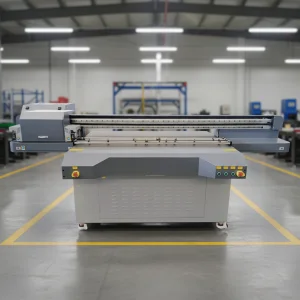
South Korea's high-density manufacturing hubs—spanning the Gyeonggi Province clusters (Suwon, Hwaseong, Pyeongtaek), the Incheon Namdong Industrial Complex, and the greater Seoul metropolitan footprint—operate under some of the world's most rigorous dimensional and optical quality thresholds. In this intensely digitized and brand-conscious market, the demand for super-wide flatbed UV printing equipment has shifted dramatically beyond standard out-of-home (OOH) advertising graphics into industrial interior fabrication, architectural glass customization, high-precision appliance control panels, and luxury cosmetics packaging.
Seoul Metro screen doors (PSD), subterranean passage murals, and urban commercial redevelopments demand single-slab visual continuity. Standard 2.5m × 1.3m beds force panel splicing. The YC3321L enables true monolithic 3.3m single-piece printing on toughened glass, composite aluminium, and fire-rated silicate boards with zero seams.
Suppliers to Tier-1 Korean consumer electronics leaders require localized flatbed systems capable of tactile varnish and scratch-resistant decorative textures on refrigerator glass fronts, washing machine fascia, and membrane switch panels, meeting stringent peel-adhesion and thermal resistance testing.
Korean beauty brands operate on micro-batch luxury product introductions requiring fast turnaround cycles. Traditional screen setups introduce unacceptable plate-making lead times. The YC3321L delivers immediate CMYK + W + Varnish spot embossing directly onto acrylic presentation fixtures and high-end cardboard packaging.
Printing across an expansive 3,300 mm × 2,100 mm working bed introduces compounding mechanical harmonics, thermal expansion risks, and ink delivery variations. The OEM YC3321L addresses these thermodynamic and kinematic challenges via an over-engineered heavy-duty steel tubular chassis, precision-milled aluminum gantry beams, and redundant dual-rail linear guidance.
| Subsystem Module | Technical Specification & Architecture | Korean Factory Impact & Benefit |
|---|---|---|
| Chassis & Gantry | Tempered high-rigidity seamless steel frame; five-axis CNC machined double THK/Hiwin silent linear guides with magnetic scale feedback. | Zero structural deformation across 10+ years; elimination of high-speed mechanical banding on 3-meter glass slabs. |
| Piezo Printhead Engine | Configurable 4 to 8 industrial Ricoh Gen6 (MH5320) or Gen5 printheads; 5pl-15pl multi-drop grayscale firing at frequencies up to 50 kHz. | Ultra-smooth skin tones for cosmetic advertising; pin-sharp 2pt Korean Hangul fonts on industrial compliance labels. |
| Ink Circulation & Degassing | Independent positive/negative pressure ink meniscus control with continuous sub-tank white ink agitation and temperature conditioning. | No nozzle clogging or titanium dioxide sedimentation during multi-shift operations in climate-controlled Korean facilities. |
| Smart Zoned Vacuum Bed | High-flatness aviation-grade hard-anodized honeycomb vacuum bed segmented into 6 to 8 dynamically controlled pneumatic zones. | Secure holding of warped acrylic sheets, heavy steel plates up to 100 kg/m², or micro-thin films without mechanical clamps. |
| Curing & Safety Sensors | Dual water-cooled LED-UV arrays (395nm wavelength) with intelligent step-less intensity modulation; dual-side infrared anti-collision bumpers. | Cold curing avoids warping heat-sensitive PP/PET substrates; instant emergency shut-off prevents catastrophic head-strike damage. |
As the domestic Korean printing and industrial decorative manufacturing sector evolves, four pivotal technological and macroeconomic drivers dictate capital investment priorities for plant managers and OEM procurement directors:
The Korean Ministry of Environment has enacted stricter atmospheric control laws targeting volatile organic compounds (VOCs) within commercial print workshops. Solvent-based screen printing shops are aggressively transitioning to UV-LED curing technology, which cures instantly via photopolymerization, generating negligible ozone and zero hazardous air pollutants.
Korea’s national push for Smart Factory 3.0 requires production hardware to seamlessly broadcast diagnostic telemetry. Our OEM YC3321L controllers provide open SDK and API hooks for real-time ink consumption tracking, error-code broadcasting, and automated job-queue ingestion from ERP software like SAP and Korean local ERP platforms.
The Korean fast-fashion and modern home interior sectors have shifted from bulk inventory to on-demand localized batches. Print providers can no longer afford to prepare mechanical silk screens for runs below 500 units. Digital flatbeds like the YC3321L permit instantaneous prepress switching between bespoke projects with zero downtime.
Visual graphics alone are no longer sufficient in Korea's luxury retail sphere. High-margin contracts hinge on sensory tactile finishes: simulated oil painting impasto, embossed braille signage complying with Korean accessibility acts, and glossy spot varnish relief patterns on matte wall paneling.
International original equipment buyers and domestic Korean distributors procuring industrial UV flatbed hardware from source factories must evaluate five critical operational criteria to safeguard capital allocation and minimize lifecycle total cost of ownership (TCO):
Korean manufacturing facilities primarily utilize three-phase 380V or single-phase 220V (60Hz frequency). Standard European or Chinese 50Hz electrical components can overheat or suffer timing desynchronization if not engineered specifically. Our Korean-spec YC3321L systems incorporate native 60Hz high-frequency servo drives, industrial Schneider and Omron electrical switches, and dedicated RFI/EMI noise suppressors.
Operator usability on the plant floor is vital. Our OEM service includes customized Korean language touch interfaces, specialized ICC color profiling calibrated to locally sourced Korean substrates (such as LG Hausys acrylics, KCC decorative glass, and Dongwha MDF boards), and turnkey compatibility with Onyx, Caldera, and Photoprint RIP environments.
Substrates like float glass, bare stainless steel, and anodized aluminum composite possess extremely low surface energy (< 38 dynes/cm), frequently causing ink flaking under Cross-Hatch Tape Adhesion Tests (ASTM D3359). We provide integrated inline digital primer printhead channels or automated plasma surface treating modules to ensure 5B adhesion ratings.
For Korean hardware brands seeking contract OEM manufacturing, we support complete private-labeling: customized powder-coated sheet metal enclosures, tailored machine livery, customized splash-screen boot loaders, and verifiable ISO9001 quality audit trails for each linear bearing, ball screw, and umbilical drag chain assembly.
Deploying high-capital machinery into the Republic of Korea requires strict adherence to domestic statutory standards and robust post-installation service level agreements (SLAs).
All electronic subsystems and high-voltage UV curing power supplies are engineered to pass Korean Certification (KC Mark) evaluations, satisfying electromagnetic interference (EMC) regulations, industrial electrical safety mandates, and workplace safety protection standards.
Our proprietary UV curable ink formulations comply with South Korea’s Act on the Registration and Evaluation of Chemical Substances (K-REACH) and the Chemical Substances Control Act, providing comprehensive Safety Data Sheets (SDS) and verifying the exclusion of heavy metals and prohibited phthalates.
Through our network of trained Korean service partners and authorized regional depots, customers in Seoul, Incheon, Daegu, and Busan receive 24-hour technical response, on-site field engineering dispatch, and local inventory buffering for critical printheads, boards, and UV LED modules.
As printing speeds and industrial integration demands accelerate, the YC3321L architecture continues to advance across three core developmental vectors:
Replacing traditional timing belts and standard rotary servo pinions with high-precision magnetic levitation linear motors (Maglev) across the X-axis carriage, achieving carriage scanning speeds up to 1.8 m/s with near-zero mechanical friction, whisper-quiet operation, and micrometer-precise droplet placement.
High-speed CCD cameras mounted adjacent to the carriage scan high-density test targets to automatically measure, calibrate, and adjust bi-directional stepping offsets, printhead angle skew, and missing nozzle compensation in under 90 seconds without human visual intervention.
Fully integrated pneumatic robotic arm feeder systems synchronized with the printer’s PLC via EtherCAT protocols. Enables autonomous continuous sheet feeding for 3m × 2m corrugated and acrylic boards, supporting "lights-out" unstaffed nocturnal factory runs.
Key technical, logistics, and operational inquiries handled by our engineering team for buyers in the South Korean commercial printing sector.
Explore our full line of hybrid, roll-to-roll, and specialized digital industrial UV printers available for factory direct shipment and OEM deployment worldwide.