
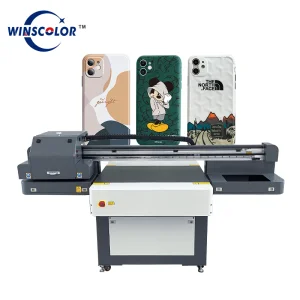
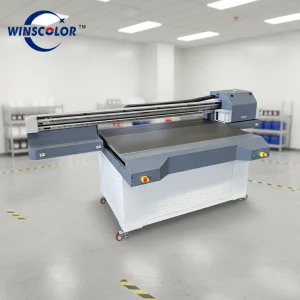
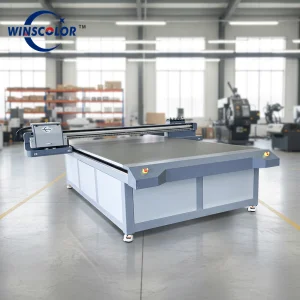
Desktop Industrial · 600×900mm
View System Specifications
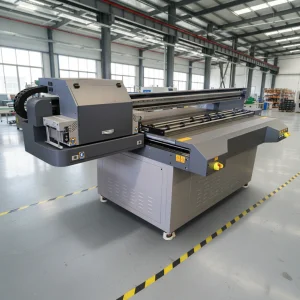
Built with industrial-grade Ricoh Gen6/Gen5 and high-density piezoelectric arrays, engineered for high-uptime manufacturing environments across rigid panels and flexible media.
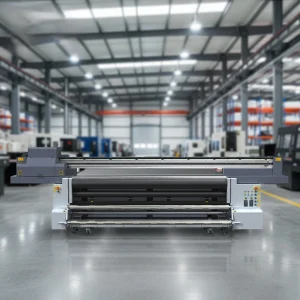
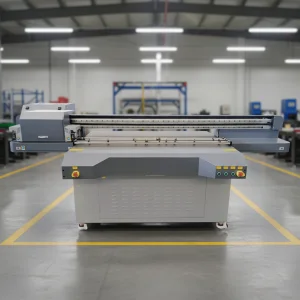
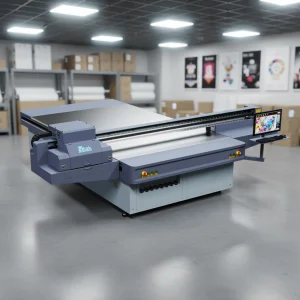
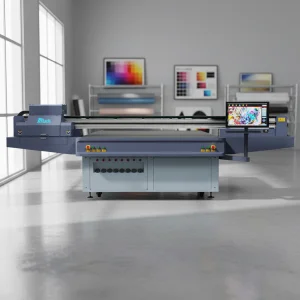
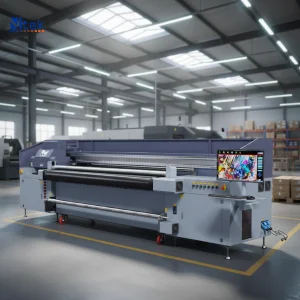
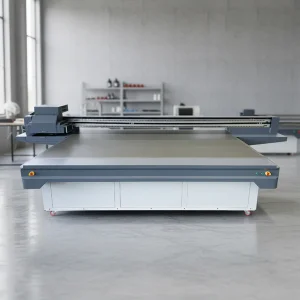
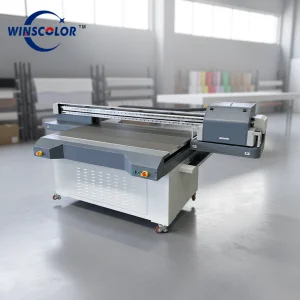
A comprehensive examination of why industrial UV hybrid systems have superseded decoupled flatbed and roll-to-roll equipment in high-throughput manufacturing plants.
Traditional flatbeds require manual board placement, indexing, and offloading, incurring substantial dead-time between print runs. Modern UV hybrid printing systems leverage precision vacuum belts driven by closed-loop magnetic encoders.
This allows automated feeding of thick, rigid boards (up to 50mm) while maintaining micro-step tension on lightweight flexible films, eliminating step-banding across dual-phase production.
Integrating industrial printheads like the Ricoh Gen6 (MH5320) or Kyocera KJ4A requires meticulous fluid dynamics design. Operating at firing frequencies up to 50 kHz with multi-drop variable dot sizes (5pl to 15pl), our print engines maximize ink yield.
Sub-micron gantry leveling paired with dual linear guide rails ensures drop placement accuracy remains within ±3 microns across carriage strokes exceeding 3200mm.
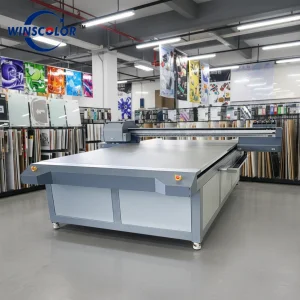
For large-scale graphics operations and industrial screen printing conversion lines, floor space directly impacts overhead. A dedicated 3.2m roll printer alongside a 2.5×1.3m flatbed consumes over 65 m² of floor space including service clearances.
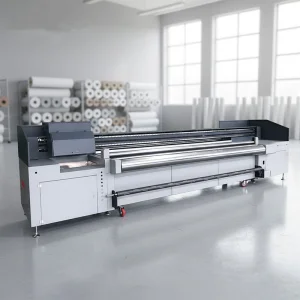
A unified hybrid system (such as the YC3200HR) condenses high-yield roll banners, rigid packaging mockups, and acrylic signs into under 28 m², yielding instant equipment amortization.
| Architecture Feature | Legacy UV Flatbed System | Dedicated Roll-to-Roll UV | NTEK Industrial UV Hybrid |
|---|---|---|---|
| Supported Media Geometry | Rigid Boards Only (Acrylic, Wood, Dibond) | Flexible Rolls (Banners, Vinyl, Fabrics) | Rigid Panels & Flexible Web Simultaneously |
| Media Transport Method | Static Stationary Vacuum Bed | Tension Dancer / Feed Rollers | Pneumatic Controlled Vacuum Conveyor Belt |
| Continuous Loading Mode | Manual Stop-and-Go Batching | Continuous Unwind/Rewind | Continuous Sheet-by-Sheet & Roll Unwind |
| Maximum Media Thickness | Up to 100mm (Z-axis dependent) | < 2.5mm | 0.1mm up to 50mm with Precision Auto-Lift |
| Floor Space Footprint | Large (18m² – 30m²) | Medium (12m² – 18m²) | Ultra-Compact Unified Footprint (< 22m²) |
How Winscolor (Jinan Yingcai Digital Technology Co., Ltd) harnesses the advanced CNC machining and optoelectronic clusters in Shandong to supply high-reliability machinery globally.
Unlike regional assemblers that outsource chassis production, Jinan Yingcai operates a vertically integrated 20,000-square-meter facility with six continuous assembly lines. Every machine frame is cast from heavy-duty structural steel, subjected to high-temperature furnace annealing to eliminate internal stress, and planed on 12-meter 5-face CNC gantry milling centers.
This ensures structural straightness within 0.02mm per meter, guaranteeing that high-speed bidirectional printing maintains dot placement accuracy over years of 24/7 industrial service.
By coupling Japanese piezoelectric components (Ricoh, Kyocera, Epson) with top-tier linear motion hardware (Taiwanese Hiwin dual-lead guideways, German IGUS drag chains, and Japanese Panasonic AC servo drives), NTEK delivers tier-one reliability without Western OEM markups.
Our localized supply chain in the Jinan equipment manufacturing belt slashes BOM costs by 35% to 50%, providing distributors and procurement teams with superior margins and rapid parts turnaround.
Industrial printing machinery procurement entails evaluating risk mitigation, ink chemical certification, and field reliability across demanding multi-shift schedules.
Exporting to the European Union, North America, and Oceania demands rigorous safety standard conformance. NTEK systems carry authentic CE Machinery Directives (2006/42/EC) and Low Voltage Directives (LVD), along with EMC compliance.
Our ink delivery systems and LED-UV curing modules align with RoHS 2.0, REACH SVHC standards, and emit near-zero VOCs, enabling permit-free operation inside urban signage studios.
For industrial converters operating 16-to-24 hour daily packaging shifts, the Mean Time Between Failures (MTBF) governs profitability. NTEK builds in active thermal ink conditioning, automated wipe stations, and redundant peristaltic supply loops.
Real-time optical media jam detection halts movement in milliseconds to protect costly printhead carriages, sustaining up to 98.4% uptime across continuous enterprise cycles.
A critical metric for overseas enterprise buyers is the speed of technical intervention. Winscolor maintains regional spare-parts hubs and offers certified technician video-diagnostics, cloud-based firmware assistance, and complete field repair kits.
Consumables such as printhead dampers, ink filters, solenoids, and negative pressure regulators ship under 24-hour dispatch SLAs to eliminate unplanned factory downtime.
Key technological breakthroughs shaping industrial digital printing through 2026 and beyond.
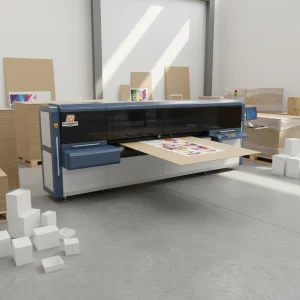
While multi-pass scanning systems satisfy signage and bespoke displays, packaging conversion lines are transitioning toward Single-Pass UV digital printing. By arraying stationary printhead bars across the entire conveyor width, feeding speeds exceed 1.5 m/sec.
This allows customized corrugated box runs without cylinder engraving fees, transforming e-commerce packaging from generic flexo into high-impact, short-run full-color graphics.
Conventional metal-halide mercury lamps generated immense IR heat that distorted thin PVC films, fluted polypropylene, and heat-sensitive backlit textiles. The current generation of water-cooled LED-UV curing systems emits pure 395nm wavelengths.
This allows operators to dial in curing energy to match ink layer thickness, saving up to 70% in power while opening new applications on ultra-thin, heat-sensitive foils.
Enterprise print houses are monetizing specialized texture layers. By jetting high-viscosity clear UV varnish alongside high-density micro-pigment white inks, NTEK hybrid printers generate true relief printing.
Tactile wood grain on architectural MDF, high-gloss spot accents on luxury cosmetic cartons, and ADA-compliant Braille can all be produced directly on the printer without secondary screen-coating steps.
Engineered to handle diverse rigid and flexible substrates without surface pretreatment compromises.
Direct printing on architectural splashbacks, shower partitions, and ceramic floor tiles with dedicated silane primers for moisture and scratch resistance.
Aluminum Composite Panels (ACP) for commercial facades and exterior wayfinding signs. Strong mechanical resistance against weathering and solar UV breakdown.
High-volume point-of-sale displays and direct carton packaging. The automated vacuum belt prevents edge lift and eliminates head strikes on bowed flutes.
Transition from rigid boards to flexible roll media in under two minutes via the integrated pneumatic dancer feed and take-up drive rollers.
Explore customized industrial variants, small-footprint PVC sheet specialists, high-speed single-pass corrugated printers, and multi-functional flatbed hybrids.


In-depth responses compiled by our chief application and after-sales field engineers for global distributors and production managers.
A true UV hybrid machine is engineered around an integrated continuous vacuum conveyor belt system. The gantry carriage remains stationary along the Y-axis while the media is indexed smoothly beneath it via a multi-zone vacuum belt driven by a high-resolution AC servo motor.
In contrast, a flatbed with roll attachment features a stationary vacuum table with bolt-on mechanical unwind/rewind fixtures at the front or rear. While sufficient for occasional roll work, bolt-on attachments suffer from step-banding on heavy rolls, lack continuous automatic sheet indexing, and take significantly more floor space to achieve similar continuous throughput.
Printhead architecture sets the balance between resolution, jetting frequency, and long-term operating costs:
Non-porous, high-surface-energy substrates such as float glass, polished stainless steel, and anodized aluminum require chemical priming to achieve permanent bond strength. Without pretreatment, cured UV ink forms a mechanical film that can peel under environmental moisture or scratch testing.
NTEK hybrid machines support either automated jetting primers (via dedicated carriage channels) or manual wipe-on wipe-off silane chemical bonding agents. This achieves a Class 5B cross-hatch adhesion rating (ASTM D3359), ensuring the print withstands water immersion, chemical exposure, and outdoor UV degradation without clear-coating.
Our direct international support model combines rapid hardware dispatch with remote telemetry:
To ensure consistent output quality and avoid electronic noise, enterprise facilities must prepare: