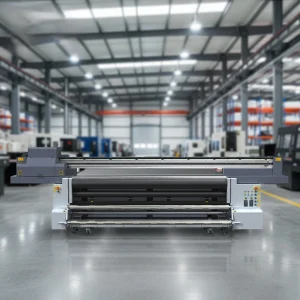
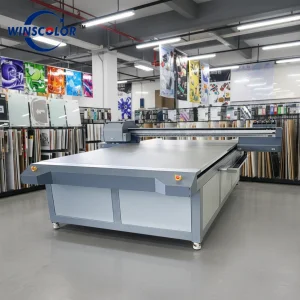
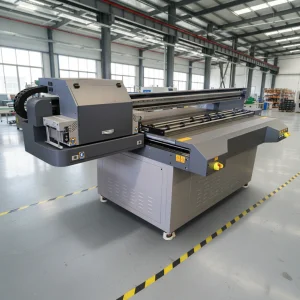
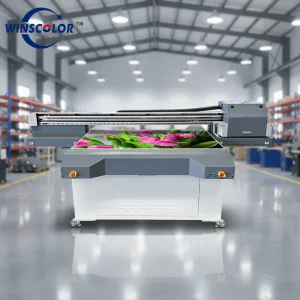
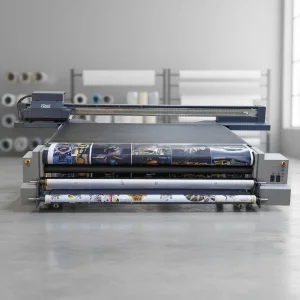
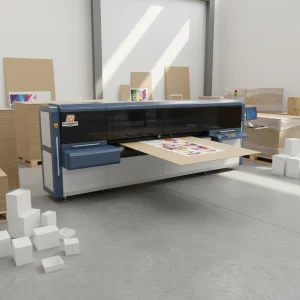
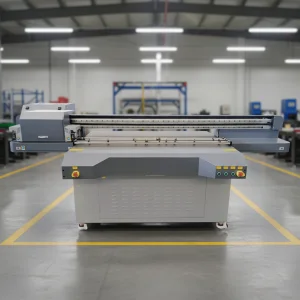
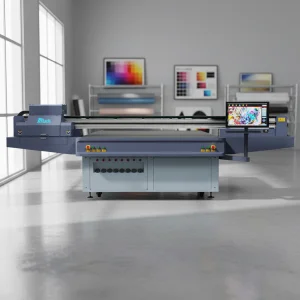
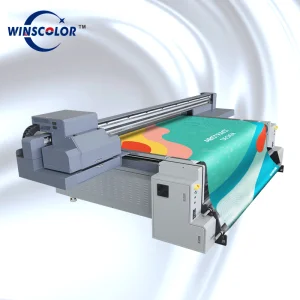
Engineered for continuous industrial run rates, micro-gap contour tracking, and photorealistic 360-degree cylindrical articulation.
Transitioning from mechanical pad printing and screen transfers to seamless non-contact multi-axis digital droplet deposition.
Traditional silk screen printing and hot foil stamping require protracted plate production, chemical baths, and lengthy alignment setups. Modern UV cylinder digital systems slash changeover setup latency to absolute zero, rendering on-demand micro-runs economically scalable.
Digital cylinder architecture solves the challenge of circular curvature distortion through dynamic algorithmic pulse synchronization. High-torque servo stepper motors adjust rotary speed relative to inkjet firing frequency within 0.01 mm axial tolerances.
Eliminate intermediate vinyl labeling and secondary heat transfer films. Advanced UV LED inks pin instantaneously upon contact with drinkware, cosmetic tubes, vacuum flasks, industrial pipes, and pharmaceutical ampoules with multi-layer adhesion.
High-yield, end-to-end multi-substrate workflows engineered to meet stringent mechanical, chemical, and food safety standards across key manufacturing markets.
From double-wall stainless steel sports bottles to specialized insulated drinkware. Utilizing advanced inline primers and flame treatment, printing systems provide 5B-grade cross-hatch tape adhesion that withstands over 50 commercial dishwasher wash cycles without delamination.
Supports low-radius taper printing on collapsible LDPE, HDPE, and extruded aluminum tubes. Utilizing dynamic droplet ejection waveforms and UV LED pinning stations, machines prevent ink sagging and deliver high-opacity 3D micro-braille warning markers.
Direct variable 2D data matrix, batch serialize, and high-contrast identification codes on PVC conduit, copper sleeves, and aerospace hydraulic conduits. Replaces prone adhesive tape with rub-resistant cross-linked photo-initiated polymer matrices.
| Substrate Material | Pre-Treatment Method | Recommended Printhead Architecture | Adhesion Strength (ASTM D3359) | Chemical Resistance Threshold |
|---|---|---|---|---|
| Austenitic Stainless Steel (304/316) | Atmospheric Pyrosil / Silane Vapor | Industrial Micro-Piezo (Ricoh G6 / Konica 1024i) | Class 5B (0% flaking) | Resistant to 99.5% Isopropyl Alcohol & MEK rubs |
| Borosilicate Glass & Crystal | Automated Inline Chemical Primer Jetting | Variable Greyscale Drop Ejection (3.5 - 14 pl) | Class 5B (Complete wet cross-hatch) | Withstands alkali bath & warm immersion up to 75°C |
| Treated Polypropylene (PP) & HDPE | Corona Discharge (42+ dynes/cm) | High-frequency Multi-Drop Firing Array | Class 4B-5B (Zero surface peeling) | Impervious to natural cosmetic essential oils |
| Anodized & Powder-Coated Alloys | De-greasing Solvent Wash + UV Flash Primer | Piezo On-Demand Micro-Actuator System | Class 5B (Exceptional anchor grip) | Tested for 1000h continuous neutral salt spray (ASTM B117) |
Leveraging Jinan’s precision digital printing machinery cluster to integrate optical R&D, structural milling, electronics integration, and global logistics under one roof.
High-end UV machinery requires structural mass to dampen micro-vibrations during accelerated carriage transits. Chinese manufacturing integrates heavy-duty CNC-annealed steel bed frameworks, eliminating torsional deformation and extending rail calibration lifespans past 10 years.
Export models integrate Japanese THK/Hiwin ultra-silent dual linear guides, German Igus energy drag chains, and Italian Megadyne timing belts. This pairing of domestic structural fabrication with global motion components guarantees Tier-1 reliability at rational factory-direct cost structures.
With fully self-contained manufacturing facilities spanning 20,000+ m², fabrication cycles move from architectural drafting to finished factory-tested production runs in less than 21 business days, delivering agile response timelines to contract manufacturers worldwide.
Analyzing key micro-mechanical, optical, and sensor integrations driving direct-to-shape digital production.
Optical triangulation laser sensors scan asymmetric and tapered shapes in real-time, dynamically computing flight trajectories and adjusting droplet burst delays across irregular substrate contours.
Next-gen sub-systems expand standard 2 mm throw gaps up to 8–15 mm without droplet atomization. This enables direct decoration on complex grooved drinkware and recessed container walls.
Continuous pressure degassing and ink recirculation past the nozzle plate eliminate titanium dioxide settling in white inks, preventing nozzle dropouts and purging ink maintenance loss by 65%.
Independently modulated, liquid-chilled UV LED arrays switch curing angles to eliminate substrate heat buildup, protecting heat-sensitive thin-walled plastics from thermal warping.
Engineered for seamless regulatory compliance and rapid commissioning across European and North American industrial settings.
Complete compliance under Machinery Directive 2006/42/EC and Low Voltage Directive 2014/35/EU. Integrated dual optical light curtains, hardware emergency interlocks, and shielded UV-blocking enclosures ensure operator safety.
Advanced photo-initiator profiles provide high curing conversion rates, minimizing residual uncured monomers. Integrated internal negative-pressure HEPA carbon extraction traps trace aerosols, complying with OSHA and EU indoor factory air quality standards.
Factory-supplied UV curable ink libraries are independently certified under REACH (SVHC compliance) and RoHS standards, free of lead, mercury, phthalates, and banned volatile organic solvents, making them suitable for consumer drinkware and toy manufacturing.
Real-world insights directly from senior application specialists, covering droplet metrics, maintenance schedules, and ink safety.
Seamless 360-degree printing requires coordinated synchronization between the carriage raster and the workpiece drive axis. Factory calibrations utilize high-resolution magnetic rotary encoders (over 20,000 pulses/revolution) combined with custom software overlap algorithms to blend starting and finishing drop patterns, eliminating visible seam lines.
Standard rotary fixtures handle cylindrical items with parallel walls effortlessly. For tapered items (such as cocktail shakers and conical cups), our variable-angle clamping chucks tilt up to 15 degrees. Combined with variable-drop grey-scale jetting, printhead-to-surface gap is maintained within a 2.5 mm tolerance along the entire stroke length.
Bare untreated metals and dense coatings present surface energies below 30 dynes/cm, leading to poor ink wetting. We recommend integrated pyrosil flame pre-treatment or plasma discharge stations to raise substrate surface tension above 48 dynes/cm, ensuring long-term ink adhesion and reliable dishwasher durability.
Under recommended operational conditions—including regular sub-tank de-aeration, factory-approved filtration changes every six months, stable clean-room humidity (40–60%), and automated daily cap maintenance—industrial Ricoh G6 piezo actuators typically achieve productive service lifetimes of 3 to 5 years under full production shifts.
Explore our complete export machinery line for signage, architectural décor, retail packaging, and cylindrical production.