Engineered for high-throughput commercial sign makers, corrugated converters, and industrial fabricators across Ontario and North America.

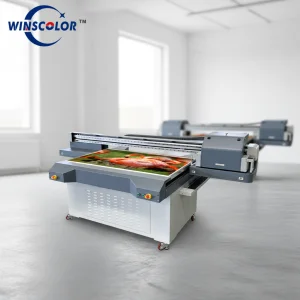
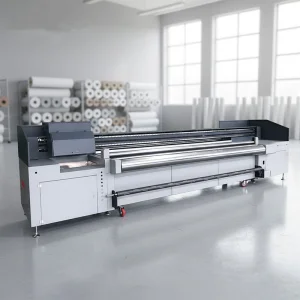
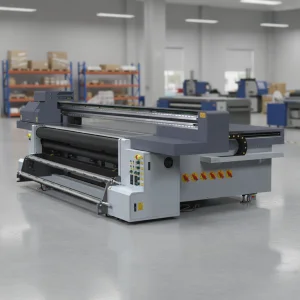
The Greater Toronto Area (GTA)—encompassing key manufacturing hubs across Mississauga, Vaughan, Markham, and Brampton—represents Canada's largest concentration of print service providers (PSPs), commercial packaging converters, and visual communications specialists. As real estate overhead in the GTA escalates, production facilities face intense pressure to optimize square-footage productivity.
Traditional print shops often maintain dedicated roll-to-roll machines alongside flatbeds, doubling capital expense and facility overhead. A true UV hybrid printer integrates dual operation into a unified footprint, allowing Toronto manufacturers to process rigid Dibond, foam PVC, and corrugated boards by day, and flexible banner, mesh, or self-adhesive vinyl by night.
Toronto's retail, cultural, and trade exhibition sectors—anchored by venues such as the Metro Toronto Convention Centre and the Enercare Centre—demand on-demand point-of-purchase (POP) signage. UV hybrid printing with immediate LED curing eliminates degassing and lamination delays, delivering finished products directly off the belt.
Beyond traditional signage, Ontario's architectural firms and automotive suppliers in the 401 corridor require precise UV printing directly onto aluminum composite material (ACM), textured glass partitions, acoustic felt, and industrial switchboards with tight color match tolerances (Delta E < 1.5).
A true commercial-grade UV hybrid printer is fundamentally distinct from an adapted roll-to-roll chassis or an entry-level flatbed with auxiliary roller tables. The mechanical design must counteract tension variances across media and maintain micron-level drop placement accuracy across high duty cycles.
The core of an industrial hybrid platform is an electronically driven, zoned vacuum conveyor belt. Perforated industrial transport belts engineered with antistatic fluoropolymer coatings ensure continuous flatbed feeding for boards up to 50 mm thick, while preventing edge curling on thin polyester films.
Integrated vacuum zones can be activated dynamically according to substrate width, eliminating vacuum leakage that can lead to media slip and banding.
Equipped with industry-standard Ricoh Gen6 (MH5320) or Konica Minolta grayscale printheads, these systems operate with variable drop sizes ranging from 5 to 15 picoliters. The multi-head configuration accommodates independent channels for CMYK, Light Cyan, Light Magenta, high-density opaque White, and architectural Gloss Varnish.
Equipped with dual water-cooled UV-LED curing units operating at 395nm wavelength, curing output is continuously modulated via RIP software control. This allows operators to run temperature-sensitive materials like thin polyolefin sheets, expanded polystyrene, and heat-reactive films without substrate buckling or thermal yellowing.
To eliminate mechanical backlash and mechanical wear associated with conventional belt-driven gantries, our manufacturing specifications incorporate high-precision linear motor drives with dual Renishaw optical encoders, ensuring bidirectional positioning precision within ±0.01 mm.
Procuring wide-format capital equipment requires evaluating full lifecycle costs rather than merely initial equipment acquisition. Corporate print networks and commercial converters evaluate suppliers across four core operational criteria:
In high-volume facilities, ink consumption represents the single largest variable cost after 24 months of operation. Our factory-calibrated waveform profiles maximize ink pigment loading while reducing consumption per square meter. The sub-drop grayscale technology delivers up to 30% ink savings compared to legacy fixed-drop systems without sacrificing optical density or color gamut volume.
Enterprise brands require multi-site color consistency under G7 and Fogra standardizations. Our UV hybrid platforms feature native color profiling support for industry-leading RIP engines including Onyx Postershop, Caldera GrandRIP+, and SAi FlexiPRINT, providing 16-bit linearizations and automated white-ink choke management for multilayer relief printing.
Unplanned downtime directly impacts gross margins. Systems are equipped with automated positive-pressure ink purging, anti-strike collision sensors, isolated white-ink recirculation loops to prevent pigment sedimentation, and continuous sub-tank degassing to extend printhead operating lifespans beyond 36 months under standard care.
North American installations require clean integration with 208V / 240V three-phase or single-phase industrial power grids. Engineered internal electrical enclosures feature separated low-voltage signal logic from high-voltage motor drivers, minimizing electromagnetic interference (EMI) and maintaining uninterrupted data transfer.
| Evaluation Parameter | Legacy UV Printers (Mercury Arc) | Industrial Flatbed-Only Units | Winscolor Advanced UV Hybrid Series |
|---|---|---|---|
| Substrate Versatility | Primarily rigid heavy sheets; heat limits flexible media | Rigid sheets only; requires secondary roll printer | Universal (Rigid boards + continuous flexible roll media) |
| Curing System | High-heat Mercury vapor; ozone generation; frequent bulb swap | Standard UV-LED (single module) | Dual-zone cold-cure UV-LED; 25,000+ hour service life |
| Footprint Efficiency | Large dedicated space with exterior ventilation ducts | Large static table footprint (up to 4.5m x 3.5m) | Compact conveyor chassis with folding auxiliary extension tables |
| VOC Emissions | High thermal outgassing; heavy exhaust required | Low VOC formulation | Zero Ozone, Zero HAPs, UL GREENGUARD Gold compliant inks |
| Energy Consumption | 12 kW - 18 kW (Continuous ballast draw) | 6 kW - 9 kW | 3.5 kW - 5.5 kW (Instantaneous on/off LED modulation) |
A primary competitive advantage of modern UV hybrid printing is direct-to-substrate versatility without pre-coating in standard commercial workflows. Industrial print shops in Toronto leverage our machines across an extensive array of industrial and commercial materials.
Direct imaging onto acrylic (PMMA), expanded foam PVC (Sintra/Komatex), aluminum composite material (ACM/Dibond), fluted polypropylene (Coroplast), and honeycomb paperboard up to 50mm thickness. Exceptional edge sharpness eliminates fraying and ink chipping during post-print CNC routing or digital knife cutting.
Continuous printing on tensioned frontlit and backlit PVC banners, polyester mesh, self-adhesive cast vinyls, polypropylene synthetic films, wallpaper, and canvas. The continuous pneumatic tension roller feed prevents wrinkles, media skew, and head strikes on wide rolls.
Customization on architectural glass panels, ceramic floor and wall tiles, primed stainless steel, powder-coated enclosures, natural hardwood, and leather upholstery. Optional in-line digital primer jetting ensures reliable long-term bonding on non-porous surfaces.
Operating industrial machinery in Ontario requires adherence to strict electrical and workplace safety guidelines administered by the Electrical Safety Authority (ESA) and the Ministry of Labour, Immigration, Training and Skills Development.
As a global manufacturer catering directly to Canadian and international businesses, our equipment is built with worldwide compliance engineering:
Every UV hybrid printer manufactured undergoes a rigorous 72-hour continuous burn-in test prior to export packaging:
✔ Bidirectional Alignment: Calibrated with digital microscopy to under 5 microns deviation.
✔ Beam Planarity Check: Heavy-duty cold-drawn steel gantry checked with laser interferometers.
✔ Hydraulic Vacuum Testing: Pressure differential certification across all vacuum partitions.
✔ Full Electronic Stress Run: 24-hour non-stop dry cycle simulating extreme peak-season workflows.
The industrial printing landscape is accelerating toward smarter, greener, and more automated hardware-software ecosystems. Our engineering R&D team continues to pioneer innovations shaping print manufacturing over the next decade.
Future iterations of our hybrid line integrate closed-loop optical inspection cameras located on the carriage. Real-time machine learning algorithms monitor jetting accuracy, detect nozzle drop-outs on the fly, and dynamically reassign neighboring nozzles through variable dot compensation, eliminating banding before waste occurs.
Addressing corporate ESG targets across Canadian retailers, our next chemical pipeline focuses on UV-LED curable formulations derived from plant-based renewable monomers. These formulations maintain cross-link density and weatherability while reducing petrochemical content by over 35%.
Collaborative robotic arms (cobots) designed to integrate directly with our hybrid conveyor belts. Optical sensors guide automated sheet pick-and-place systems, creating an automated 24/7 dark-factory printing cell tailored for corrugated box converting and industrial faceplates.
Explore our specialized digital inkjet printing systems engineered for sign fabricators, custom decorators, packaging converters, and industrial lines worldwide.
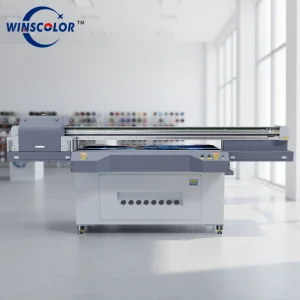
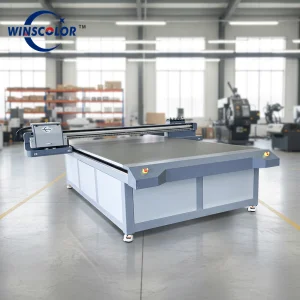
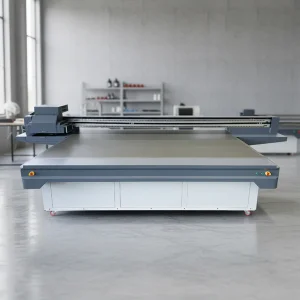
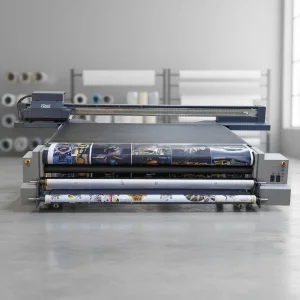
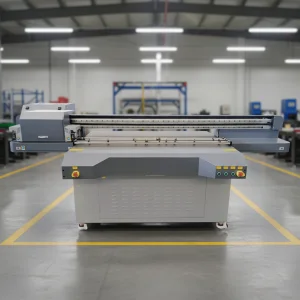
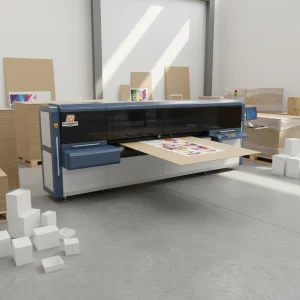
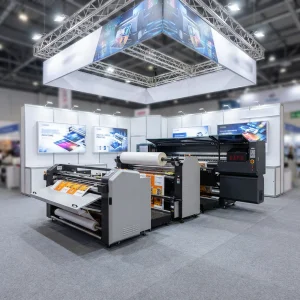
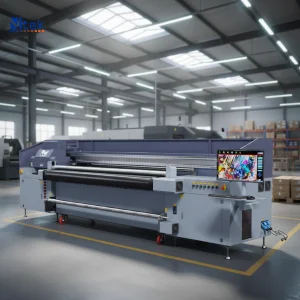
In-depth responses compiled by our senior application engineering team addressing substrate handling, mechanical reliability, maintenance schedules, and shipping procedures.
Consult with our lead technical engineers to receive direct-from-factory pricing, printhead configurations, and sample test prints for your substrates.
