Targeted manufacturing systems deploying industrial piezo drop-on-demand drop control, multi-zone vacuum suction, and dual UV-LED cold curing calibrated for Osaka’s dense manufacturing corridors.
Analyzing precision fabrication, urban redevelopment, Expo 2025 Kansai infrastructural acceleration, and SME operational dynamics across the Greater Osaka region.
Higashiosaka represents one of the world's most concentrated clusters of precision manufacturing SMEs. These fabricators demand industrial digital direct-to-substrate marking platforms that interface smoothly with pre-machined metals, milled plastics, and anodized aluminum chassis without expensive setup screens or volatile solvent emissions.
From the Yumeshima island mega-development to comprehensive architectural rebuilds across Namba, Umeda, and the Midosuji corridor, regional signage vendors are confronted with massive throughput demand for high-durability Wayfinding displays, textured architectural glass backdrops, and flame-retardant Dibond exterior installations.
The Kansai Economic Federation (Kankeiren) and Osaka Prefectural Government enforce stringent indoor air quality policies and VOC reductions under the Pollution Control Ordinance. Legacy screen printing with volatile solvent inks is rapidly migrating toward mercury-free UV-LED cold-curing technology with closed-circuit ink recirculation systems.
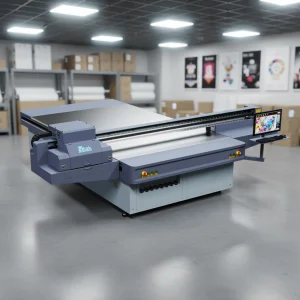
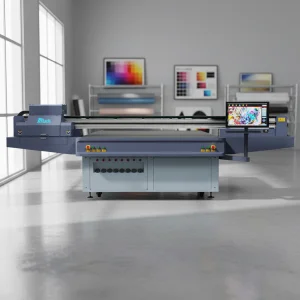
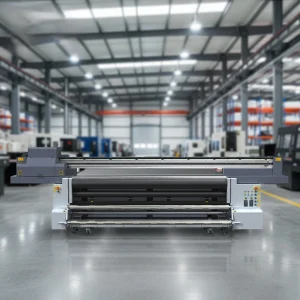
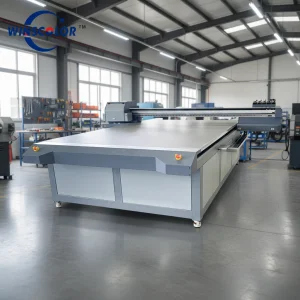
A granular exploration into the structural rigidity, fluid dynamics, and micro-piezo firing behavior that establishes the YC2030L as an industrial benchmark for heavy-duty production.
In large-format printing, structural thermal stability is the determining factor in avoiding micro-banding across extensive monochrome flat zones. The YC2030L gantry and chassis are manufactured from stress-relieved, fully annealed welded tubular steel, CNC-milled in a single setup. This prevents microscopic chassis twisting caused by the ambient humidity and temperature changes typical of coastal Kansai bayside facilities.
Dual Japanese THK silent linear guide rails carry the carriage assembly smoothly. Coupled with an optical linear encoder with 1-micrometer positional feedback, the carriage maintains microscopic drop placement tolerances even when operating at scan velocities exceeding 1.2 meters per second.
Configurable with Ricoh Gen6 (MH5320) or Kyocera KJ4A industrial printheads, the YC2030L delivers multi-drop grayscale printing ranging from 5 picoliters for crisp 2-point typographic vector lines up to 15 picoliters for rich solid block saturation.
Crucial to maintaining high uptime across multi-shift plants is the continuous negative pressure circulation module. Unlike entry-level systems that suffer from white pigment settlement and nozzle drops during rest periods, the YC2030L circulates white ink continuously through the sub-tank and nozzle manifold, minimizing purge waste and preventing head starvation during high-speed runs.
| Engineering Parameter | YC2030L Industrial Specification | Operational Value for Osaka Plants |
|---|---|---|
| Usable Print Envelope | 2000 mm × 3000 mm (True Flatbed format) | Directly accommodates 3x6 ft and oversized 4x8 ft standard Japanese construction & architectural boards with zero trimming. |
| Printhead Compatibility | Ricoh Gen5 / Gen6 or Kyocera KJ4A Piezo Drop-on-Demand | Industrial longevity exceeding 5 billion actuations per nozzle with field-replaceable head arrays. |
| Addressable Resolution | 600 × 900 dpi, 1200 × 1200 dpi, up to 2400 dpi apparent | Meets high-aesthetic museum, cosmetics retail, and luxury department store visual display standards. |
| Z-Axis Clearance | 0 to 100 mm (Optional upgrade to 250 mm deep gantry) | Supports thick wooden doors, industrial junction boxes, molded instrument panels, and acrylic display cases. |
| Curing System | Dual Water-Cooled Variable Output UV-LED Solid State Lamps | Cold curing prevents thermal warping of thin styrene, foamed PVC, and delicate film backings. |
| Color Channel Matrix | CMYK + Lc + Lm + Double White + Varnish / Primer Optional | Single-pass spot varnish tactile embossing, raised Braille textures, and under/over white sandwich printing. |
Addressing structural labor pinches, raw material margin constraints, and high turnaround expectations across cross-border industrial enterprises.
Faced with Japan's aging demographic curve and manufacturing labor crunches, the YC2030L integrates pneumatic substrate registration pins and air-reverse floating tables. A single technician can effortlessly position heavy 150 kg tempered glass or metal sheets without back strain or alignment skew.
By pairing high-density micro-pigment UV curable suspensions with variable drop size jetting, average ink consumption is reduced to 8–11 ml/m², delivering up to 42% cost savings per square meter compared to OEM cartridge systems common in legacy Japanese agency workshops.
Seamlessly integrates into enterprise ERP, CAD/CAM sign production suites, and industry-standard raster image processors including Onyx, Caldera, and Photoprint. Supports automated hot-folder rendering and high-precision nesting layouts for high-mix low-volume job queues.
Stringent compliance with Ministry of Economy, Trade and Industry (METI) electrical standards, PSE safety certifications, and localized preventive maintenance routines.
Deploying printing equipment into Japanese manufacturing plants requires adherence to specific electrical harmonics, grounding practices, and safety cutouts:
Downtime in industrial manufacturing is exceptionally costly. Our service infrastructure provides comprehensive protection for production runs:
Continuous evolution toward autonomous digital printing, lights-out robotic handling, and sustainable circular printing processes.
High-resolution top-mount CMOS camera matrices detect pre-cut substrate shifts, dynamically rotating vector print paths to match CNC milled margins with zero mechanical jigs.
Integration of standardized AGV (Automated Guided Vehicle) loading arms with auto-vacuum synchronizers for unattended, 24/7 dark-factory production shifts.
Commercialization of non-petroleum based UV oligomers and resins, reducing the life-cycle carbon footprint of printed display boards by more than 40%.
Advanced layered haptic printing capable of matching tactile wood grains, brushed metals, and Japanese architectural stone textures with sub-micron 3D surface mapping.
Explore our complete spectrum of flatbed, roll-to-roll, and specialized carton packaging machinery trusted by commercial printers and converters worldwide.

Comprehensive technical guidance addressing substrate handling, operational compliance, printhead lifetime, and adhesion chemistry.
In Japan, building materials, composite panels, and interior cladding follow standardized dimensions such as 3×6 shaku (approx. 910 × 1820 mm), 4×8 shaku (approx. 1220 × 2440 mm), and 1×2 meter sheet sizes. The YC2030L’s 2000 × 3000 mm bed allows operators to run multiple 3×6 panels side-by-side or mount an oversized 2×3 m architectural sheet without manual re-clamping, maximizing continuous spindle-hour throughput and eliminating seam lines.
Non-porous inorganic substrates like tempered glass, anodized aluminum, and polished ceramics possess high surface energy barriers that can lead to delamination if printed with standard UV inks. The YC2030L features an optional dedicated chemical primer channel. By jetting industrial silane coupling agents selectively beneath the image layer via an independent printhead channel, the ink establishes covalent cross-linking bonds, passing cross-hatch tape adhesion tests (JIS K 5600-5-6) and 4H pencil scratch resistance standards.
Western Japan (including Osaka, Kobe, and Kyoto) operates on a 60Hz AC grid frequency, unlike Eastern Japan's 50Hz. All YC2030L units destined for the Osaka market are built with dual-frequency rated servo drives, Japanese Omron switching relays, and Schneider high-frequency line filters. This prevents harmonic distortion and ensures zero overheating in blower motors and chilling compressors during long industrial runs.
Under standardized industrial operation with temperature-controlled ink heating systems and daily automated maintenance cleans, Ricoh Gen6 piezo printheads routinely deliver between 100 to 150 billion actuations per nozzle—translating to 3 to 5 years of steady production in double-shift Japanese facilities. The onboard closed-loop negative pressure ink circulation system shields internal piezo walls from micro-cavitation and pigment aggregation.
Yes. With dedicated double-white and thick-film varnish channels, the YC2030L supports high-build multi-pass relief printing. Using vector height-mapping algorithms within the RIP software, the printer deposits successive micro-layers of UV polymer to construct crisp Braille dots conforming to the Japanese Standards Association (JIS T 0921) tactile accessibility regulations, as well as woodgrain textures and museum-grade art reproductions.
Connect directly with our senior mechanical applications team. Receive detailed technical documentation, calculate specific consumable ROI on your target substrates, or coordinate test-print evaluation runs using your materials.
